Divination
Pendulum Work: A Witch's Guide to Dowsing
Rowenna
Solitary witch and the founder of Grimoire. Built the app she couldn't find anywhere else. Writes about the craft with primary sources, honest lineage notes, and a low tolerance for vague correspondences. Based in the UK with more herbs than shelf space.
· 8 min read
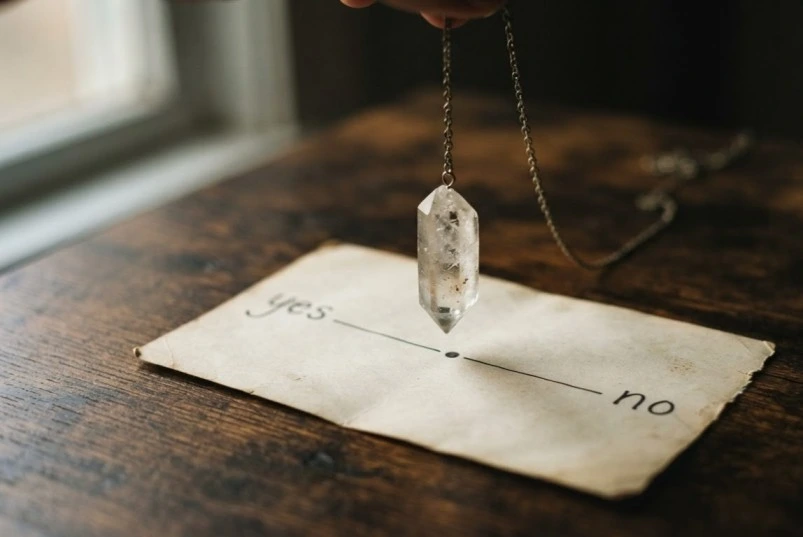
Of all the divination tools on a witch's shelf, the pendulum is the cheapest, the fastest to learn, and the easiest to dismiss as a toy. A weight on a string, swinging over a chart of yes and no. It is also one of the tools with the longest continuous practical history, because dowsing, the older and wider tradition the pendulum belongs to, has been used for centuries by people with no interest in magic at all, looking for water and metal in the ground.
This is the eighth piece in the Grimoire Divination series, following the tarot guides, charm casting, tea-leaf reading, and scrying. Where scrying asks you to sit in the dark and let images surface, pendulum work is quick, portable, and built for direct questions. The two sit at opposite ends of divination's spectrum, and a working witch often keeps both.
The real history: dowsing, not fortune-telling
The honest starting point is that the pendulum's oldest and best-attested ancestor is not a magical tool at all. Dowsing, using a suspended weight or forked rod to search for water, minerals, or lost objects, has a long practical history in Europe, with German miners recorded using divining rods to locate ore seams by at least the sixteenth century. Dowsing was, for centuries, a working trade skill, taken seriously enough that its practitioners were sometimes formally employed to find water sources and mineral deposits.
The pendulum as a tool for yes-or-no questioning, answering directly rather than pointing toward a location, is a somewhat later refinement, gaining particular popularity through the early twentieth-century movement known as radiesthesia, a French term for the practice of using a pendulum or rod to detect subtle "radiation" from objects, people, or questions. That framework, with its pseudo-scientific radiation language, is where the modern yes/no pendulum chart largely descends from, layered on top of the much older and more plainly practical dowsing tradition. Knowing that lineage does not make the tool less useful. It simply means the modern practice is a twentieth-century development sitting on genuinely centuries-old roots, rather than an unbroken ancient art.
The specific combination of a suspended ring and a lettered surface is also far older than radiesthesia. In AD 371, at Antioch, a group of conspirators tried to divine the name of the Roman emperor Valens's successor using a small tripod, a metal bowl marked with the letters of the alphabet at even intervals, and a ring suspended by a fine thread. Swung above the bowl, the ring touched successive letters to spell out an answer, and the historian Ammianus Marcellinus, an eyewitness to the affair, recorded the method in detail. The ring stopped on the letters that spelled the start of the name Theodorus, and the resulting purge cost several people their lives. Whatever the yes/no pendulum owes to the twentieth century, the letter-spelling method it distantly echoes is genuinely ancient.
What a pendulum actually does
Before anything else, the honest mechanical explanation, because it matters for how you use the tool responsibly. A pendulum's movement comes from the ideomotor effect: tiny, involuntary micro-movements in the hand, driven by subconscious thought, that the eye cannot see but that a freely swinging weight will amplify into a visible arc. This is well-documented and not remotely mysterious. It means a pendulum is best understood as a tool for accessing and reading your own subconscious rather than a hotline to external spirits or objective outside fact, and the two framings call for quite different handling. Read as subconscious access, pendulum work is a genuinely useful practice of self-inquiry. Read as an infallible oracle for questions with real external stakes, medical, financial, safety, it is a poor and potentially harmful substitute for actual expertise and information.
Choosing a pendulum
Almost anything on a chain or cord will work: a crystal point, a ring on a thread, a simple weighted pendant. Crystal pendulums are popular and pleasant to use, and if you want to choose by correspondence, clear quartz is a neutral, all-purpose choice, while a stone that already means something to you personally often works better than one picked purely for its listed properties. Weight matters more than material. Too light and the swing is erratic and hard to read; a little heft gives a clearer, steadier arc. There is no need to spend heavily. A pendant you already own, on a chain long enough to swing freely, is a complete tool.
Learning your pendulum's language
Every pendulum needs to be "programmed" before its first real use, which sounds more technical than it is. You are simply establishing which swing direction means what for your own hand and mind.
Hold the pendulum steady by its chain, elbow resting if that helps keep your hand still, and let it hang motionless. Ask clearly, out loud or in your head: "Show me yes." Wait and watch what the pendulum does on its own, a swing forward and back, side to side, or a circle in one direction. Once it settles into a movement, ask it to show you "no" and note the different movement. Some practitioners also establish "maybe" or "I cannot answer this" as a third response. Write down what you observe. This is now your pendulum's language, specific to you, and it may differ from someone else's entirely.
Asking good questions
The quality of a pendulum reading depends almost entirely on the quality of the question, more than with any other divination tool, because a yes/no answer cannot correct for a badly framed question the way a tarot card's imagery can.
Ask questions that are genuinely answerable with yes or no, phrased clearly and singly. "Should I take this job?" is better asked as several narrower questions than as one broad one, because a single sweeping question invites a single vague answer. Avoid questions loaded with a hoped-for answer, since the ideomotor effect responds readily to what you already want to hear, which is precisely why urgent, high-stakes, or emotionally loaded questions are the ones a pendulum answers least reliably. Save the pendulum for lower-stakes inquiry, gentle self-reflection, or narrowing down options you have already researched, rather than asking it to make real decisions for you.
Working with charts
Beyond simple yes and no, printed or hand-drawn pendulum charts let you narrow toward a specific answer: letters of the alphabet, numbers, a spread of options laid out in an arc. Hold the pendulum over the centre of the chart, ask your question, and watch which direction it swings toward. The specific charts sold today, with their printed arcs of letters or laid-out options, are a modern convenience rather than an ancient design, useful for that convenience alone. But the underlying idea, a suspended point spelling out an answer letter by letter, is not new: it is close kin to the method a group of Roman conspirators used at Antioch in AD 371 to try to divine an emperor's successor, recorded by the eyewitness historian Ammianus Marcellinus. A hand-drawn chart works exactly as well as a printed one either way.
Questions
How do you use a pendulum for beginners? Start by programming your pendulum: hold it still, ask it to show you "yes", note the movement, then repeat for "no". Once you know your pendulum's language, ask clear, single, genuinely answerable questions and watch how it moves. Keep early questions low-stakes while you learn to trust and read your own pendulum's responses.
Is pendulum dowsing real? The pendulum's movement comes from the ideomotor effect, small involuntary muscle movements driven by subconscious thought, which is a well-documented and non-mysterious mechanism. This makes a pendulum a genuine tool for accessing your own subconscious rather than an external oracle, which is a different and more honest claim than "the pendulum knows the future".
What is the history of pendulum divination? The pendulum descends from two older strands. One is dowsing, a centuries-old practical tradition of using a suspended weight or rod to find water and minerals, documented among European miners from at least the sixteenth century. The other is dactylomancy, divination by a suspended ring, genuinely ancient: the historian Ammianus Marcellinus recorded a ring-and-alphabet method used at Antioch in AD 371. The yes/no pendulum format popular today draws its chart-and-questioning style mainly from the early twentieth-century radiesthesia movement, but the basic idea of a swinging point spelling out an answer has real ancient precedent.
Can a pendulum answer any question? No, and it should not be asked to. A pendulum answers best when questions are low-stakes, clearly framed, and free of a hoped-for outcome, since the ideomotor effect readily reflects what you already want to hear. It is a poor substitute for real expertise on questions with genuine external stakes, such as medical, financial, or safety decisions.
What pendulum should a beginner buy? Almost any weighted pendant on a chain will work; material matters less than a comfortable weight that gives a clear, steady swing. Clear quartz is a popular neutral choice, but a pendant you already own and feel connected to often works just as well as a purpose-bought crystal pendulum.
The pendulum will not out-argue a good decision-making process, and it was never meant to. Used honestly, as a quick way of listening to what you already half-know, it earns its place beside the slower work of scrying and the tarot.
Sources
For the ring-and-alphabet divination at Antioch: Ammianus Marcellinus, Res Gestae 29.1.29 to 32. For the history of dowsing among German miners: Georgius Agricola, De re metallica (1556). For the early scientific study of the "exploring pendulum": Michel-Eugène Chevreul, De la baguette divinatoire, du pendule dit explorateur et des tables tournantes (1854).
Grimoire is a digital practice companion for the solitary witch: a spell builder, sacred calendar, private grimoire journal, herbology compendium, and daily tarot, all in one place. Now available on Android.
More from the Blog

Scrying: A Witch's Guide to the Dark Mirror
Scrying for beginners: a witch's guide to the mirror, the bowl, and the crystal, with its real history and a clear method that actually works.
A Beginner's Guide to Tarot for Solitary Witches
Tarot is not fortune telling. It is a mirror, a way of asking better questions.
Begin your practice
Grimoire is available now on Android and as a web app. Start today.