PRACTICE
Ritual Practice Tools for the Solitary Witch
The workbench of your craft.

Practice is the working heart of Grimoire: the section where knowledge becomes action. The Spell Builder is where you compose and save complete ritual workings, drawing on correspondence data from the Vault and checking your Apothecary stock before you begin. Timing is held in the Codex's Sacred Calendar: moon phases, sabbats, planetary hours, and auspicious dates calculated for your location, surfaced into Practice when you need them.
For devotional practice, the Deity Journal holds your offerings, signs, and sacred dates for every deity you work with. The Scent Magic blend wizard guides the creation of intentional oils and incense, cross-referenced with your Apothecary stock. And for the inner work that underpins everything else, the Shadow Work journal provides a completely private space, stored only on your device, never shared.
What's Inside
Spell Builder
A structured ritual composition tool. Set your intention, choose your correspondences, write your rite. Save every working to your Grimoire with date, moon phase, and outcome notes.
Deity Journal
Record and tend your relationships with the divine. Log offerings, signs received, dreams, and devotional practice. Each deity has its own sacred space in your journal.
Scent Magic
A three-step blend wizard for crafting ritual oils, incense, and sprays. Choose your purpose, layer your botanicals, and save every recipe to your personal collection.
Dream Weaver
A dream journal built for waking: voice or text capture on a dark, low-glare screen, mood and lucid tagging, auto-detected symbols, and a built-in Dream Dictionary. Mirrored automatically into My Craft.
Meditation
A self-guided space for stillness: meditation timer with a breathing animation, six ambient soundscapes, and a daily inspiration quote. Reflections written after a session land in My Craft automatically.
Runelore
The full Elder Futhark: twenty-four runes with meanings, history, and traditional magical use. The Norn three-rune spread for casting against your held question. A sourced guide for readers new to runic practice.
Sigil Forge
Craft a personal sigil from your intention. Three-step ritual (inscribe, distill, charge), two generative methods (Chaos and Rose Wheel), and direct save to your grimoire as a Sigil entry.
Virtual Altar
A drag-and-drop shrine canvas. Place candles, offerings, crystals, herbs, and sacred objects on a scene of your choosing. Save to a private gallery, inscribe to your grimoire, export as SVG.
Shadow Work
A private, device-only journal with guided prompts for inner work. A private space for the parts of yourself you're still learning to name.
Apothecary
Track your magical pantry: herbs, oils, resins, crystals, and tools. Know what you have before you begin a working. Never reach for something that isn't there.
The Shop
Curated magical supplies from trusted sources. Herbs, crystals, candles, oils, and tools: sourced with the quality of serious practice in mind.
Definition
What is the Practice section?
Practice is the working section of Grimoire, the part of the app where knowledge becomes action. It contains the tools a witch reaches for during active practice: a structured Spell Builder for composing rituals, a Deity Journal for devotional record-keeping, a Scent Magic wizard for blends, a Dream Weaver for capturing and reading dreams, a Meditation timer with ambient soundscapes, Runelore for Elder Futhark casting, a Sigil Forge for crafting personal glyphs, a Virtual Altar canvas, a Shadow Work journal for inner work, an Apothecary for stock management, and a curated Shop for sourcing supplies.
Where the Codex holds reference and Discovery holds self-knowledge, Practice holds the workbench. It is the layer that turns the rest of the app into something that gets used, not just something that gets read.
The Tools at the Workbench
Which tool do you reach for, and when?
Each tool in Practice answers a different practical question. The table below maps each tool to the moment in a working when you tend to need it.
| Tool | Purpose | When you reach for it |
|---|---|---|
| Spell Builder | Compose and save complete ritual workings | When intention becomes action, composing a working from scratch |
| Deity Journal | Tend devotional relationships over time | After an offering, when a sign appears, on a feast day |
| Scent Magic | Build intentional oil and incense blends | Crafting a blend for a specific working or atmosphere |
| Dream Weaver | Capture and read dreams as a working text | On waking, before the dream fades: voice or text capture, then symbol tagging |
| Meditation | A self-guided space for stillness | Before a spell, after a card, around shadow work, on a sabbat morning |
| Runelore | Cast and study the Elder Futhark | When a question wants the runic voice rather than the tarot's |
| Sigil Forge | Craft a personal glyph from your intention | When a working wants a single charged symbol to anchor it |
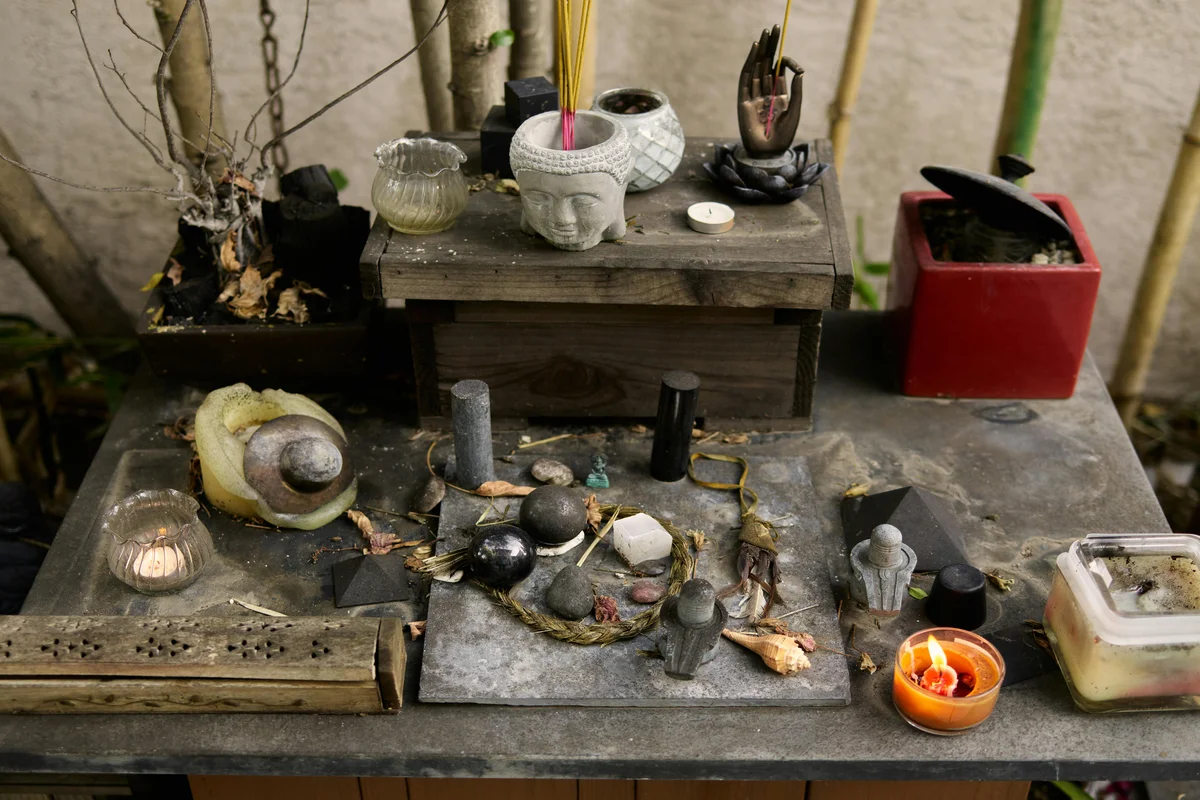
| Virtual Altar | Compose an altar on a drag-and-drop canvas | When the physical altar isn't possible, or a layout wants to be planned first |
| Shadow Work | Private inner work in a contained space | When something inward needs to be written down honestly |
| Apothecary | Track and manage your magical pantry | Before a working: checking what you have available |
| The Shop | Source supplies from curated suppliers | When the Apothecary runs short and stock needs replenishing |
Approach
How does Grimoire approach practice?
As a discipline, not a performance. The tools in Practice are designed to support the actual work of a witch: composing rituals carefully, tending devotional relationships over time, choosing timing deliberately, keeping the apothecary alive. Not to make practice look elaborate. The Spell Builder asks you to name your intention before it lets you choose correspondences. The Deity Journal is built for years, not weeks. The Apothecary surfaces low stock so you don't start a working you can't finish.
I built this section around the question I kept asking myself: what do I actually need to have with me when I sit down to work? The answer turned out to be specific. A place to compose a working without losing the thread. A record for the deity I have been tending since last autumn. Something that tells me I have used all the mugwort and need to restock before I begin.
What Practice does not do is cast spells on your behalf. The structure, the references, the timing, the records: all of it is in service of the witch's own work. The casting is always yours.
FAQ
Frequently asked questions.
What is the Practice section?
Practice is the section of Grimoire you open when you are ready to do the work rather than read about it. It holds eleven tools: the Spell Builder for composing workings, the Deity Journal for devotional relationships, Scent Magic for blending oils and incense, the Dream Weaver for capturing and reading dreams, a Meditation timer, Runelore for the Elder Futhark, the Sigil Forge, a Virtual Altar canvas, the Shadow Work journal, the Apothecary for stock management, and the Shop for sourcing supplies. Where the Codex holds reference and Discovery holds self-knowledge, Practice holds the workbench.
How does Practice differ from the Codex?
The Codex is for knowing; Practice is for doing. The Codex holds reference material: what a herb is for, what a card means, what a deity governs. Practice holds the working tools that put that knowledge to use. The two are designed to be used together: research a herb in the Codex, add it to your Apothecary in Practice, choose it for a working in the Spell Builder. The Codex is the library; Practice is the workbench.
How does Practice differ from My Craft?
Practice is for doing the work; My Craft is for recording the work that has been done. The Spell Builder in Practice helps you compose a ritual; My Craft holds the entry that records what happened when you performed it. The Deity Journal in Practice tracks an active devotional relationship; My Craft holds the wider reflections, dreams, and tarot readings that surround it. The two are designed to flow into each other: a ritual built in Practice writes its outcome into My Craft, and a reflection in My Craft can prompt a new working in Practice.
Which tool should I start with in Practice?
Start with whichever tool answers the question your practice is currently asking. If you want to compose a ritual, the Spell Builder is the entry point. If you want to tend a relationship with a deity, the Deity Journal. If you want to capture a dream before it fades, Dream Weaver. There is no recommended order through Practice; the tools are independent of one another, and most witches use two or three regularly while leaving others for specific occasions. The Apothecary is the one most witches set up early, because every other tool reads against it.
Do the tools in Practice work for any tradition?
Yes. Practice is built without privileging any tradition. The Spell Builder does not impose a particular ritual structure, the Deity Journal supports any pantheon, and Runelore and the Sigil Forge sit alongside the more familiar tools without ranking one path above another. A Wiccan, a folk practitioner, a chaos magician, and a solitary witch with no named tradition can all use the same tools. The application is yours to make.
Is anything in Practice locked behind a subscription?
Yes. The Spell Builder, Deity Journal, Apothecary, Scent Magic, Dream Weaver, and Shadow Work are all Premium features, unlocked with a Grimoire Premium subscription: $4.99/month or $39.99/year ($3.33/month, a 33% saving on the annual plan). All new accounts receive a 14-day free trial when they subscribe so you can explore every tool before deciding. The free tier includes the daily tarot draw, moon phase tracking, tarot gallery, herbology compendium, The Vault, and a basic grimoire journal. See the pricing page for the full breakdown.
How does Practice connect to the rest of Grimoire?
Practice draws on every other layer of the app. The Spell Builder pulls correspondences from The Vault and herbs from the Herbology compendium in the Codex. The Apothecary cross-references the same Herbology data so every item in your pantry has its full magical context. The Deity Journal opens out from Pantheon profiles in the Codex, and the Sacred Calendar (also held in the Codex) feeds timing data into the Daily Pulse. Completed workings save into My Craft. Every working tool in Practice is connected to the reference, self-knowledge, and journal layers that surround it.
What you'll find inside
Explore More
From the Blog

Building a Daily Practice as a Solitary Witch
You do not need an hour a day, a dedicated altar room, or a coven. You need five minutes and a clear intention.
How to Build a Daily Spiritual Practice Without Burning Out
The practices that last are the ones that fit inside a real life. How to build a daily spiritual practice without burnout.

How to Start a Grimoire (And Why You Should)
A grimoire is not a finished object. It is a living record of your practice. It starts with a single entry.
Begin your practice
Grimoire is available now on Android and as a web app. Start today.