Divination
Charm Casting: A Guide to Building Your Own Divination Set
Rowenna
Solitary witch and the founder of Grimoire. Built the app she couldn't find anywhere else. Writes about the craft with primary sources, honest lineage notes, and a low tolerance for vague correspondences. Based in the UK with more herbs than shelf space.
· 10 min read
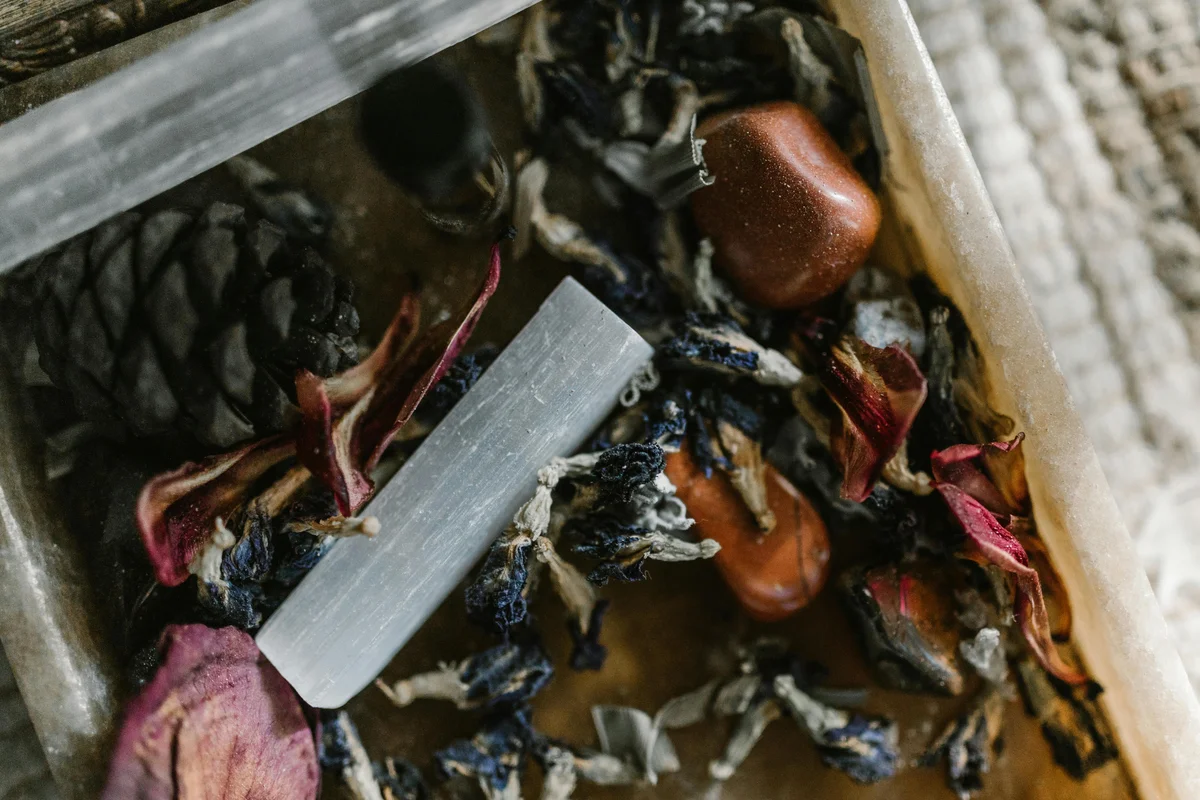
The rise of the personal oracle: why we are casting charms now
Something is shifting in how solitary practitioners are approaching divination. The structured, archetypal systems (tarot's twenty-two majors, astrology's twelve houses, runes' twenty-four staves) are being quietly set aside in favour of something older and more personal. A handful of small objects, dropped onto a cloth, read by the witch who chose them. This is charm casting, and its return to common practice is one of the more telling signs of where contemporary witchcraft is heading.
The numbers underneath the shift are striking. IBISWorld's industry research places the US psychic services market at $2.3 billion in 2024, with a compound annual growth rate of 5.5% over the preceding five years. MysticMag's analysis of the broader sector confirms a sustained move toward personalised, tactile spiritual practice across that same period. Trend forecasting for 2026 points consistently to practitioners favouring meaningful, individual objects over mass-produced spiritual goods. The pattern is consistent across categories. After two decades of digital saturation, practitioners are reaching for things they can hold.
Charm casting answers that hunger directly. It is tactile where tarot is visual, intuitive where astrology is technical, and (most importantly) personal where almost every other system is communal. A charm set is not bought from a shop and used as instructed. It is assembled, slowly, from objects that have meaning to the witch who carries them. Each charm is a word in a dictionary only its owner can read. The result is a divination practice that cannot be performed for an audience and cannot be looked up in the moment. It can only be developed.
What is charm casting? Divination beyond the rulebook
Charm casting is a form of divination in which a small collection of symbolic objects is cast onto a flat surface, then read for meaning according to which charms appear, where they land, and how they relate to one another. It belongs to two old families of practice: lithomancy, the reading of stones, and cleromancy, the reading of cast lots. Both have deep roots: Wikipedia's article on lithomancy traces the earliest verified account to Photius, patriarch of Constantinople, while Britannica documents cleromancy as practised in ancient Rome, Egypt, and across the ancient Near East. Charm casting is what those traditions have become in solitary modern practice: pared down to its essentials, relieved of priesthoods, and placed entirely in the hands of the witch doing the work.
What makes charm casting distinctive among divination methods is the absence of a fixed system. Tarot has its set deck. Runes have their canonical alphabet. Astrology has its houses, signs, and planets. Charm casting has none of these. The witch chooses her objects. The witch decides what they mean. The witch interprets the cast. This is what Rebecca-Anuwen, author of Charm Casting (2021) and one of the clearest contemporary voices on the practice, describes on her website as a method whose power "lies in its simplicity and the fact that there are no rules": a description that captures both what makes it accessible and what makes it serious.
The "no rules" framing can sound like permission to dabble, but it is the opposite. A system without fixed rules requires more from its practitioner, not less. A tarot reader can fall back on Pamela Colman Smith's imagery and a published meaning when intuition stalls. A charm caster has only the symbols she has chosen and the context she has built around them. The practice reads back exactly as much as the practitioner has put into it. That is its discipline, and it is also why it rewards patience over performance.
Building your personal dictionary: how to curate your set
The phrase "personal dictionary" comes up reliably in the better writing on charm casting, and it is the right one. A charm set is not a collection of pretty objects. It is a vocabulary. Each charm stands for a word the witch has chosen, and the cast is the sentence those words make when arranged on the cloth.
The objects themselves can come from anywhere. There is no requirement that they be expensive, antique, or specifically marketed for the purpose. In fact, the most resonant sets are usually the ones with the most varied origins: a tradition the practice itself acknowledges in the four classic categories.
The found
Found objects make the strongest charms in most witches' sets. A river pebble picked up at a moment of decision. A pheasant feather noticed on a walk. A fragment of pottery turned up in a garden. These objects already carry context: the place they came from, the question that was on the witch's mind when she bent to pick them up. They cost nothing and they cannot be duplicated.
The gifted
Charms given by another person are weighted with the relationship. A button from a grandmother's coat. A small stone pressed into the palm by a friend. These charms tend to speak to themes of inheritance, connection, and the long currents of love and obligation that run beneath ordinary life.
The inherited
Objects that came from someone now gone (a thimble, a key, a religious medal) function as charms partly because they are already loaded with the dead's continued presence. They surface in casts about ancestors, lineage, and the work of integrating what has been passed down.
The purchased
Bought charms are the least personal but not less valid, particularly when filling specific gaps in the set. A small silver crescent for the moon. A miniature anchor for stability. A skeleton key for opportunity. The act of choosing a deliberate symbol is itself meaningful; the issue is only that purchased charms require more conscious bonding before they will read clearly.
A working set typically draws from each of these four categories, organised loosely around the territories a divination practice tends to ask about: people, emotions, timing, and action. Around twenty to thirty objects is the usual range. Fewer than fifteen and the readings start to repeat themselves. More than forty and the cast becomes difficult to read.
Bonding with the set is the final step. Carry the objects in a pouch for a week before using them. Cast them daily with no question, simply to see how they fall. Add to your grimoire a short entry for each charm: what it is, where it came from, what associations it already carries. By the end of a month, the set will read.
The charm casting mat: mapping the geography of your soul
The casting mat is what makes charm casting more than fortune-telling. Without a mat, a cast is simply a pile of charms on a table; the symbols matter, but their relationship to one another is loose. With a mat, the cast acquires geography. The same charm means something different in the centre than at the edge, in the upper region than at the lower, near the sun-sign than near the moon. A mat is the structure that lets a "no-rules" practice still be read coherently.
There are three layouts most solitary practitioners use, each suited to a different kind of question.
| Layout | Best for | Complexity |
|---|---|---|
| Past / Present / Future | Direct questions with a time element | Low: three zones, easily learned |
| The Self Circle | Inner work, identity, current state of being | Medium: requires understanding of the inner / outer divide |
| Houses of the Zodiac | Comprehensive readings across all areas of life | High: assumes knowledge of the twelve astrological houses |
The Past / Present / Future layout is the most straightforward and the natural starting point. A cloth is divided into three vertical bands. Charms that fall on the left speak to what has shaped the situation; charms in the centre speak to its present state; charms on the right speak to what is forming. The Self Circle uses concentric rings: the centre representing the questioner's interior life, the outer ring representing the world she moves through, with the space between recording the relationship between the two. The Houses of the Zodiac mat divides the cloth into twelve segments corresponding to the astrological houses, allowing a single cast to be read across all areas of life simultaneously. It is the most demanding of the three and rewards practitioners who already work with astrology.
A casting mat does not need to be expensive or specifically purchased. A square of plain cotton or linen, around 40cm on each side, marked with a fabric pen, will serve indefinitely. The three steps are simple: choose a layout that suits the questions you are most likely to ask, mark the divisions clearly enough that you can read them at a glance, and resist the urge to over-decorate. A clean, plain mat reads better than an ornate one. The charms are the focus; the mat is only the field they fall on.
A dictionary of meanings: common symbols and their interpretations
The list that follows is not a key to your charm set. It is a starting point: the conventional readings that most practitioners share, paired with the intuitive question that a working practice will eventually translate them into. Use the traditional meaning to begin. Replace it with your own interpretation as your set teaches you what each charm actually says when it lands.
Anchor. Traditional: stability, hope, holding fast. Intuitive prompt: what is keeping you in place, and is the holding helpful?
Heart. Traditional: love, the emotional life. Intuitive prompt: where is your feeling actually directed at the moment?
Key. Traditional: opportunity, access, secrets. Intuitive prompt: what door is open, and what is locked?
Bird. Traditional: messages, perspective, freedom. Intuitive prompt: what news is arriving, and from how high a vantage point?
Star. Traditional: guidance, hope, navigation. Intuitive prompt: what are you orienting toward, and is the orientation accurate?
Moon. Traditional: cycles, intuition, the hidden. Intuitive prompt: what is in shadow, waxing, or waning in your situation?
Knot. Traditional: a problem, an entanglement. Intuitive prompt: what is bound, and is the binding deliberate?
Coin. Traditional: money, value, exchange. Intuitive prompt: what is being given and what is being received?
Tree. Traditional: growth, ancestry, rootedness. Intuitive prompt: what has been growing slowly that you have not noticed?
Skull. Traditional: ending, ancestry, mortality. Intuitive prompt: what is finishing, and what is being inherited?
Hand. Traditional: action, agency, work. Intuitive prompt: what is being done, and by whom?
Egg. Traditional: potential, beginning, fragility. Intuitive prompt: what is incubating that should not yet be disturbed?
The traditional readings are inherited from older folk-magic and divinatory traditions: the same symbol systems that turn up in tarot, in folklore, and in the carved amulets held in collections such as the British Museum and the Wellcome Collection. They have weight because they have been used. But they are not your meanings yet. Cast your set ten times with the same charm, note where it lands and what was true afterwards, and within weeks you will start to see the charm say something only it says: a phrase your set has taught you. That is the moment the personal dictionary begins to write itself.
Clarifying the 'Charm Person' confusion: ritual vs. gameplay
Search "who can cast charm person" and you will find yourself in Dungeons & Dragons forums rather than divinatory practice. Charm Person is a first-level enchantment spell from the D&D player's handbook, cast by bards, sorcerers, warlocks, and wizards to influence non-player characters. It is not what this article is about.
The crossover is worth noting, though. A meaningful number of practitioners came to witchcraft through tabletop gaming: the structured magic of role-playing systems gives a vocabulary to people who would otherwise have none, and that vocabulary travels. Many of the witches reading this article first encountered the word "charm" in a campaign. There is nothing diminishing about that route in. Real practice is what happens once the dice are put away and the questions become your own.
Charm casting in the ritual sense is older than D&D by several thousand years, and it answers a different question: not how to influence others, but how to listen.
Becoming your own oracle
The objects do not divine. The practitioner does. A bag of charms in the wrong hands is a bag of charms; in the right hands, with sufficient practice and a working dictionary, it becomes a fluent way of asking and answering. The whole arc of charm casting moves in one direction: from learning a system to creating a language. Once that language is in place, the practitioner is no longer consulting an oracle. She has become one.
The starting point is small and unromantic. Pick up the next interesting object you find on a walk. Save the next button that falls off something of your grandmother's. Note them down in a charm journal: what it is, where it came from, what it might mean. Within a year you will have a set, and within two you will have a practice. Charm casting rewards exactly the kind of patient, private attention that solitary work runs on.
Sources
- IBISWorld, Psychic Services in the US: Industry Market Research (2025) ($2.3bn market size, 5.5% CAGR): ibisworld.com
- MysticMag, Psychic, Mediums & Tarot 2026: Best Statistics, Facts & Trends: mysticmag.com
- Rebecca-Anuwen, Charm Casting (2021) and rebeccaanuwen.com (primary contemporary source on the practice): rebeccaanuwen.com
- Wikipedia, Lithomancy (earliest verified historical account): en.wikipedia.org/wiki/Lithomancy
- Britannica, Cleromancy (ancient history of cast lots divination): britannica.com/topic/cleromancy
More from the Blog
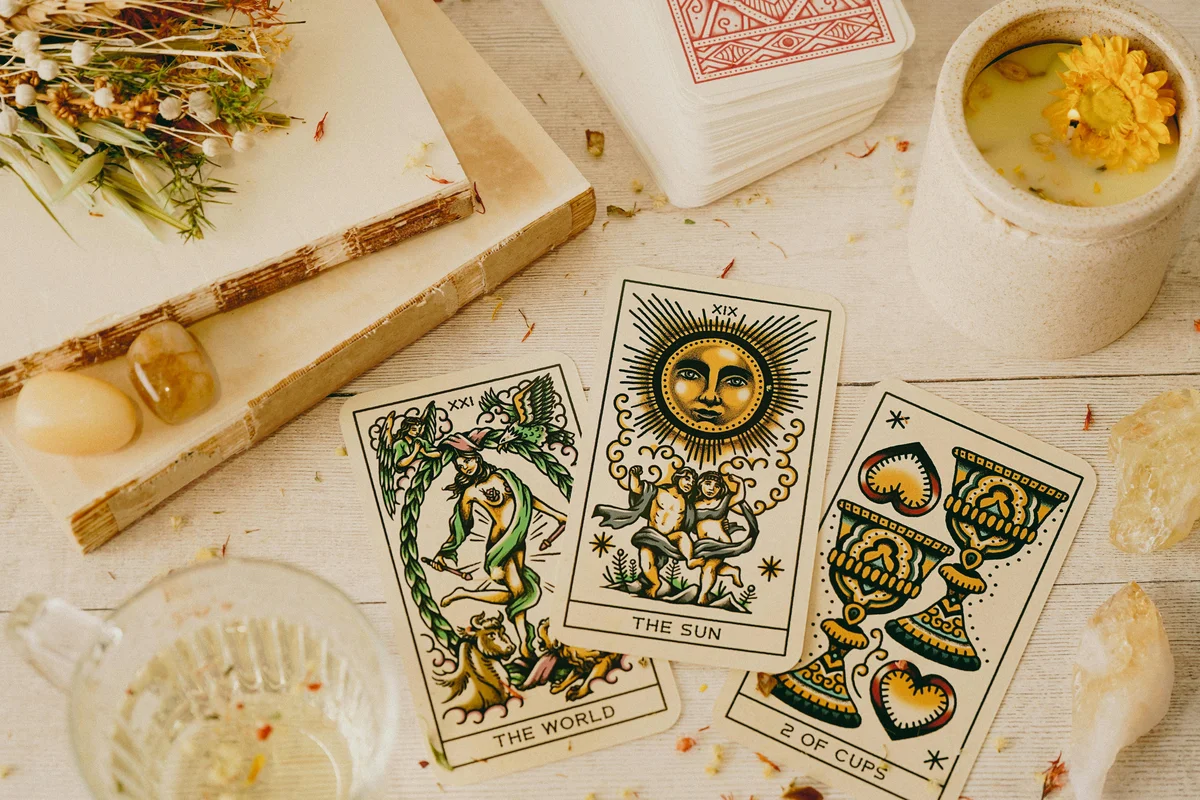
How to Start a Daily Tarot Practice (And Actually Stick to It)
A daily tarot practice doesn't require an hour of quiet and a perfectly set altar. It requires a card, a moment, and a way to remember what you noticed.
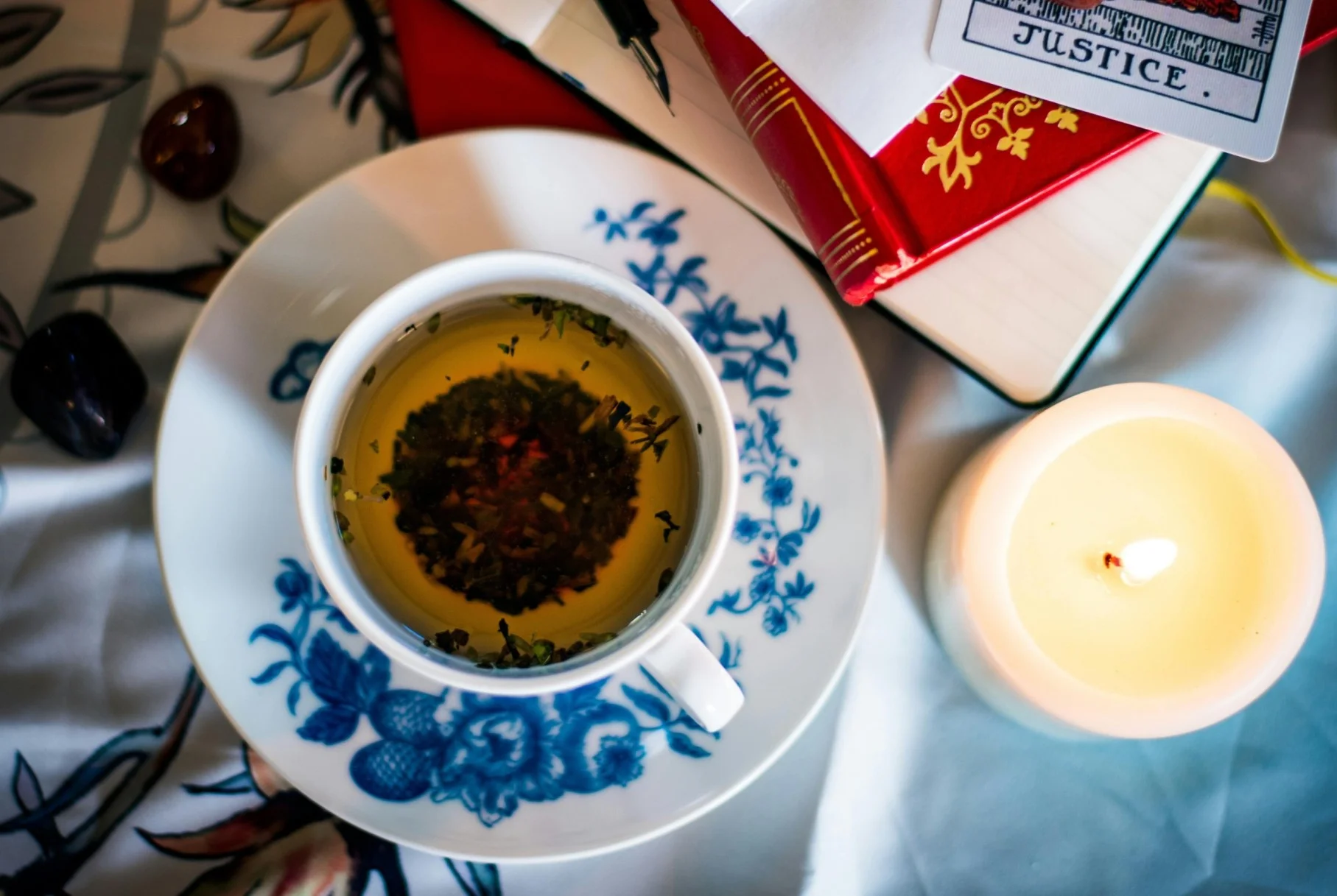
How to Read Tea Leaves: A Beginner's Guide to Tasseography
How to read tea leaves for beginners: choosing your tea, the ritual, reading the cup, and a symbol dictionary of common shapes and what they mean.
Begin your practice
Grimoire is available now on Android and as a web app. Start today.