Divination
How to Read Tea Leaves: A Beginner's Guide to Tasseography
Rowenna
Solitary witch and the founder of Grimoire. Built the app she couldn't find anywhere else. Writes about the craft with primary sources, honest lineage notes, and a low tolerance for vague correspondences. Based in the UK with more herbs than shelf space.
· 9 min read
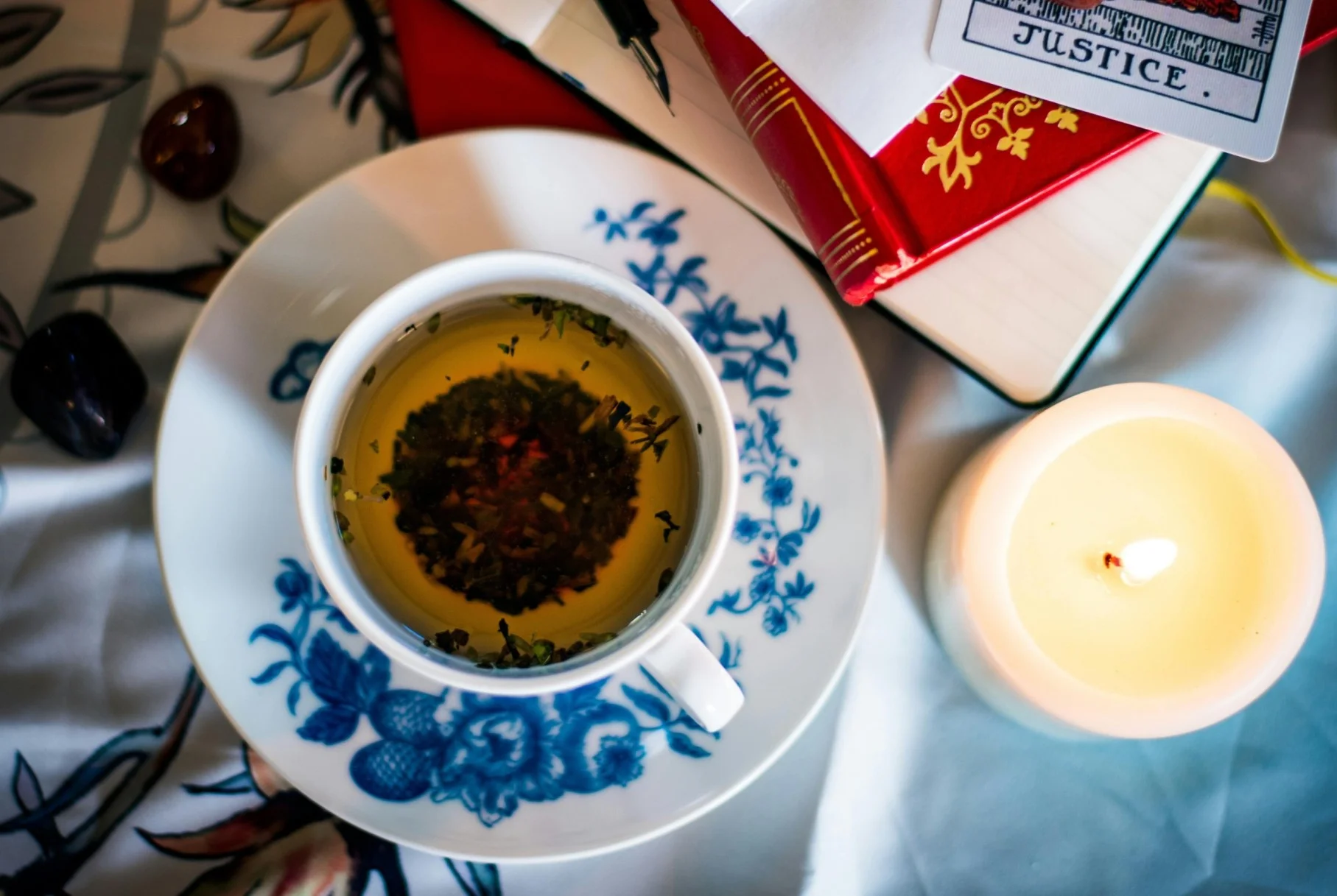
Tea leaf reading is one of the oldest and most companionable forms of divination, and one of the very few that asks almost nothing of you to begin. No deck, no cards to memorise, no special tools. A cup of loose tea, a quiet few minutes, and a willingness to look are the whole of the kit. I think that is a large part of its enduring charm: it turns an ordinary cup at the end of the day into a small act of attention.
This guide covers what tasseography is and where it comes from, what you need to start, the method step by step, and a dictionary of the symbols people most often find in the cup and what they have traditionally meant. By the end you will have enough to sit down with a real cup and read it.
One gentle note before we begin. Tea leaf reading is a tool for reflection and intuition, a way of letting the loose shapes in a cup give your own insight something to settle on. It is not a guaranteed forecast of fixed events, and it reads best when you hold it as a conversation with yourself rather than a verdict handed down. Kept that way, it is a quietly useful practice.
What Is Tasseography?
Tasseography, sometimes called tasseomancy, is the reading of the patterns left by tea leaves in a cup. The same method applied to coffee grounds, and occasionally to wine sediment, goes by the same name. The word is a polite hybrid: from the French tasse, a cup, and the Greek for writing. Writing in the cup, more or less.
The practice is generally traced to the tea-drinking cultures of China, where it is said to have followed not long after tea itself, and it travelled outward along the same routes the tea did. Tea reached Europe in the 17th century, and as loose-leaf tea spread from a luxury of the wealthy to an everyday drink, the small rituals around it, including reading the leaves, spread with it. By the late 1800s a recognisable set of British image-meanings had taken shape, and tasseography had become a popular parlour pastime in the Victorian home.
The practice also owes a real and often-noted debt to Romani fortune-telling traditions. The travelling Romani communities of Europe are widely credited with carrying tea and coffee reading from place to place and keeping it alive as a living craft rather than a parlour novelty. It is worth naming that inheritance plainly and with respect, rather than reaching for the caricature the Victorians often did; the practice many people enjoy today passed through real communities and real practitioners. The exact lines of transmission are not all documented, and careful sources flag some of the popular history as uncertain, so it is best held as a tradition with deep roots rather than a tidy timeline.
What You Need
You need very little, and most of it is probably already in the kitchen.
- Loose-leaf tea, not bags. This is the one requirement worth insisting on. The leaves need room to move and to settle into shapes, and they have to be loose in the cup to do it. A standard tea bag holds finely cut leaf penned behind paper, which gives you nothing to read. A broad-leaf black tea is traditional and easy to read, the leaves being large enough to form clear shapes.
- A plain, light-coloured cup. A wide cup with sloping sides and a pale, undecorated interior is ideal. The width gives the leaves somewhere to spread, and the pale inside gives you contrast, so a dark clump of leaf reads clearly against it. A busy patterned cup hides the very shapes you are trying to see. A matching saucer is the other half of the kit.
- Hot water, and a little calm. Freshly boiled water, and a few unhurried minutes when you will not be interrupted. The practice rewards a settled mind more than any tool does.
How to Read Tea Leaves, Step by Step
Here is the method as it is traditionally done. Read it through once, then try it with a real cup; it makes far more sense in the hand than on the page.
- Brew the tea loose in the cup. Put roughly a teaspoon of loose leaf straight into the cup, pour on hot water, and let it steep. Use no strainer and no infuser; the leaves are the point. Drink the tea slowly, or pour off the liquid when you are ready, until only a little liquid and the wet leaves remain in the bottom.
- Swirl the cup. Take the cup in the hand you write with, and while you settle your question, or simply an open and receptive attention, swirl it three times. The common tradition is to swirl from left to right. The leaves will lift and scatter around the sides.
- Invert onto the saucer. Turn the cup upside down over the saucer and let it drain for a few moments, so the last of the liquid runs off and the leaves settle where they will. Then turn the cup back upright.
- Read by position. Where a symbol sits matters as much as what it is. Leaves near the rim speak to the present and the near future; those down the sides to events further off; those at the bottom to the distant future, or to the heart of the matter. The handle stands for the querent and the home: symbols near it sit close to the person asking, while those opposite are more distant or external.
- Read the shapes that stand out first. Let your eye travel over the cup and notice what it lands on without forcing it. The first clear impression is usually the truest. Look for single distinct shapes, clusters, and lines, and read them together rather than one by one. A bird beside a letter is a message coming; an anchor at the bottom near the handle is stability arriving at home. The combinations carry more than any symbol alone.
A Dictionary of Common Tea Leaf Symbols
These are the meanings the tradition most often attaches to common shapes. Treat them as a starting vocabulary rather than a fixed code: where two traditions disagree, both are noted, and the cup itself, together with your own sense of it, has the final word.
- Anchor. Stability, rest, a safe harbour. Clear and well-formed it is good fortune and security; clouded or broken it warns against trusting too soon.
- Bird. News or a message on its way. A bird in flight tends to mean good news arriving; at rest, news that is waiting to come.
- Book. Knowledge and revelation. An open book points to news brought into the light; a closed book to something hidden, or a matter still to be looked into.
- Cat. Readings differ here. In some traditions a cat warns of deceit or a false friend; in others it speaks of independence and the need to rely on yourself.
- Circle. Completion and success, a cycle closing as it should. Near other symbols it can also mean an offer or a proposal.
- Clouds. Doubt, uncertainty, or troubles passing through. The heavier and darker the clump, the more weight the difficulty carries.
- Cross. A burden to carry or a crossroads to choose at. In older readings it can also stand for protection.
- Dog. A loyal friend and a faithful companion. Close to the rim, a friend near at hand; further down, one further off but constant.
- Flower. Happiness, esteem, a wish granted. A simple and welcome sign.
- Heart. Love and matters of the heart: a close relationship, affection, a bond that matters to the question.
- House. Security, home, family life, and stability in practical affairs.
- Key. Opportunity and access: a door opening, new knowledge, or a solution coming within reach.
- Letters. Single letters of the alphabet point to the initials of people connected to the reading, to be read alongside the symbols near them.
- Line. A journey or a path. A straight line suggests direct progress; a wavy line an uncertain or winding road ahead.
- Moon. Intuition, the unconscious, and hidden influences. A crescent can mean a fresh start or a new phase beginning.
- Mountain. An obstacle to climb, or a high ambition. Several mountains can mean a series of challenges, or large goals in view.
- Numbers. Timing or quantity: days, weeks, or months, or a count of something, read in the light of the symbols nearby.
- Ring. Commitment, union, a cycle coming round. A complete ring is a promise kept or a bond formed; a broken ring, a promise undone.
- Ship. A journey, or an opportunity arriving from a distance: good fortune travelling toward you.
- Snake. The traditions part here. In many readings a snake warns of caution or a hidden adversary; in others it means healing and transformation, the shedding of an old skin. Read it by what surrounds it.
- Square. In one tradition protection and security; in another, confinement or a limitation to be aware of. Context decides.
- Star. Hope, success, and good fortune: a guiding light and an encouraging sign.
- Sun. Vitality, happiness, and success. Energy and warmth returning to the matter at hand.
- Tower. Unexpected change or disruption; in some readings, an ambition that reaches too high. A sign to hold plans lightly.
- Tree. Growth, family, and putting down roots. Strength that develops slowly and steadily rather than overnight.
Reading with Intuition, Not Just the Dictionary
A symbol list is a wonderful place to start and a poor place to stop. The dictionary gives you words; the reading is the sentence. The strongest readings come not from looking each shape up in turn but from how the symbols sit together, where they fall in the cup, and what your own intuition makes of them in the moment. As with other intuitive forms of divination, such as charm casting, the meanings deepen as you learn the particular language your own practice speaks.
This is also what keeps tea leaf reading honest. The cup does not hand down a fixed fate, and a heart near the rim does not guarantee a wedding. What the leaves offer is a set of images for your own insight to gather around, a way of slowing down enough to notice what you may already sense. Two readers can find different things in the same cup, and both can be true, because the reading is partly the reader. Trust the dictionary to get you started, and trust yourself to take it the rest of the way.
The cup rarely tells you something new. More often it lets you say something you already half-knew.
Questions
Do I need a special cup to read tea leaves?
No special or consecrated cup is required. Any wide cup with a pale, plain inside will do the job well, because the width gives the leaves room to spread and the pale interior gives you the contrast to see them. Some readers keep a particular cup for the practice simply because they like to, not because it is necessary.
Can I use a tea bag instead of loose leaf?
Not really, and this is the one rule worth keeping. The leaf in a standard bag is cut very fine and stays trapped behind the paper, so it cannot settle into the shapes you read. If loose tea is genuinely all you lack, you can snip a bag open and tip the contents into the cup, but the cut leaf still forms vaguer patterns than proper loose-leaf tea. A broad-leaf loose tea is much easier to read.
Is tea leaf reading the same as reading coffee grounds?
They are close cousins. Reading coffee grounds falls under the same name, tasseography, and uses much the same method: you look at the patterns the grounds leave in the cup and read them by shape and position. Coffee reading has its own long tradition, strong across the Middle East, the Balkans and beyond, and the grounds tend to leave denser, darker marks than tea. The interpretive language overlaps a great deal.
Can beginners read tea leaves accurately?
Yes. Tea leaf reading rewards practice and attention far more than a perfect memory for symbols. Beginners can read meaningfully from the very first cup, and the skill that grows is less about memorising the dictionary and more about trusting the first impression and learning how the symbols speak to you. Read often, keep an open and honest mind, and the kind of accuracy that matters, insight you can actually use, comes with time.
Closing
There is a particular quiet pleasure in this practice that has nothing to do with prophecy. To read the leaves you have to stop, sit with a cooling cup, and look at something for a while without rushing it, and that alone is worth the ten minutes. More often than not the cup shows you what you already half-knew and had not let yourself say. That, I think, is the real gift of the leaves: not a fixed future, but a slower and kinder look at the present.
If you would like a quiet place to keep that kind of attention, Grimoire's Meditation space holds a timer and gentle soundscapes for the few still minutes a good reading asks for, so you can settle the mind before you ever turn the cup.
Sources
- Wikipedia, Tasseography: the practice defined as the reading of tea leaves, coffee grounds or wine sediment, its etymology from the French tasse, its spread along the tea and coffee trade routes, its late-1800s popularity as a British parlour pastime, and its association with Romani tradition (noted there as not fully documented), en.wikipedia.org/wiki/Tasseography
- Tea Leaf Reading (Tasseography), Encyclopedia.com: reference overview of the practice, its history and its method, encyclopedia.com
More from the Blog
Charm Casting: A Guide to Building Your Own Divination Set
Charm casting is divination without a rulebook: a practice built from objects you choose and meanings you write yourself. A guide to building your set.
The Major Arcana for Beginners
The 22 cards of the Major Arcana are the spine of the Tarot deck: the ones that carry the deepest archetypal weight and mark the most significant themes in a reading. A complete beginner's guide: the Fool's Journey, every card characterised, and how to actually learn them.
Begin your practice
Grimoire is available now on Android and as a web app. Start today.