Sabbats
Litha Deities: Gods and Goddesses of the Summer Solstice
Rowenna
Solitary witch and the founder of Grimoire. Built the app she couldn't find anywhere else. Writes about the craft with primary sources, honest lineage notes, and a low tolerance for vague correspondences. Based in the UK with more herbs than shelf space.
· 10 min read
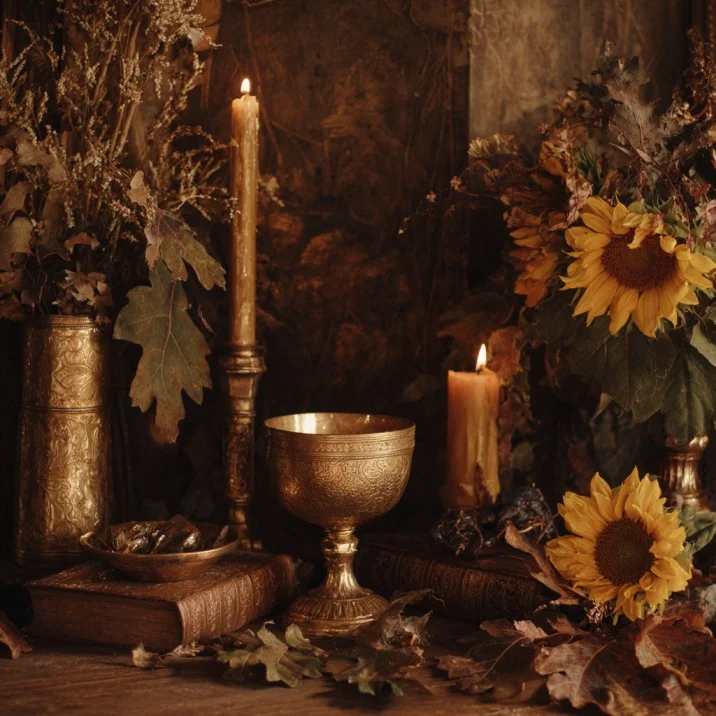
Litha, the summer solstice, is the longest day of the year and the peak of solar power in the Wheel of the Year. It falls around June 21 in the Northern Hemisphere, at the moment when the sun reaches its highest point and the light is at its fullest. It is a day of culmination, of fire, of abundance already ripening on the vine.
It is also one of the most deity-rich points in the pagan calendar. Sun gods and solar goddesses, gods of light and skill, deities of the land at its height of fertility, many figures from across traditions find their natural home at Litha. This guide covers the gods and goddesses most closely associated with the summer solstice across Celtic, Norse, Greek, Roman and other traditions, along with how to honour each in your practice.
Litha and the solstice in pagan tradition
The word Litha is drawn from the Old English name for the month of June, used by the Venerable Bede in his eighth-century account of the Anglo-Saxon calendar. In modern Wiccan and pagan practice it has become the standard name for the midsummer sabbat, though it is also celebrated under names including Midsummer, Alban Hefin in the Druid tradition, and simply the Summer Solstice.
The solstice itself has been observed as a sacred threshold across cultures for thousands of years. Stone circles aligned to the midsummer sunrise, most famously Stonehenge, predate any named tradition and speak to how deeply humanity has always felt the significance of this moment. It is a time when the sun is honoured at its height, even as its decline begins the very next day.
That paradox (the peak that immediately begins its descent) runs through much of Litha's mythology. The Oak King and the Holly King must exchange their crowns. The sun is most powerful and yet most vulnerable. Litha deities often carry this dual quality: triumphant and yet turned toward what comes next.
Lugh: Celtic god of light and skill
Lugh is perhaps the most widely honoured deity at midsummer across Celtic traditions, though he is more formally celebrated at Lughnasadh in August: the harvest festival that bears his name. At Litha, it is his solar aspect that is most relevant: Lugh as the shining one, the long-armed, the master of all arts.
In Irish mythology, Lugh is a member of the Tuatha Dé Danann and one of the most accomplished figures in the tradition. He is skilled in every craft: warrior, poet, craftsman, sorcerer, physician. His name is cognate with the Latin lux, meaning light, and he is associated with the sun, lightning, and the heights of summer.
Working with Lugh at Litha is appropriate for any working around skill, achievement, creative mastery, or the full expression of your gifts. His energy is triumphant and bright. Offerings include grain, bread, berries, mead, and crafted objects made by your own hands. Yellow and gold are his colours. The spear is his primary symbol.
Áine: Irish goddess of summer and sovereignty
Áine is an Irish goddess deeply associated with summer, the sun, and the sovereignty of the land. Her name means brightness or radiance, and she is connected to Cnoc Áine in County Limerick, a hill where midsummer celebrations in her honour were recorded as late as the nineteenth century: among the most direct documented survivals of ancient solstice practice in Ireland.
She is a goddess of abundance, love, and the fertile land at its height. She is also associated with the fairy mounds and with the protection of women. In some accounts she is a sun goddess; in others, she is the land herself made divine, and at midsummer, those two things are barely distinguishable.
Áine is the deity on this list I work with most personally. The Irish female divine in its summer expression (sovereign of the land at its most abundant, protector of women, tied to a specific place and a specific practice that survived into the nineteenth century) is exactly the territory my practice gravitates toward. She responds well to gratitude for abundance already present rather than petitionary requests.
Freyr: Norse god of sunshine and fertility
Freyr is one of the Vanir gods of Norse tradition: the gods associated with nature, fertility, and prosperity rather than the war and wisdom of the Aesir. He is the ruler of Álfheimr, the realm of the light elves, and is associated with sunshine, rain, and the flourishing of the earth. His name simply means lord.
At midsummer, Freyr's solar and agricultural associations make him a natural focus. He is a god of the land at its most generous: crops growing, herds thriving, light long and warm. He is also associated with peace and pleasure, in some accounts his hall is a place of untroubled ease, and he is invoked for good harvests and for joy.
Freyr is depicted with a magical sword that fights on its own and a golden boar named Gullinbursti. His sacred animals include the horse and the boar. Offerings appropriate to Litha include grain, fruit, mead, and flowers. He is a generous deity and responds well to joyful, celebratory ritual rather than solemn petition.
Sol and Sunna: Norse solar goddess
In Norse mythology, the sun itself is a goddess: Sol, also called Sunna. She drives the solar chariot across the sky each day, pursued by the wolf Sköll who will one day catch her at Ragnarök. She is a figure of tireless, radiant service: constantly in motion, the source of the light that sustains all life.
Sol is not as extensively mythologised as some other Norse figures. What I find most significant about her is not just that she is female but that she is the sun itself: not a consort or companion to a male solar god, but the source. She does not rule the sun. She is it, in constant motion, pursued by the wolf who will one day catch her. That is a different kind of solar power from Apollo's triumphant brilliance: tireless rather than sovereign, constant rather than glorious. At Litha, the moment of her greatest light before the long retreat, I find it worth acknowledging directly. Working with Sol is appropriate for any practice around sustained effort, consistency, the gifts of light, and gratitude for the abundance the sun makes possible.
Her symbols are the sun wheel and the solar disc. Offerings include sunflowers, gold items, and candles burned at dawn or noon on the solstice. If you keep a Norse-oriented practice, the solstice is one of the most appropriate times to honour her directly.
Apollo: Greek god of the sun and light
Apollo is one of the most widely recognised solar deities in Western tradition, and the one on this list I feel least personal kinship with. My practice tends toward the female divine, and Apollo's Olympian scope, his association with male-led oracular traditions, and his overwhelming accumulation of domains make him a figure I approach with respect rather than warmth. That said, for practitioners drawn to the Greek tradition or working with themes of creative mastery and clarity at midsummer, he is entirely appropriate to invoke. In Greek mythology he is the god of the sun, light, music, poetry, art, prophecy, truth, archery, healing, and more. He is a figure of almost overwhelming scope: the ideal of the Olympian god at the height of his powers.
His solar chariot drives the sun across the sky (in some accounts shared with the titan Helios), and his association with light extends beyond the literal to encompass clarity, truth, and the illumination of what is hidden. At Litha, Apollo's energy is one of confidence, brilliance, and the full expression of creative and intellectual gifts.
Apollo is appropriate to invoke at midsummer for workings around creative work, clarity of purpose, healing, and the arts. His sacred plants include laurel, sunflowers, and heliotrope. His colours are gold and white. Offerings include music, poetry composed in his honour, and burning laurel leaves.
The Oak King and the Holly King
The Oak King and the Holly King are not figures from ancient mythology but from the modern Wiccan and neo-pagan tradition, most associated with Robert Graves and later Wiccan writers. They represent the dual forces of the waxing and waning year: the Oak King rules from Yule to Litha, presiding over the growing light, and the Holly King rules from Litha to Yule as the darkness returns.
At midsummer, the Oak King is at his peak, but it is also the moment the Holly King defeats him and begins his own reign. The two are not enemies so much as two faces of the same force: the endless cycle of growth and retreat, life and death, expansion and return.
Working with this mythology at Litha is particularly powerful for anyone engaging with themes of transition, the ending of a peak period, or releasing what has served its purpose. A simple ritual involves two candles (one gold for the Oak King, one silver for the Holly King) and a meditation on what you are completing and what new phase is beginning.
How to honour Litha deities in your practice
You do not need to work with every deity here. Choose one whose mythology resonates with what you are working through at this point in your year, or who fits your existing tradition. A single well-tended relationship will do more than six cursorily honoured ones.
Practical ways to honour Litha deities: build a solar altar with gold and yellow candles, sunflowers, and oak leaves. Burn a candle at sunrise on the solstice. Make offerings of bread, grain, mead, honey, or fruit. Spend time outdoors at noon. Journal on what has come to fruition since Yule and what you are ready to release as the year begins to turn.
I record all of this in my Deity Journal in Grimoire: ritual notes, offering records, the slow accumulation of a relationship across seasons. If you want to go deeper on the sabbats, the Beltane deities guide follows the same format for the sabbat just passed.
Sources
More from the Blog
Beltane for Solitary Witches: Celebrating the Fire Festival Alone
Beltane is one of the great fire festivals. Here is how to celebrate it as a solitary witch, simply and meaningfully.

Litha for Solitary Witches: Celebrating the Summer Solstice Alone
Litha is the longest day of the year and the peak of solar power. Here is how to celebrate it as a solitary witch, simply and meaningfully.
Begin your practice
Grimoire is available now on Android and as a web app. Start today.