History
The North Berwick Witch Trials
Rowenna
Solitary witch and the founder of Grimoire. Built the app she couldn't find anywhere else. Writes about the craft with primary sources, honest lineage notes, and a low tolerance for vague correspondences. Based in the UK with more herbs than shelf space.
· 11 min read
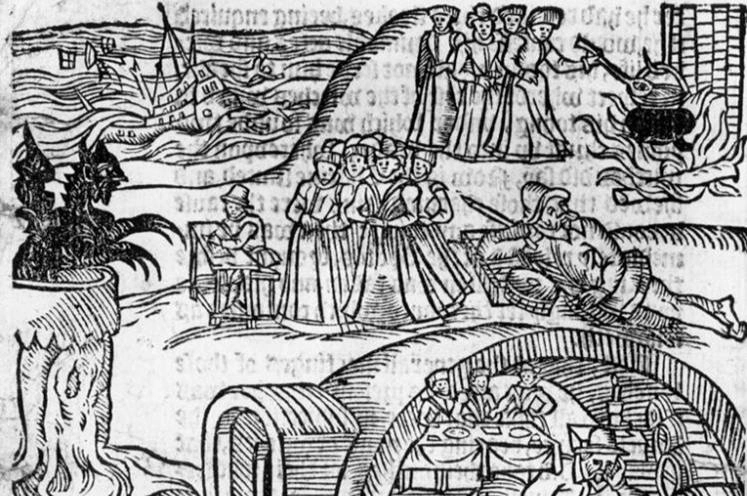
In the winter of 1589, James VI of Scotland was returning from Denmark with his new bride, Anne. The North Sea crossing was brutal. Storms scattered his fleet twice. Ships were damaged, sailors nearly lost. When James arrived safely in Edinburgh in May 1590, he was convinced the storms had not been natural. He was convinced that witches had raised them to kill him.
The investigation he helped oversee over the following months would produce Scotland's most famous witch trial, the most dramatically confessed set of allegations in the history of British witch-hunting, and (when James later published his response to the crisis) the most influential royal treatise on witchcraft in the English language. The North Berwick trials did not happen because witches were raising storms in East Lothian. They happened because a young king with a credulous theology and a political enemy needed an explanation for his own vulnerability, and the machinery of interrogation provided one.
The setting and the spark
The accused at North Berwick were arrested beginning in the summer of 1590. The initial spark was a servant girl in Tranent, East Lothian (a young woman later named in the records as Geillis Duncan) whose employer, the deputy bailiff David Seton, became suspicious of her nightly absences and her apparently successful folk-healing practice. Seton examined her, found a "witch's mark" on her neck, and subjected her to torture.
Under the thumbscrew, Geillis Duncan confessed to witchcraft and named others.¹ This was how the network of accusations spread: each confession, extracted under torture, implicated new people, who were then arrested and examined, who confessed and implicated others in turn. The confessions were not independent testimonies corroborating each other; they were the sequential product of a single coercive chain, each link forged under physical pain.
Among those named by Duncan's confession was Agnes Sampson (also recorded as Agnes Thompson) an older woman known locally as a midwife, healer, and wise woman. Sampson was arrested, subjected to the "witches' bridle" (a metal cage locked around the head, with four sharp prongs pressing into the mouth and tongue to prevent speech), and eventually confessed.
James VI and the interrogation
James VI was twenty-four years old in 1590. He was intelligent, well-educated, and deeply interested in theology, particularly in the theological question of whether witchcraft was real and whether it represented a genuine supernatural threat to the state. He was also, by the evidence, genuinely frightened. The storms had been real. Ships had nearly been lost.
When Agnes Sampson was brought before him at Holyrood House in Edinburgh, she was initially resistant. She had, it was said, continued to deny the main accusations even after extensive torture. What changed the king's mind (and the detail that would be recorded and repeated and used to demonstrate the reality of witchcraft for decades) was a specific private moment.
Agnes Sampson, according to the account in the pamphlet Newes from Scotland published in 1591, drew the king aside and whispered in his ear the precise words that James and Anne had spoken to each other on their wedding night.² Words that no one else could have known, or so the story went. James was reportedly astonished and declared before his court that she had been dealing with the devil.
What actually happened in that moment is irrecoverable. The whispered words could have been a guess, a rumour, a calculated gambit, or a fabricated detail added to the pamphlet after the fact. What is certain is that the story served the purpose it was told to serve: it confirmed to James and to the public that the North Berwick accusations were real, that the magic was genuine, and that the threat was serious.
The accused and their confessions
The confessions produced at North Berwick are among the most dramatic in the British witch-trial record. Under torture and interrogation, the accused described:
A gathering of some two hundred witches at the church of North Berwick, dancing in a ring around the churchyard while the devil played music. A wax image of James VI, passed hand to hand among the coven, intended to melt him to death. A ritual in which parts of a corpse were burned, the ashes to be thrown at the king's ship. Storms raised by witches beating a cauldron and casting a cat into the sea with parts of a dead man tied to it.
These images (the dancing circle, the wax figure, the raised storm) are the images of witchcraft that James VI would later codify in Daemonologie. They came from the accused's confessions. The confessions came from torture. The things being described under torture reflected, in large part, what the interrogators expected to find, not what was actually practised.
A schoolmaster named John Fian (John Cunningham) was accused of being the secretary and registrar of the coven. He was subjected to extraordinary torture: pins driven under his fingernails, his finger bones crushed, the boot (a device that compressed the leg). He confessed. He then recanted. He was tortured again until he re-confessed. He was eventually executed.
Agnes Sampson was strangled and burned at the stake on the Castle Hill of Edinburgh. Geillis Duncan was executed. John Fian was executed. The precise total of those killed in the North Berwick trials and their immediate aftermath is uncertain; historians' estimates range from around a dozen to significantly more, depending on which connected cases are included.
The political dimension: Francis Stewart, Earl of Bothwell
The most significant figure implicated in the North Berwick accusations was never convicted. Francis Stewart Hepburn, 5th Earl of Bothwell, was James VI's first cousin and one of the most powerful nobles in Scotland. He was named, in the confessions extracted from the accused, as the devil's representative: the master of the North Berwick coven who had commanded the witches to raise the storms.
Bothwell had political and personal reasons to want James gone. He was in the line of succession and had already demonstrated his willingness to challenge royal authority. The accusation against him (which he denied, which he could not be made to confess, and which he escaped by fleeing Scotland before he could be tried) fits the pattern of witch trials used as a tool of political power that would recur throughout the European witch-hunting period.³ The king was using the trial to neutralise a rival. Whether he believed the accusations against Bothwell or merely found them useful is not entirely clear from the record. Both may be true.
Daemonologie and its legacy
In 1597, James VI published Daemonologie: a philosophical and theological dialogue in three books, arguing for the reality of witchcraft, the devil's capacity to work through human agents, and the necessity of prosecuting accused witches. The North Berwick trials were a direct prompt for the book; James had been collecting evidence of witch activity for years and the 1590 trials were the crystallisation of his concern.
Daemonologie is a genuinely learned work for its time. James was engaging with continental witch-hunting theory, with Protestant theology, and with specific cases from his own experience. His conclusions (that witches were real, that they served the devil, that magistrates had a duty to prosecute them) were not unusual views in late-sixteenth-century Protestant Europe. What made Daemonologie significant was that its author became James I of England in 1603.
When James took the English throne, his book came with him. The 1604 Witchcraft Act (the statute under which the Pendle witches and Matthew Hopkins's victims would be prosecuted) was James's legislation, passed by a Parliament influenced by a king whose views on witchcraft had been shaped at North Berwick.⁴ The pamphlet Newes from Scotland, the torture chambers at Holyrood, the burning of Agnes Sampson on Castle Hill: these are the events that shaped the legal framework under which hundreds of English people would be executed across the following century.
Scotland's witch-hunting tradition
North Berwick matters not only because of its influence on English law. It matters because of what it became in Scotland.
Scotland executed significantly more people for witchcraft per head of population than England over the same period: estimates suggest roughly five times the English rate, with somewhere between 2,500 and 4,000 executions total against England's figure of perhaps 500.⁵ The North Berwick trials did not cause this alone. But they established the template: the king-endorsed investigation, the confessions produced under torture, the named networks of accused implicating each other, the political dimension lurking in the background. Scotland's later witch-hunting followed this template with increasing scale through the seventeenth century, with major panics in 1629-30, 1649, 1661-62, and others.
The accused in these later Scottish trials, like those at North Berwick, were not pagans. They were not practitioners of a pre-Christian goddess religion. They were midwives, servants, cunning folk, the poor elderly, and the socially vulnerable: the same profile as the accused everywhere in the early modern witch-trial world. The confessions they gave, under torture or under the coercion that was inseparable from being accused, reflected the expectations of their interrogators and the theological framework of their accusers, not anything these people actually practised.
Conclusion
The North Berwick witch trials are one of the most precisely documented events in the history of British witch-hunting: documented because the king's personal involvement guaranteed that the official pamphlet version was published and preserved. Newes from Scotland is propaganda as much as record. The confessions it preserves were extracted under torture and shaped by royal expectations. The political motivation for at least some of the accusations is visible from the surviving evidence.
What the trials actually show is what all witch trials show when examined carefully: the mechanism of persecution, the role of torture in producing confessions, the use of accusations as political tools, and the specific social vulnerabilities that made particular people targets. Agnes Sampson's skill as a healer made her a target. John Fian's literacy made him a useful figure for the narrative of an organised coven with a secretary. Bothwell's political ambition made him the invisible master of the conspiracy.
For the legal structure that North Berwick helped produce, see The Pendle Witches: the English trial prosecuted under the James I statute. For the cunning-folk tradition that some of the accused may have come from, see Cunning Folk: The Working Witches of English History, which publishes in August.
Sources
- Lawrence Normand and Gareth Roberts, eds., Witchcraft in Early Modern Scotland: James VI's Demonology and the North Berwick Witches (University of Exeter Press, 2000): the standard scholarly edition, containing primary documents including the contemporary depositions, Newes from Scotland, and the full text of Daemonologie alongside scholarly analysis.
- Newes from Scotland, Declaring the Damnable Life and Death of Doctor Fian, a Notable Sorcerer (London, 1591): the contemporaneous pamphlet published about the trials, available in various modern reprints and in Normand and Roberts's edition above.
- Julian Goodare, The European Witch-Hunt (Routledge, 2016): the leading modern survey of European witch-hunting including substantial discussion of Scotland's unusually high execution rate and the role of the North Berwick trials in establishing the Scottish tradition.
- Wikipedia: North Berwick witch trials, overview of the trial chronology, the accused, and the political context.
- Wikipedia: Scottish witch trials, statistical overview of Scottish witch-hunting and comparison with England.
More from the Blog
The Pendle Witches: A History of the Lancashire Witch Trials of 1612
The Pendle witch trials of 1612 are among the most documented witch trials in English history. Who the accused were, what actually happened, and how they are remembered by modern witches.
Cunning Folk: The Working Witches of English History
For five hundred years, when ordinary English people needed magical help, they went not to a witch but to a cunning man or cunning woman: paid professional folk-magicians present in nearly every parish. Who they were, what they did, and what modern witchcraft actually inherits from them.
Begin your practice
Grimoire is available now on Android and as a web app. Start today.