Practice
Shadow Work Prompts: 30 Questions to Begin (and How to Use Them)
Rowenna
Solitary witch and the founder of Grimoire. Built the app she couldn't find anywhere else. Writes about the craft with primary sources, honest lineage notes, and a low tolerance for vague correspondences. Based in the UK with more herbs than shelf space.
· 9 min read

The difference between a blank page and a good question is the difference between staring and seeing. I have sat in front of both, and the blank page only ever gave me back my own avoidance, dressed up as patience. A real question goes past the answer you would offer in company and reaches the one you actually hold.
This page gives you thirty of those questions, grouped by theme, plus how to use them without taking on too much at once. If you want the grounding first, what shadow work is covers the why before the how. One framing line before the list: this is reflective practice and not therapy, and there is guidance further down on pacing the work and knowing when to set it down.
How to Use These Prompts
Pick one prompt, not ten. The temptation is to read the whole list, feel the pull of several at once, and try to answer them all in an evening. That is not depth; it is a way of staying on the surface of many things instead of the bottom of one. Choose the question that makes you flinch slightly, or the one you would rather skip, and stay with only that.
Write without editing. The first answer is usually the honest one; the second is usually the version you have already tidied for an audience that is not even there. Let the writing be ugly. No one is going to read it, and the freedom to write with no audience is, in psychologist James Pennebaker's expressive-writing research, exactly what produces the most meaningful processing.
Set an edge around the work so it has a beginning and a deliberate end. A candle lit when you open the page and put out when you close it, or a single dark-moon night set aside, gives the digging a shape. Open-ended shadow work tends to either fizzle out or follow you around all week; a contained session does neither.
And notice your resistance. If a prompt makes you want to close the page, that reluctance is not a signal to move along to an easier one. It is information. The questions you least want to answer are usually pointing at the door you have been walking past.
Thirty Prompts, Grouped by Theme
The prompts below are grouped into seven themes. You do not need to work through them in order, and you certainly do not need to do them all. Read until one catches, and start there.
Triggers and Reactions
A strong reaction is rarely about the thing in front of you. It is usually guarding something older and softer.
- Think of the last time a small thing produced a large reaction in you. What was actually being threatened underneath the size of the response?
- When someone's tone shifts toward you, what do you assume it means, and where did you first learn to assume that?
- What kind of comment can spoil a whole day for you, and what would have to be true about you for it to land that hard?
- When you feel defensive, what are you protecting, and is it still something that needs protecting?
- Name a reaction you are slightly ashamed of. If that reaction were trying to keep you safe, what would it believe it was saving you from?
Avoidance
What we avoid is often what we already know. The avoidance is the knowing, kept at arm's length.
- What is the thing you keep meaning to do, that a quieter part of you already knows you should? What does not doing it spare you from feeling?
- What conversation are you avoiding, and what would you have to admit to yourself if you finally had it?
- Where in your life are you staying busy so that you do not have to be still? What might arrive in the stillness?
- What have you been calling "not the right time" for longer than is honest?
Inherited Beliefs
Some of what you believe about yourself was handed to you before you were old enough to refuse it.
- Finish this plainly: "I am the kind of person who ___." Now ask whose voice first taught you that sentence.
- What did the people who raised you treat as obviously true that you have never actually examined for yourself?
- What were you praised for as a child, and what did you decide you had to keep being in order to keep the praise?
- Name a value you live by. Did you choose it, or did you absorb it before you were old enough to choose?
Projection
Jung gave this its name: projection, the way we locate in other people the very things we have refused to see in ourselves. The charge is the clue.
- Think of the person whose behaviour irritates you most right now. Jung suggested that what we cannot bear in others is often something we have exiled in ourselves. How much of that quality lives in you, unadmitted?
- What trait do you criticise loudly in other people? When was the last time you did a smaller, quieter version of it?
- Whom do you envy, and what does the envy tell you about a desire you have not let yourself name?
- When you call someone "too much" of something, what part of yourself are you working hard to keep "not too much"?
Recurring Patterns
If a situation keeps happening to you with different people, the constant worth examining is you.
- What situation keeps recurring in your life, with different faces each time? What is the one element present in every version?
- Think of a recurring argument you have. What is your reliable role in it, and what do you get to avoid by playing that role?
- What kind of person do you keep choosing, and what familiar feeling do they tend to bring with them?
- Where does your life keep arriving back at the same point, no matter which route you took to get there?
The Body and Grief
The body keeps a record the mind would rather not. You can listen to it without forcing anything open.
- Where does tension settle in your body when you are not paying attention to it, and what does that place seem to be holding for you?
- Name a loss you moved past quickly because moving on was easier. Is it actually finished, or only filed away?
- What feeling do you reach to numb the fastest, and what would you have to sit with if you stopped numbing it?
- Is there an old grief that still tightens something in you when it is touched? You do not have to open it here; only to notice that it is still there.
Integration
Seeing a thing is the first half. Owning it, letting it back inside the circle of who you are willing to be, is the half that makes the work whole.
- What has shifted in you since you last sat with questions like these, even slightly?
- Name a trait you have always exiled as "not me." What would it look like to own a small, honest amount of it?
- What would you need to forgive yourself for in order to stop carrying it?
- Think of something an earlier prompt surfaced. What did it once need, and how might you meet that need in the open now?
- What part of you have you been treating as a problem that might, looked at gently, be a strength you were taught to distrust?
Pacing the Work
Shadow work has no prize for speed and no medal for depth reached quickly. If a prompt opens something that feels larger than the page can hold, that is the moment to slow down, not to push further. Close the page, put the candle out, and do something ordinary and grounding: a glass of water, a walk, the washing up. Come back another day. The material is not going anywhere, and you will meet it better rested than raw. I have had to set this work down mid-session more than once, and every time it was the right call rather than a failure of nerve.
It helps to be honest about what solitary work can and cannot do. Digging alone is not the same as being supported while you dig. A page will hold your honesty, but it cannot hold you. That is not a flaw in the practice; it is the edge of it, and knowing where that edge sits is part of the work itself.
So, plainly: shadow work sits alongside therapy and does not replace it. If something opens that needs more than a page can carry, that is not a sign to find a deeper prompt. It is a sign to reach for a person: a therapist, your doctor, someone trained to hold what reflective practice is not built to hold. Reaching for help is not the practice failing. It is self-knowledge doing exactly what it is for.
Working with the Dark Moon
A recurring, marked time is the simplest way to turn an open-ended practice into a contained one, and the craft already offers one. The dark moon, the night before the new crescent when the sky gives nothing back, has long been the witch's inward phase, and it makes a natural monthly appointment with a single question. You sit with one prompt on that night, and then for the rest of the month you do not. The calendar paces you, so you are not relying on willpower to know when to stop.
This is the same containment that the wider guide to shadow work describes: a beginning and a deliberate end, so the digging has edges and does not trail you into the rest of your days.
Questions
How many shadow work prompts should I do at once?
One is enough, and one is usually better than several. The aim is depth on a single question, not coverage of the list, so resist the pull to answer five in a sitting. If you finish quickly and feel steady, sit with the same prompt again rather than reaching for the next one.
Are shadow work prompts safe to do alone?
For everyday material, patterns, small shames, old habits, yes, reflective work like this is safe and genuinely useful done alone. The thing to watch is your own response: if a prompt leaves you more unsettled with each session rather than steadier, that is the moment to bring in a therapist or another trusted person. A solitary practice has never meant an unsupported life.
Do I need to be religious or a witch to use these?
No. These are reflective questions, not rituals, and they work the same whether or not you hold any belief at all. The dark-moon framing above is offered as a way to pace the work, not as a requirement. Take what is useful and leave the rest.
How often should I do shadow work?
Less often than you might expect. Most people do well with a single session around each dark moon, roughly once a month, with the weeks in between left for ordinary life. Shadow work is meant to inform your days, not crowd them, and a slower pace tends to reach deeper than a daily one.
I still keep the same rule I started with: one question, one quiet night, and the honesty to write down the first answer rather than the tidy one. That alone has carried me further than any longer method ever did.
This kind of work lives best in a private, quiet space that belongs to no one but you. Grimoire's Shadow Work space keeps these prompts and your responses together in one contained place, stored only on your device, so the page you write on is as private as the work deserves.
Sources
- Carl Jung, Aion: Researches into the Phenomenology of the Self, Princeton University Press (1951, Collected Works Vol. 9, Part II): the shadow as a moral problem requiring self-knowledge, and projection as the mechanism by which it is met in others, Internet Archive
- Robert A. Johnson, Owning Your Own Shadow: Understanding the Dark Side of the Psyche, HarperCollins (1991): the work of integration and the golden shadow, en.wikipedia.org/wiki/Robert_A._Johnson
- James W. Pennebaker, research on expressive writing and psychological processing (the mechanism behind reflective writing), see en.wikipedia.org/wiki/Expressive_writing
More from the Blog

The Olfactory Ghost: A Formulation Guide
Most occult books treat scent like a lookup table: cinnamon for wealth, lavender for peace. Here is how to build a layered three-tier formula that actually holds, with evaporation rates, percentages, and honest herb safety.
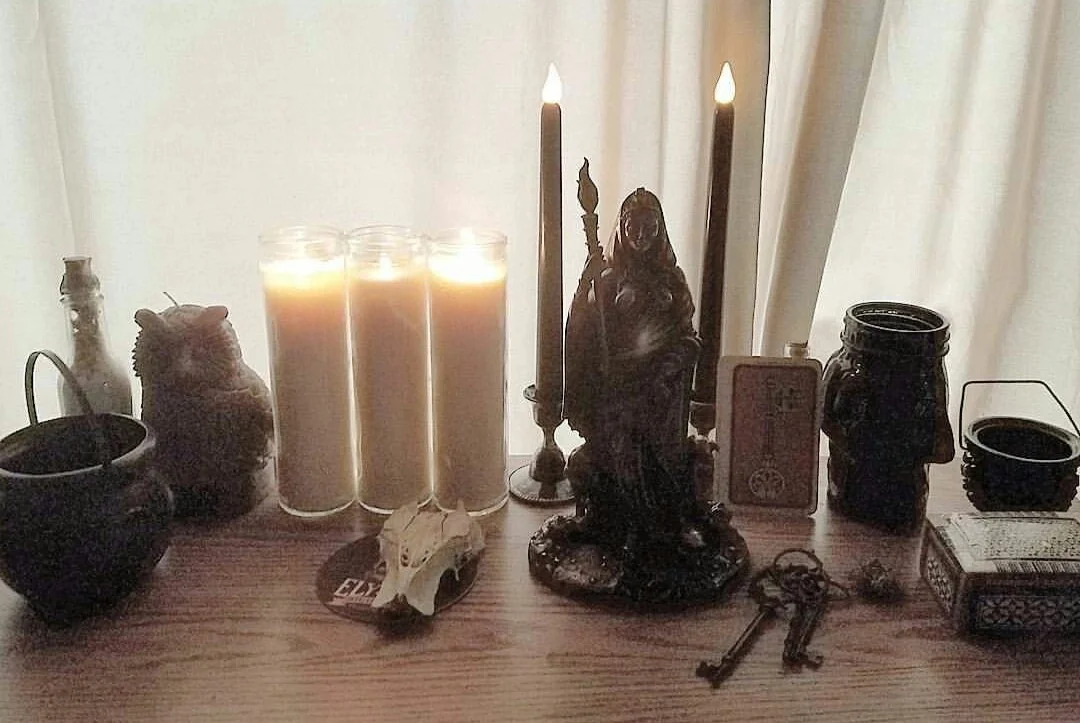
Shadow Work with Hecate: Meeting the Goddess of the Crossroads
Shadow work with Hecate, goddess of crossroads and thresholds: who she is, why she suits the work, and how to begin a practice with her at the dark moon.
Begin your practice
Grimoire is available now on Android and as a web app. Start today.