Practice
Shadow Work with the Morrigan: Sovereignty, Fate, and the Necessary Ending
Rowenna
Solitary witch and the founder of Grimoire. Built the app she couldn't find anywhere else. Writes about the craft with primary sources, honest lineage notes, and a low tolerance for vague correspondences. Based in the UK with more herbs than shelf space.
· 9 min read
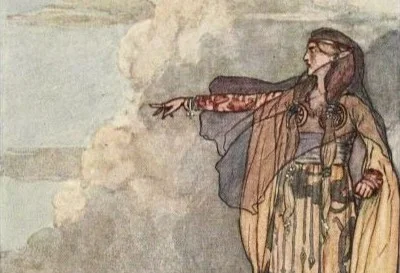
Of all the figures a person might bring to this kind of inner work, the Morrigan is the one most people are afraid to approach. She is the war goddess, the crow on the battlefield, the voice that foretells a death and does not soften it. People come to her late, if they come at all, and usually with their shoulders up. I want to suggest that the fear is not a reason to keep away from her. With this particular goddess, and this particular work, the fear is closer to the doorway.
This page is about why the Morrigan suits shadow work, the practice of meeting the parts of yourself you have disowned. It covers who she is in the Irish tradition, why she fits the work of facing what must end, and how a person might begin, honestly framed. I should say at the outset that I write about her from the tradition rather than from a devotional practice of my own; what follows leans on the old sources and on the shape of the work, not on private experience I do not have.
One thing to set down before anything else. This is reflective and devotional practice, a way of working with a deity and with yourself, and it is not therapy. It can sit alongside that kind of help; it does not stand in for it. That line matters more with the Morrigan than almost anywhere, and I will come back to it.
Who the Morrigan Is
In the Irish tradition she is the Morrigan, or Mor-Rigan, a name usually translated as "great queen" or "phantom queen." The World History Encyclopedia describes a goddess bound up with war and fate and death: she incites battle, stirs its fury, foretells its outcome, and presides over the dead it leaves behind. The creature she is most often joined to is the crow or raven, the bird the Celts associated with war and death and the inciting of conflict, and it is as a crow that she most famously appears, watching a battlefield from a bare branch or wheeling above it.
She is often a triple figure. The medieval material groups her with the war goddesses Badb and Macha (and in some tellings Nemain), a cluster sometimes called the Morrigna, and scholars tend to read these less as separate beings than as faces of one. The sources do not fully agree, and that is worth saying plainly: the texts that survive are fragmentary and contested, copied and recopied by Christian scribes centuries after the beliefs they record, and a great deal of what we would like to know about her is simply gone.
There is one motif worth holding onto for what follows. In the tradition she appears as the Washer at the Ford, a figure met at a river washing the bloodied clothes or armour of those about to die. To come upon her at her washing was to learn that your death was already decided. It is a hard image, and a clarifying one: she does not so much cause the ending as show you, without flinching, the ending that is already on its way.
Underneath the war and the prophecy, scholars of Irish myth read an older role: the Morrigan as a goddess of sovereignty, the one who grants and withdraws the right to rule. In the texts she meets the Dagda before the great battle in Cath Maige Tuired, and her favour is bound up with whether the land's defenders will hold their kingship or lose it. Sovereignty, in this reading, is hers to give and hers to take back. That idea, more than the blood, is the metaphorical heart of why she belongs in this work.
Why the Morrigan Suits Shadow Work
Here is the conceptual heart of it. The point of working with her is not the war. It is what the war stands for: the inner reckoning that most of us spend years avoiding. Three threads tie her to the shadow, and all three are metaphorical.
Sovereignty. The shadow, in the sense the wider guide uses, holds the parts of yourself you long ago decided were unacceptable and pushed out of sight: the anger, the need, the grief, the ambition you were taught to be ashamed of. To live without sovereignty is to be governed by those exiled parts from underground, ruled by what you will not look at. To own your sovereignty is to take the whole self back, including the disowned country of it. The Morrigan grants sovereignty to those who can stand in front of her and not run. That is the same threshold the shadow asks you to cross: not the destruction of the difficult part, but the reclaiming of it.
Fate, and the necessary ending. Shadow work, done honestly, almost always means letting something die. An old self-image you have outgrown. A story you told about who you are and why. A version of a relationship you keep resurrecting because the grief of ending it feels heavier than the cost of carrying it. The Morrigan presides over exactly these endings: the ones nobody wants and everybody needs. As the Washer at the Ford she does not negotiate with what is already finished. There is a relief in that, once the fear thins. She will not help you keep what is already dead.
The thing you are afraid to look at. She is frightening, and that is not incidental to the work; it is the work in miniature. The shadow is, almost by definition, the material you flinch from. Meeting the Morrigan rehearses meeting it: you walk toward the figure on the branch instead of away, and you find that the fear was guarding the threshold, not the wall. As with other deities of the threshold, the dread you feel at the edge is information about where the work is, not a sign that you should stop.
The fear is the doorway, not the wall.
None of this is about aggression turned outward. The battle the Morrigan presides over here is the one inside a single person: the quarrel between the self you show and the self you have buried, and the slow, unglamorous peace that comes only when the buried one is allowed back. Keep the swords metaphorical. The reckoning is real enough without them.
How to Begin Shadow Work with the Morrigan
Because I do not keep a devotional practice with her, I will not hand you mine; there is no altar of my own to describe. What I can offer is how the tradition and the shape of the work suggest a person might begin, carefully.
Approach with respect, and slowly. The Morrigan is not a gentle starter deity, and the old reputation is not marketing. It is entirely acceptable, and probably wise, to begin by simply sitting with her symbolism rather than rushing to invoke her: the crow, the ford, the idea of sovereignty granted and withdrawn. You can study a goddess for a long season before you ever address her, and with this one that patience is itself a form of respect.
Make a simple, quiet space. It does not need to be elaborate or specific to her. Somewhere set apart from where you answer messages, where you can return and be undisturbed. The tradition marks certain times as fitting for endings and for the dead: the waning and dark moon, when the cycle turns toward release, and the season of Samhain, when the old year is let go. These are containers, not requirements. They pace the work so that it has a beginning and an end.
Do the reflective work itself. This is where shadow work proper begins, and a set of prompts grouped by theme will give you somewhere honest to start. With the Morrigan, three questions sit close to her nature: what needs to end that you keep refusing to bury; where you have handed your sovereignty to someone or something else; and what you are most afraid to look at directly. Take one, not all three. Write the true answer rather than the tidy one.
Close deliberately, and ground. However you open the work, shut it as cleanly. Thank her if you have addressed her, put out any candle you lit, and let the threshold close. Then do something ordinary and grounding: water, food, a walk, the washing up. With work this serious the closing is not a formality; it tells a part of you older than language that the digging has edges and is done for now.
If you wonder about offerings, the honest answer is that they are optional and that the tradition is light on the detail. In modern practice she is associated with the crow and with offerings such as whiskey or red wine, given respectfully; these are contemporary conventions rather than anything I keep myself or would present as fixed. An honest few minutes of attention is worth more than a poured drink given to tick a box.
Pacing and Respect
Two things to hold the whole way through, and I would rather over-say them than leave them out.
The first is safety. Shadow work has no prize for depth reached quickly, and a goddess of war and death does not change that. If a session opens something larger than the night can hold, that is the signal to stop, not to press further. Close the work, ground yourself, and reach for a person rather than a deeper working. And if what surfaces is more than reflective practice was built to carry, if you find yourself returning to memories that overwhelm rather than inform you, or thinking of hurting yourself, then the next step is not the Morrigan. It is a therapist, your doctor, someone trained to hold what a candle and a page cannot. This practice sits alongside that help and never in place of it.
The second is respect, and with this goddess it carries extra weight. She has a fierce reputation in the tradition, and the right posture is humility: no demanding, no bargaining for a guaranteed outcome, no treating her as a tool. It is acceptable, and often wise, to go slowly, or to decide that studying her is enough for now and that working with her can wait. There is no failure in that. Approaching a deity like the Morrigan is a relationship, not a transaction, and a relationship of this kind is not owed to anyone on demand.
Questions
Is the Morrigan safe for beginners to work with?
She is intense, and honesty serves better than reassurance here. The Morrigan is not a gentle introductory deity, and there is no shame in approaching her slowly or in deciding to simply study her for now. If you do begin, go in small steps, keep each session contained, and pay attention to your own response. If the work leaves you more unsettled each time rather than steadier, slow down and bring in another person rather than digging further alone.
When is the best time for shadow work with the Morrigan?
The waning and dark moon are the traditional times for release and ending work, the part of the cycle turned toward letting go rather than drawing in. The season of Samhain, when the old year is released and the dead are remembered, suits her too. None of this is a rule. A marked time is useful mainly because it paces the work and gives it edges: one night you sit with a question, and a stretch afterward when you do not.
Do I have to be Irish or a Celtic polytheist to honour her?
No. Plenty of people who work with the Morrigan come to her from outside Irish polytheism. What matters more than ancestry or a formal pantheon is the respect you bring: reading something of who she is in the tradition, approaching honestly, and not treating her as a costume. Come with humility and a willingness to learn, and the question of the right label tends to matter less.
What is the Morrigan the goddess of?
In the Irish tradition she is associated with sovereignty, with fate and prophecy, and with war and death, and she is most often seen as a crow or raven. Many sources also treat her as a triple figure alongside Badb and Macha. The surviving texts are fragmentary and not always in agreement, so she is better understood as a cluster of associations than as a single tidy definition.
Closing
What strikes me about the Morrigan, studying her, is the particular honesty of the work that bears her name. She is not a comforting goddess, and the tradition does not pretend otherwise. But there is a hard mercy in a figure who will not let you keep what is already dead: the self-image that stopped being true, the story that has outlived its use, the version of you that you are exhausted from defending. She shows you the ending that is already on its way, the way the Washer at the Ford shows the soldier his, and she does not soften it. The grace is in the not-softening. You cannot begin to live as the whole of who you are until you stop guarding the parts of you that have already gone.
If you keep a practice like this, it asks for a private and contained place to live. Grimoire's Shadow Work space keeps your prompts, reflections and sessions together and stored only on your device, so the page where you face what must end stays as private as the work deserves.
Sources
- Mark Cartwright, The Mórrigan, World History Encyclopedia (2021): Irish goddess of war, fate, death and prophecy, most associated with the crow or raven, grouped with Badb and Macha as a triple figure (the Morrigna), appearing in the medieval texts Cath Maige Tuired and the Ulster Cycle's Táin Bó Cuailnge, worldhistory.org/The_Morrigan
- Morrígan, Encyclopaedia Britannica: Celtic war goddess, at times identified with Macha, britannica.com/topic/Morrigan
- Carl Jung, Aion: Researches into the Phenomenology of the Self, Princeton University Press (1951, Collected Works Vol. 9, Part II): the shadow as the disowned material a person must meet and integrate to become whole, Internet Archive
More from the Blog
Cord Cutting: How to Release an Attachment Without Severing the Person
Cord cutting meditation and ritual for releasing an old attachment: what it is, what it cannot do, and a simple practice for taking your energy back.

What Is Glamour Magic? Confidence, Scent, and Letting Your True Self Be Seen
Glamour magic is not about changing your appearance or bending how others see you. It is about growing the confidence that lets your true self be seen. A practitioner's guide, with the scent ritual at the heart of my own practice.
Begin your practice
Grimoire is available now on Android and as a web app. Start today.