Herbology
The Witch's Guide to Vervain
Rowenna
Solitary witch and the founder of Grimoire. Built the app she couldn't find anywhere else. Writes about the craft with primary sources, honest lineage notes, and a low tolerance for vague correspondences. Based in the UK with more herbs than shelf space.
· 8 min read
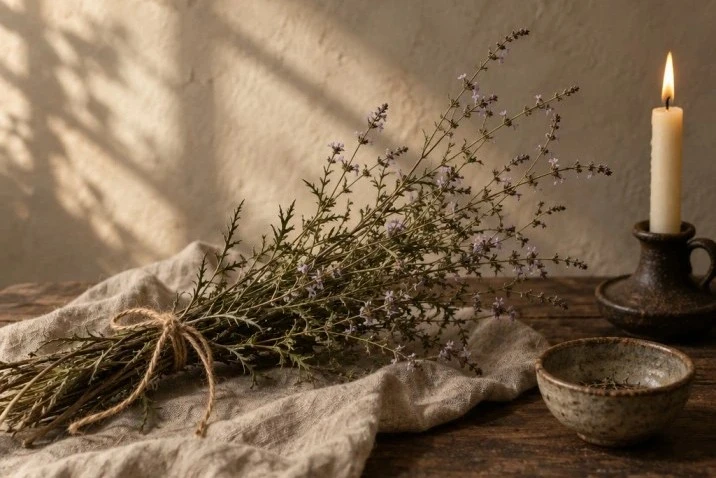
Some herbs carry a magical reputation you can trace back only as far as a paperback from the 1980s. Vervain is not one of them. Its standing as a sacred and protective plant runs unbroken from the Roman world through medieval Europe to the modern altar, and it is one of the few herbs whose ancient credentials survive contact with the sources. When a plant has been called holy for two thousand years, that is worth saying plainly.
This is a single-herb deep-dive in the Grimoire Herbology series, and vervain (Verbena officinalis, common vervain) is one of the most storied of them all. Unassuming to look at, a slender stem with spikes of tiny pale lilac flowers, it has been called the enchanter's herb, the holy herb, and the herb of the cross, and each of those names has a real history behind it.
One safety note first
Vervain is gentle and widely used, but avoid it in pregnancy. It has a traditional and pharmacological reputation for stimulating the uterus, which is exactly why it was historically associated with childbirth, and that makes it a herb to set aside while pregnant. If you are pregnant, breastfeeding, or taking prescribed medication, treat any ingestion of vervain as something to clear with a medical professional first. Working with it as a dried herb on the altar, in a charm bag, or as incense raises none of these concerns; the caution is about taking it internally.
The real history, which is unusually deep
Vervain's sacred reputation is genuinely ancient and, rarer still, genuinely documented. The Roman writer Pliny the Elder, in the first century, recorded that the people of Gaul used vervain in fortune-telling and prophecy, and that the Magi, his term for the more excitable claimants to magical knowledge, made yet more elaborate claims about the plant, including a precise rite for gathering it at the rising of the Dog Star, unseen by sun or moon. Pliny does not name the druids in this particular passage, and the claims should be read with the same outsider's caution that applies to any Roman account of Gaulish practice, but the passage is real and it places vervain among the most storied plants of the ancient world.
The Romans themselves treated vervain as sacred. Bundles of it, the verbenae, were used to sweep and purify the altars of Jupiter, and the plant was carried by the fetiales, the priestly envoys, as a token of their sacred and inviolable status when they went to negotiate peace or declare war. That association with peace, purification, and sanctity is the taproot of vervain's entire magical character, and it is Roman, not modern.
The medieval and Christian layer came later and is folklore rather than history, but it is old folklore and worth knowing. Vervain became the "herb of the cross", said to have been found growing at the foot of the crucifixion and used to staunch Christ's wounds, which earned it the name holy herb and a reputation as a supreme protective plant against evil, witches, and ill fortune. Like much plant folklore it sits alongside the older Roman meaning rather than replacing it.
Magical uses
Vervain's uses in practice follow directly from that history, which is part of what makes it satisfying to work with: the tradition is coherent rather than invented.
Protection. This is vervain's headline use, running straight from the Roman altar and the medieval "herb of the cross" through to the modern practitioner. Hung in the home, carried in a charm bag, or grown by the door, vervain is one of the classic protective herbs of European tradition.
Purification and cleansing. The verbenae that swept Jupiter's altars give vervain a genuine ancient claim as a cleansing herb. An infusion of vervain (not for drinking, but as a wash) has long been used to cleanse ritual tools and sacred space, and dried vervain can be burned as a purifying incense.
Peace and reconciliation. Because the Roman envoys carried it as a token of peace, vervain has a traditional association with calming conflict, smoothing quarrels, and drawing tranquillity to a household. A sprig kept in a shared space is a simple and historically grounded working.
Love and attraction. Vervain also carries an old association with love and desire, which is why it appears in countless folk love charms. The enchanter's-herb name belongs partly to this thread: vervain was a staple of the charm-worker's kit for drawing affection.
Divination and vision. Following the fortune-telling use Pliny recorded among the people of Gaul, vervain has a long reputation as a herb of divination and heightened insight, used to anoint tools or included in incense before scrying and other divinatory work.
Working with vervain
Vervain is easy and pleasant to work with, and none of its magical uses require you to ingest it, which sidesteps the pregnancy caution entirely for most practice. Grow it in the garden as a living protective plant, dry the flowering tops for charm bags and incense, or keep a sprig on the altar as a general herb of protection and peace. For cleansing, steep the dried herb in hot water, let it cool, and use the infusion to wipe down tools or asperge a space. For divination, add a pinch to an incense blend before the work.
Vervain rewards a light touch. It was never a dramatic or dangerous herb in the tradition, but a steady, trusted, everyday one, the plant you reach for when you want protection without theatrics and cleansing without harshness. Two thousand years of witches and priests reaching for the same slender lilac spike is its own kind of endorsement.
Questions
What is vervain used for in witchcraft? Vervain is used chiefly for protection, purification, peace, love, and divination. These uses run directly from its documented history: the Romans swept sacred altars with it and carried it as a token of peace, and Pliny recorded the people of Gaul using it in fortune-telling. It is one of the classic protective and cleansing herbs of European tradition.
Is vervain safe to use? Vervain is safe for most people to handle and to use as a dried herb, incense, or ritual wash. It should be avoided internally during pregnancy, as it has a traditional and pharmacological reputation for stimulating the uterus. Anyone pregnant, breastfeeding, or on prescribed medication should clear any internal use with a medical professional first.
Why is vervain called the enchanter's herb? The name reflects vervain's long use in charm-work, especially love and attraction charms, and the divination use Pliny recorded among the people of Gaul. It has also been called the holy herb and the herb of the cross, the latter from the medieval folklore that it grew at the foot of the crucifixion.
How do I use vervain for protection? Hang dried vervain in the home, carry it in a charm bag, grow it by the door, or keep a sprig on the altar. Its protective use is one of the oldest and best-attested in European tradition, running from the Roman altar through the medieval "herb of the cross" to modern practice. None of this requires ingesting the herb.
Did the druids really consider vervain sacred? Pliny the Elder's own vervain passage does not name the druids specifically. He records the people of Gaul using it in fortune-telling, and separately reports the Magi making more elaborate claims about it, including a precise gathering rite. The druid association comes from later readers connecting this passage to Pliny's more famous druid accounts elsewhere, which concern different plants, so it is a reasonable but indirect link rather than something Pliny states outright.
If you are building a herb shelf you can trust, vervain belongs near the front of it, protective, cleansing, peaceable, and honest about its own long past. For more of the working herbs, the wider Herbology guides gather the rest of the apothecary.
Sources
For vervain's sacred use in Rome, its role in the diplomatic rites of the fetiales, and its use by the Gauls in divination: Pliny the Elder, Natural History, Book 25, chapter 59 (numbered LIX in the traditional Latin chapter divisions).
Grimoire is a digital practice companion for the solitary witch: a spell builder, sacred calendar, private grimoire journal, herbology compendium, and daily tarot, all in one place. Now available on Android.
More from the Blog
The Witch's Guide to Yarrow
Yarrow has been named in almost every Grimoire herb piece: the wound-herb of Achilles, the I Ching's divinatory stalk, the English love-dream herb. A complete profile: botany, folklore across three distinct traditions, magical correspondences, practical use, and three simple workings.
Five Herbs Every Witch Should Have in Their Apothecary
You don't need a fully stocked herb cabinet to practise effectively. You need a handful of versatile, accessible plants and an understanding of why they work.
Begin your practice
Grimoire is available now on Android and as a web app. Start today.