Herbology
The Witch's Guide to Yarrow
Rowenna
Solitary witch and the founder of Grimoire. Built the app she couldn't find anywhere else. Writes about the craft with primary sources, honest lineage notes, and a low tolerance for vague correspondences. Based in the UK with more herbs than shelf space.
· 8 min read
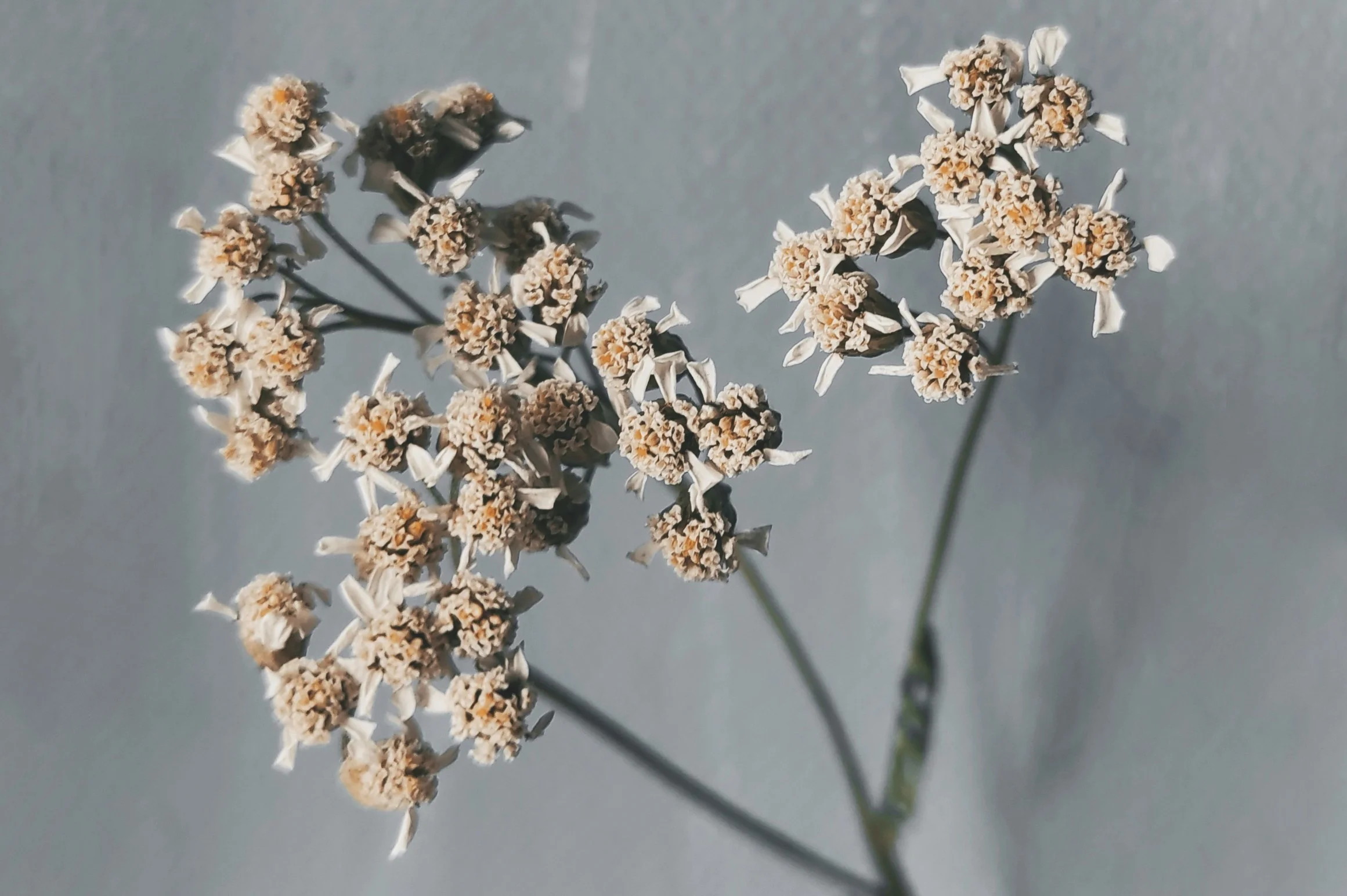
Yarrow appears in the herbs of Litha, the herbs of Mabon, and the Solstice Sun Magic protective sachet. It has been present throughout the Grimoire herb work and has not yet had its own piece — an omission that the timing of October makes right. Yarrow in early autumn is at the end of its flowering season, its stalks dried and stiffening toward winter, and the Samhain season amplifies its divinatory associations more than any other time of year.
This is the fourth single-herb deep-dive, continuing the pattern of Lavender, Mugwort, and Rosemary. Of all the herbs in the Western witchcraft tradition, yarrow may have the longest and most cross-culturally consistent practical record — Greek medicine, Anglo-Saxon herbalism, Chinese divinatory tradition, English folk love-magic, and modern witchcraft have all reached independently for the same plant. That consistency is worth examining.
The plant itself
Achillea millefolium belongs to the Asteraceae family — the daisies — and its species name says everything about its most distinctive quality. Millefolium means thousand-leaf, for the finely divided, feathery leaves that are entirely unlike anything else you will encounter on a summer meadow. The leaves are deeply cut into tiny segments along the full length of the blade, giving each one a frothy, almost fern-like texture. The flowers are flat-topped clusters of small white or pale pink florets, the composite heads characteristic of the daisy family, carried on stems that reach between thirty and ninety centimetres tall.
Yarrow blooms from June through October across grassland, verges, meadow edges, and waste ground throughout Europe, Asia, and North America. It is extremely common in the UK — one of the herbs you are most likely to already be walking past without knowing it. Crush a leaf and the smell is immediately distinctive: sharp, herby, slightly bitter, and unmistakably medicinal.
Safety note. Yarrow is a mild emmenagogue and should be avoided in pregnancy. Some people with Asteraceae sensitivity — ragweed, chrysanthemum, or daisy family allergies — may react to it. These cautions apply primarily to internal use; yarrow as a dried bundle or bath herb does not carry the same concern. Do not take yarrow internally in large amounts or over long periods.
Yarrow in folklore
The Achilles association. The genus name is the folklore. Achilles is said to have used yarrow to staunch the wounds of his soldiers at Troy — Achillea for the hero who knew the plant's power, millefolium for the thousand-leafed plant he carried. Dioscorides describes the same use in the first century CE; Pliny records it in Naturalis Historia; the folk name "soldier's herb" or herbe aux militaires in French reflects the same tradition. The folk medicine is not wrong: yarrow contains compounds — achillin and achilleine among them — with genuine haemostatic properties, promoting blood clotting in minor wounds. The wound-herb tradition is one of the rare cases where the magical and the medicinal record align so completely that separating them becomes artificial.
The Anglo-Saxon medical tradition. Yarrow appears repeatedly in the Lacnunga, the same Anglo-Saxon medical manuscript that preserves the Nine Herbs Charm, and in other early medieval English medical texts. It is a wound herb, an herb against fever, and an herb of protection in these sources — consistent with the classical record and with the later folk tradition. Anglo-Saxon practitioners were working with yarrow at least a thousand years before the modern crystal-correspondence table, and their use was primarily physical-magical in the integrated way of early medieval medicine.
The I Ching. Yarrow stalks are the traditional divinatory instrument of the I Ching — the Chinese Book of Changes, one of the oldest extant divinatory texts in the world. Fifty dried stalks of Achillea millefolium are used in a specific counting process, dividing and grouping the stalks repeatedly to produce the binary sequences that determine a hexagram. The yarrow-stalk method predates the coin method — which is faster but considered less nuanced — and the association between this herb and divinatory practice appears to have emerged entirely independently of the Western folk-magic tradition. A plant used for divination in China and for divination in England, with no documented connection between the traditions. That coincidence of use is, at minimum, interesting.
English love divination. Yarrow carried a specific folk tradition of love divination in England that is well-attested in the historical record. The dried herb placed under the pillow would bring a dream of a future spouse. A version of the verse runs: "Thou pretty herb of Venus' tree, / Thy true name it is Yarrow; / Now who my bosom friend must be, / Pray tell thou me tomorrow." The plant was also used in the nosebleed divination — tickling the inside of the nostril with a yarrow leaf: if it draws blood, the lover is faithful; if not, they are not. The folk name "nosebleed herb" reflects both this divinatory use and the plant's haemostatic properties working in the opposite direction. Yarrow featured in bridal bouquets for fidelity, in the same tradition as rosemary, and was carried at weddings for the guarantee of at least seven years of love.
Magical correspondences
Yarrow is most consistently given to Venus — the love-divination tradition, the fidelity associations, the bridal use. The wound-herb tradition pushes some practitioners toward Mars as a secondary attribution, and both work: Venus for the love and protection, Mars for the courage and the wound-staunching.
Its powers: courage (the warrior herb, the herb that steadies the person who must face something difficult), divination (the I Ching stalk, the love-dream herb, the divinatory tea), protection (threshold-guarding, the herb in the sachet before difficult work), healing (physical wound-healing and the healing of emotional old injuries), and love in the context of fidelity and enduring bonds rather than new attraction.
The courage correspondence is the one most underused in modern witchcraft, where yarrow tends to be filed as a divination or love herb. The warrior tradition is old and genuine: this is the herb soldiers carried, the herb Achilles used, the herb that steadies the body that is about to face something hard. Working with yarrow for courage before a difficult confrontation, a threshold moment, or a piece of work that frightens you is exactly what the plant's longest tradition supports.
Working with yarrow
A courage sachet. The simplest and most immediate yarrow working: dried yarrow flowers and leaves in a small linen sachet, carried in a pocket before anything that requires steadiness. For work, for a difficult conversation, for the moment when you have to say the true thing. No complex ritual required — the herb carried deliberately is the working. This is what the soldier's-herb tradition ultimately reduced to: carry it and it holds you.
Smoke cleansing. Dried yarrow burns as a cleansing smoke with a sharp, herby character distinct from mugwort and rosemary. It produces a lighter smoke than either, less resinous, appropriate for a space where you want clarity and protection without the heavier dreamlike quality mugwort brings. Good before divination, before a working that requires careful thinking, before a conversation that needs to be clean and clear.
A divinatory bath. Dried yarrow in a muslin sachet in a bath taken before tarot, scrying, or any other divinatory work — the long English tradition of the plant as a sharpener of divinatory perception, brought into a practice that is immediately accessible. The warm water releases the volatile compounds; the yarrow-scented bath prepares the practitioner in the same gesture it has prepared practitioners for centuries.
The wound working. For minor physical wounds: fresh yarrow leaves applied topically with the haemostatic intention spoken plainly. The physical action is the magical action. For old emotional wounds — the kind that have been carrying since before the practitioner can remember — a slow yarrow tea infusion drunk with the specific intention of healing what was never fully healed. The herb's dual wound-tradition supports both uses.
Gathering and growing
Yarrow is among the easiest UK wild herbs to gather. The feathery leaf is distinctive enough to identify confidently once you have seen it once — nothing else on a British meadow looks quite like it. Gather after the flowers have opened but before they begin to brown, cutting the aerial parts (stems, leaves, flowers) cleanly. Hang in small loose bundles to dry somewhere dark and airy; it keeps well through winter and retains its properties for at least a year.
Do not confuse with hemlock (Conium maculatum), which is toxic. Hemlock has purple-spotted hollow stems and an unpleasant smell when crushed — very different from yarrow's pleasant herby scent. The feathery yarrow leaf is the reliable identification mark; if the leaf matches and the smell is sharp and herby rather than unpleasant, you have yarrow. Gather from clean ground, away from roadsides and agricultural spray.
Common questions
Is yarrow safe to make tea from? In small, occasional quantities for adults who are not pregnant and not sensitive to the Asteraceae family, yes. The divinatory tea tradition involves a weak infusion taken occasionally, not a daily health supplement. Avoid it in pregnancy, avoid large or regular doses, and if you have ragweed or daisy family allergies treat it with care.
Why is it called a love herb if it's also a courage herb? Because in the folk tradition, love and courage are not separate domains. The love divination tradition asks you to be honest about who you love and what you hope for; the courage tradition asks you to face what is difficult. Both require the same quality of steady, clear attention. Yarrow doesn't separate the two.
Can I use fresh yarrow or does it need to be dried? Both are appropriate for different uses. Fresh yarrow is better for topical wound work. Dried yarrow is better for sachets, smoke, and tea — it concentrates the compounds and stores well. For bath work, either works well.
Sources
Dioscorides, De Materia Medica (c. 50–70 CE) — the classical source for yarrow's wound-herb use. The Lacnunga (British Library MS Harley 585, c. 10th–11th century) — for the Anglo-Saxon medical tradition. For the I Ching yarrow-stalk method: Wilhelm/Baynes translation of the I Ching or Book of Changes (Princeton/Bollingen, 1950) gives the full counting procedure. For the English love-divination folklore: standard British folk-botanical collections including Maud Grieve, A Modern Herbal (1931).
Grimoire is a digital practice companion for the solitary witch — a herbology compendium, sacred calendar, daily tarot, private grimoire, and spell builder, all in one place. Now available on Android.
More from the Blog
The Witch's Guide to Rosemary
Rosemary is the most quietly ubiquitous herb in the Western witchcraft tradition — present at weddings and funerals alike, in bridal garlands and mourning wreaths, on every Mediterranean doorstep and in every kitchen. A full profile: botany, folklore, magical correspondences, and why it is not a substitute for white sage but a tradition in its own right.
Five Herbs Every Witch Should Have in Their Apothecary
You don't need a fully stocked herb cabinet to practise effectively. You need a handful of versatile, accessible plants and an understanding of why they work.
Begin your practice
Grimoire is available now on Android and as a web app. Start today.