Practice
Why Witches Take a Craft Name (And How a Name Becomes a Ward)
Rowenna
Solitary witch and the founder of Grimoire. Built the app she couldn't find anywhere else. Writes about the craft with primary sources, honest lineage notes, and a low tolerance for vague correspondences. Based in the UK with more herbs than shelf space.
· 5 min read
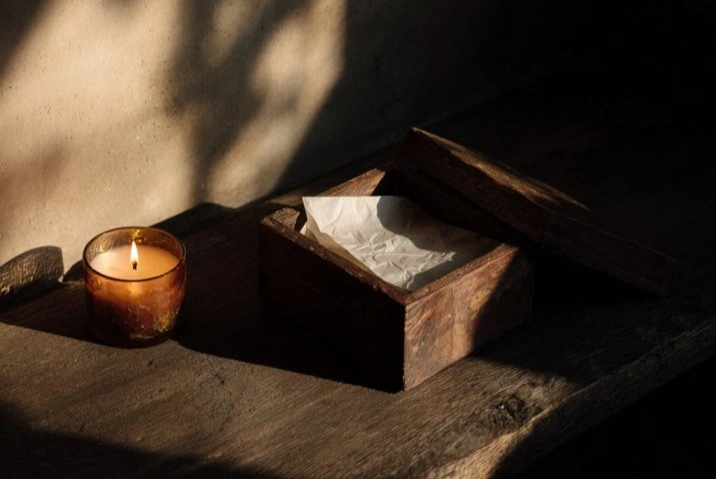
We are taught to think of a name as a label: a convenient handle, attached to us at birth and used by everyone else for their own convenience. Folk magic has never quite agreed. In the older understanding, a name is not a label at all. It is a link: a thread that runs back to the person who carries it. And a thread can be followed.
This is the quiet logic beneath a practice most witches meet early and rarely examine closely: the craft name. It is usually presented as a matter of taste, a chance to choose something more evocative than the name on your post. It is that. But it is also, and originally, a ward.
The Name as a Link
The principle is older than witchcraft and wider than any one tradition. The anthropologist James Frazer, surveying folk belief across the world in The Golden Bough, named two laws that magic seemed everywhere to assume. One of them (the Law of Contagion) held that things once connected continue to act upon one another after they are separated. A lock of hair, a worn garment, a signature: each remains, in this understanding, a working link to the person it came from.
Your name belongs to that list. It is, in fact, the most generous link of all, because you give it away constantly and to almost everyone. Hair and handwriting take some effort to obtain. A name is offered at the first introduction.
The folklore that grew up around this is remarkably consistent across cultures. In Egyptian myth, the goddess Isis gains power over the sun god Ra by tricking him into surrendering his secret, hidden name: the name beneath the name he is known by. The Brothers Grimm gave us Rumpelstiltskin, where knowing the creature's name is the whole of the victory; folklorists catalogue that story and its many cousins under a single tale type, "The Name of the Supernatural Helper." Across traditions with no contact between them, the same instinct surfaces: a true name is power, and a true name kept back is power kept safe.
Why Witches Take a Craft Name
This is where the craft name stops being decoration.
I have published under the name Rowenna for years. It is not the name on my bank cards, and the difference is not an accident of branding. A legal name is a bureaucratic object: it sits on databases, contracts, the electoral roll, a hundred forms you did not choose to fill in. It is exposed by design. A craft name is the opposite: a name you choose, deliberately, and carry into the one space where you most want your intention clean and your attention undivided.
Held that way, a craft name does two things at once. It draws a working boundary around the practice: when you sit down as your craft self, you are setting aside the self that answers emails. And it keeps your most exposed name (the legal one, already scattered across the public record) held back from magical space. Not because a stranger will otherwise curse you, but because a practitioner who keeps something back is practising discretion, and discretion is the foundation every other ward is built on.
This is why a craft name chosen only for its sound misses half its purpose.
The name matters less than the keeping of it.
A plain craft name you actually guard is a stronger ward than a beautiful one you announce on every profile you own.
Practical Ways to Ward Your Name
Warding a name is mostly a matter of attention, not ritual. A few practices, in rough order of how much they ask of you:
Keep the craft name genuinely uncoupled. The ward only holds if the two names are not trivially connected. A craft name listed beside your legal name, your face, and your town is not a ward; it is a second label. Keep the link between them something you give deliberately, to people you choose, rather than something a search engine assembles for free.
Make a sigil of it. An old and satisfying practice is to distil a name down to a single mark (a sigil) which then stands in for the name without spelling it out. A sigil of your craft name can be drawn inside the cover of your grimoire, or kept as a small protective mark, carrying the name's intention without leaving it legible. Grimoire's Sigil Forge is built for exactly this kind of quiet, personal work.
Keep your name, rather than guard it. If you want a working, keep it gentle: write your full name on a slip of paper, fold it once toward yourself, and keep it somewhere contained and safe: a box, a book, a drawer that closes. The gesture is small and the meaning is plain. This name is mine; I am keeping it close. You are not building a fortress. You are simply deciding that your name lives somewhere you have chosen.
Notice where your name already travels. Your signature is a name and a piece of handwriting at once: two links in one mark. None of this needs to alarm you. It is enough to know it, and to sign, speak, and share your name a little more deliberately than habit alone would.
A Note on Proportion
It would be easy to read all of this and grow watchful: to flinch when a stranger says your name, to wonder what a careless mention might set loose. Resist that. It is the opposite of what warding a name is for.
Your name is spoken constantly, by people who mean nothing by it, and it carries nothing on those currents. Folk magic has always held that intention is what gives a working its force; and a name said idly, with no will behind it, is just a sound. The witch who startles every time her name is spoken has not warded her name. She has only frightened herself, which is its own kind of unguarded.
The real ward is not vigilance. It is a calm, deliberate relationship with your own name: knowing it is a link, choosing what you put forward and what you keep, and then living easily, because the choosing is already done. A name well warded is one you can finally stop thinking about.
Sources
- James George Frazer, The Golden Bough: A Study in Comparative Religion, Macmillan (1890): the Law of Contagion: things once in contact continue to act on one another at a distance. Set out in Chapter III, "Sympathetic Magic.", Wikipedia
- "The Legend of Ra and Isis": the Egyptian myth in which Isis gains power over the sun god by learning his secret name; recorded in hieratic on the Turin Papyrus. English translation in E. A. Wallis Budge, Legends of the Gods (1912). Internet Sacred Text Archive
- Jacob and Wilhelm Grimm, "Rumpelstilzchen" ("Rumpelstiltskin"), Kinder- und Hausmärchen, 1st ed. 1812, tale no. 55: classified in the Aarne–Thompson–Uther Index as tale type ATU 500, "The Name of the Supernatural Helper." Wikipedia
More from the Blog

How to Build a Daily Spiritual Practice Without Burning Out
The practices that last are the ones that fit inside a real life. How to build a daily spiritual practice without burnout.

The Olfactory Ghost: A Formulation Guide
Most occult books treat scent like a lookup table: cinnamon for wealth, lavender for peace. Here is how to build a layered three-tier formula that actually holds, with evaporation rates, percentages, and honest herb safety.
Begin your practice
Grimoire is available now on Android and as a web app. Start today.