Sabbats
Yule for Solitary Witches: Marking the Solstice Alone
Rowenna
Solitary witch and the founder of Grimoire. Built the app she couldn't find anywhere else. Writes about the craft with primary sources, honest lineage notes, and a low tolerance for vague correspondences. Based in the UK with more herbs than shelf space.
· 8 min read
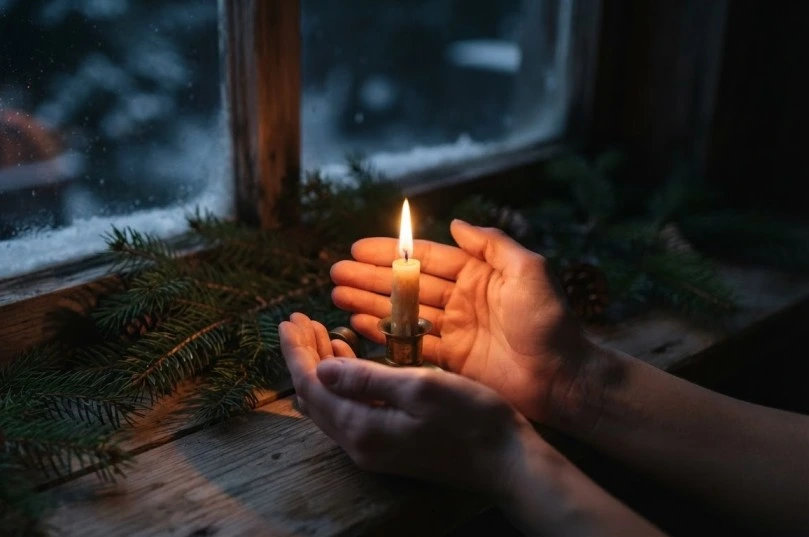
Yule can feel like the loudest sabbat to celebrate alone. The wider culture spends the whole season insisting midwinter is a communal, family-filled, crowded sort of time, and a solitary witch can end up marking the solstice with one eye on everyone else's gathering. That comparison does the night no favours. Yule at its oldest is about the dark and the return of the light, which is exactly the kind of quiet, internal turning that solitary practice does best.
This is the latest in the Grimoire series on keeping the sabbats alone, alongside the pieces on Beltane, Litha, Lughnasadh, Mabon, and Samhain. Yule asks for something different from Samhain's threshold work or Mabon's harvest reckoning: it asks for warmth kept deliberately, light kindled on purpose, in the year's longest dark.
What solitary Yule is actually for
The winter solstice is the year's turning point, the night the dark stops winning and the light, however slowly, begins its return. Working alone at Yule is not a lesser version of a group celebration. It is its own complete practice: a private vigil for the turning, kept by the person who notices it happens whether or not anyone gathers to mark it. The solitude suits the occasion. The solstice itself is a quiet astronomical fact, not a party, and a single candle held through the dark hours honours that as well as any crowd could.
A simple solitary Yule ritual
You do not need elaborate materials. A candle, some evergreen if you can get it, and an hour of your evening will carry the whole working.
Darken the room. Before anything else, sit for a few minutes in a room with the lights off, by a window if you have one facing the dark. Let yourself actually feel the length of the night. This is not meant to be unpleasant. It is the whole point: you cannot properly welcome the returning light without first sitting honestly in its absence.
Light one candle. When you are ready, light a single candle, ideally timed as close to your local sunset or to midnight as you can manage. Say something simple as you do it, in your own words: an acknowledgement that the dark has reached its depth and the light is about to turn. There is no required wording. The candle is doing the work.
Bring in the evergreen. A sprig of holly, pine, or ivy on the altar or windowsill is a genuinely old midwinter custom, evergreen brought indoors as a reminder that something in the world stays green through the dark months. Set a small piece where you will see it.
Sit with the turn. Spend a little time simply with the candle and the dark window: think back over the year now closing, and forward, gently, to the light's slow return. This does not need to be elaborate. Sitting with the turning point, alone and attentive, is the ritual.
Keep the light burning a while. Let the candle burn for a stretch before you put it out, rather than snuffing it the moment the working ends. The longer light, however small, is itself the working: the returning sun does not arrive all at once either.
Warmth without company
Solitary Yule benefits from deliberate comfort in a way some of the other sabbats do not ask for as directly. This is the coldest, darkest stretch of the year, and looking after yourself physically is part of the practice, not separate from it. Make something warm to eat or drink as part of the evening. Wrap in something soft. Keep the room actually warm rather than just symbolically candlelit. The old midwinter festivals were, among everything else, about surviving the hard season together, and marking that alone is honoured by treating your own comfort as worth the effort, not as an afterthought to the ritual.
If the solitude feels heavy tonight
Some solitary Yules will feel purely restful. Others, particularly if this is a hard season for other reasons, may bring the solitude into sharper focus than usual. That is worth naming plainly rather than glossing over. If the quiet of the night starts to feel like loneliness rather than solitude, it is entirely in keeping with the craft to reach out: a call to a friend, a message to another practitioner, even just having the radio on low while you keep the rest of the ritual. Solitary practice is a chosen shape for your craft, not a rule that you must be isolated to do it properly. There is no purity test in sitting alone with a candle. If company would help tonight, let it.
Journal prompts for the longest night
If you want to take the reflection further than the candle alone, a few questions to write against, not to answer neatly, just to sit with honestly.
What did this year actually ask of me, and what did I give it? What is this year finished with, that I am still carrying out of habit rather than need? Which small comfort got me through the hardest stretch of the dark months, and how do I keep it close through the rest of winter? Where is a small light already trying to start, even if it is too soon to see much of it yet? What do I want the returning year to find different, when it arrives?
Closing the working
When you are ready to end the evening, thank the returning light in whatever words feel honest, and let the candle finish burning down or put it out with care. Keep the evergreen up through the rest of the dark season if you like, a small reminder of the promise the solstice makes: that the light is already turning back, even on the nights it is hardest to believe.
Questions
How do I celebrate Yule alone? Keep it simple: darken the room to sit with the length of the night, light a single candle near sunset or midnight to mark the sun's turning, bring in a sprig of evergreen, and spend a little time reflecting on the year closing and the light's slow return. No elaborate materials or group are needed; the quiet attention is the ritual.
What should I do for solitary Yule if I feel lonely? It is entirely in keeping with solitary practice to reach for company if the night needs it, a call or message to someone, or simply having low background noise while you keep the ritual. Solitary practice is a chosen shape for your craft, not a requirement to be isolated, and there is no rule against easing the solitude when it feels heavy.
What is the significance of the winter solstice for witches? The winter solstice marks the year's longest night and the turning point after which daylight begins to lengthen again. It represents the return of the light from its lowest point, making it a natural time for reflection on the closing year and for rituals that welcome the light's slow comeback.
Do I need special tools for a solitary Yule ritual? No. A single candle and, if you can get it, a sprig of evergreen are enough to carry the whole working. The practice is built around attention and simple symbolism rather than equipment, which makes it easy to keep even with minimal preparation.
However you spend the longest night this year, the return of the light does not depend on how many people are in the room to welcome it. One candle held with attention does the work. For the deities of the season and the wider Yule series, the companion pieces in this series carry the rest of the festival.
Sources
For the history of bringing evergreen indoors at midwinter: Ronald Hutton, The Stations of the Sun: A History of the Ritual Year in Britain (Oxford University Press, 1996).
Grimoire is a digital practice companion for the solitary witch: a spell builder, sacred calendar, private grimoire journal, herbology compendium, and daily tarot, all in one place. Now available on Android.
More from the Blog
Yule Deities: Gods of the Winter Solstice
Yule deities of the winter solstice: Norse Odin, Roman Saturn, the Holly and Oak Kings, and honest notes on which are ancient and which are modern.
Beltane Energy and Intentions: What to Manifest at the Fire Festival
Beltane is the sabbat of commitment and full bloom. Here's how to work with its energy intentionally, and what it's most potent for.
Begin your practice
Grimoire is available now on Android and as a web app. Start today.