Practice
Cord Cutting: How to Release an Attachment Without Severing the Person
Rowenna
Solitary witch and the founder of Grimoire. Built the app she couldn't find anywhere else. Writes about the craft with primary sources, honest lineage notes, and a low tolerance for vague correspondences. Based in the UK with more herbs than shelf space.
· 8 min read
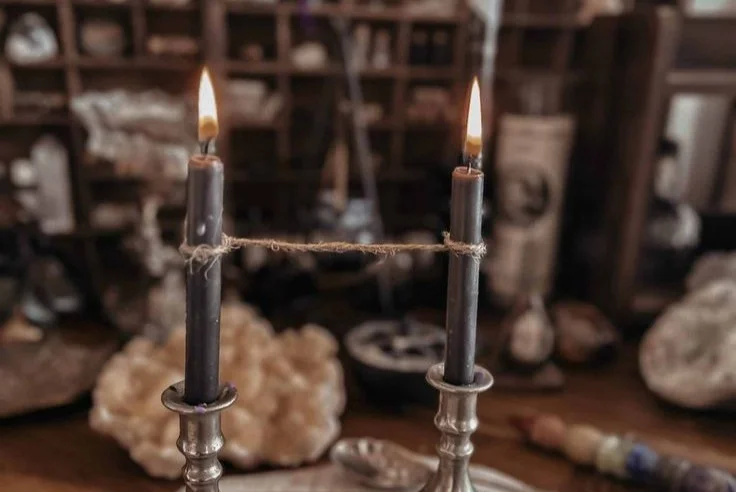
There is a particular kind of tiredness that comes from carrying someone who is no longer in the room. You finish with a person, or a friendship ends, or a parent dies, and still some thread of you reaches for them. You rehearse conversations they will never hear. You feel the pull of them in your chest when their name surfaces. The relationship is over and the connection is not, and that gap is where most of us live for a while.
Cord cutting is the practice of tending to that thread. Not slicing a person out of your life with a dramatic flourish, but acknowledging the energetic line you still run to them and choosing, gently and deliberately, to take your end of it back. I want to be honest with you about what it is and what it is not, because a great deal of what gets written about it online quietly promises the wrong thing.
What an energetic cord actually is
The idea is old and it is simple. When we form a strong bond with someone, the tradition holds that a kind of energetic line forms between us, a cord we feed with attention and feeling. With the people we love and want in our lives, that cord is nourishing and we leave it be. The trouble comes with the bonds we have outgrown, the ones that drain us, the ones that tie us to someone who hurt us or to a version of a relationship that no longer exists. Those cords keep pulling energy across a bridge that leads nowhere good.
Cord cutting is the act of releasing your side of that line. I think of it less as cutting and more as untying, which is why it sits so close to knot magic in my own practice. You are not destroying anything. You are setting it down.
The thing I need to say plainly
A lot of people come to cord cutting hoping it will do something to the other person. They want the ex to feel the loss, or to come back, or to finally understand. I have seen the searches, and I understand the ache underneath them, but I will not pretend the practice works that way, because it does not and because wanting it to keeps you tied to them more tightly than any cord ever could.
Cord cutting is yours. It works on your attachment, your end of the line, your nervous reaching toward someone who is gone. It does not control them, punish them, summon them, or send them a message. If what you actually want is for someone to come back, this is not that working, and any honest witch will tell you the same. What cord cutting offers is quieter and more useful: it gives you back the energy you have been pouring across the bridge, so you can stand in your own life again.
If you find that you cannot want to release someone, that the wanting-them-back is louder than the wanting-to-be-free, that is worth sitting with rather than ritualising past. Sometimes the kindest thing is to wait until you are actually ready to let go, and to find a person to talk to in the meantime. This is reflective spiritual practice, and it sits alongside grief and support, never in place of them.
A simple cord cutting meditation
You do not need tools for this. You need a quiet half hour, a door you can close, and the willingness to be honest with yourself for the length of it. If you want to mark it with a candle, a plain white one is more than enough.
Sit comfortably and let your breath settle. Bring the person to mind. Not the story of them, not the argument you keep rehearsing, just the felt sense of the connection between you. Let yourself notice where in your body you feel the pull. Most people find it in the chest or the belly. Picture the cord running from there to them, and look at it honestly. Notice what colour it is, how thick, how taut.
Then, in your own words, acknowledge it. Thank it if you can, because most cords were love once, even the ones that curdled. Tell it that you are taking your end back now. When you are ready, see the cord dissolve, or untie, or fall away, whatever image comes naturally to you. Do not force a violent severing if it does not want to come; a knot loosened is as final as a rope cut. Draw your own energy back into yourself and feel the place where the cord was begin to close.
Sit for a moment in what remains. Then open your eyes, and do something ordinary and kind for yourself.
The closing matters as much as the cutting.
Working with the dark moon
If you want to give the practice a container, the waning and dark moon are the traditional time for release work, the part of the cycle when things are meant to be let go rather than drawn in. I find the discipline of a marked time helpful. It turns an open wound into an appointment, something you do deliberately on a particular night rather than something you keep half-doing every time their name comes up. You can pair the meditation with reflective prompts if it helps you find the honest shape of what you are releasing.
How you know it is working, and what comes after
People often ask how to tell if a cord cutting has worked. The honest answer is that it is rarely a thunderclap. You will not usually wake up cured of someone. What you tend to notice, over days and weeks, is that the pull is quieter. Their name surfaces and your chest does not lurch. You go a morning without the rehearsed conversation. The energy you were spending on the bridge is back in your own hands, and you find you have a little more of yourself to give to your actual life.
Sometimes one cutting is enough. More often, with a deep attachment, you do it more than once, because we re-tie these cords without meaning to. That is not failure. It is just the work being honest about how grief actually goes.
Questions
Does cord cutting affect the other person?
No, not in the way people hope. It works on your own attachment, not on them. It will not bring someone back, make them feel anything, or reach them at all. It is a practice you do for yourself, to release your side of a connection.
When is the best time to do a cord cutting?
The waning or dark moon is traditional for release work, but the truthful answer is whenever you are genuinely ready to let go. Doing it before you mean it tends not to take.
Do I need any tools or to be experienced?
No. A quiet room and an honest half hour are enough. A plain candle if you like, but the work is internal, not in the objects.
What if I cannot bring myself to release them?
Then do not, yet. That reluctance is information, not a problem to ritual your way past. Sit with it, and reach for a person to talk to if the grief is heavy. The practice will keep.
Closing
I have done this working for people I loved and for people I should never have let close, and the strange grace of it is the same either way: you stop bracing against someone's absence and start living in your own presence again. The cord was never really about them. It was about how much of you was still turned in their direction.
If you keep a practice like this, it helps to have a quiet and private place to do it in. Grimoire's Meditation space holds a guided cord cutting and a private record of what you have set down, kept private to your account, for whenever you need to release something again.
Sources
Cord cutting is a folk and contemporary energy-work practice rather than a doctrine drawn from a single primary text; the account here reflects how it is commonly taught and how I work with it, not a peer-reviewed reference.
More from the Blog
Shadow Work with Hecate: Meeting the Goddess of the Crossroads
Shadow work with Hecate, goddess of crossroads and thresholds: who she is, why she suits the work, and how to begin a practice with her at the dark moon.
Shadow Work with the Morrigan: Sovereignty, Fate, and the Necessary Ending
Shadow work with the Morrigan, Irish goddess of sovereignty, fate, and war: who she is, why she suits the work of facing what must end, and how to begin.
Begin your practice
Grimoire is available now on Android and as a web app. Start today.