Practice
Shadow Work with Hecate: Meeting the Goddess of the Crossroads
Rowenna
Solitary witch and the founder of Grimoire. Built the app she couldn't find anywhere else. Writes about the craft with primary sources, honest lineage notes, and a low tolerance for vague correspondences. Based in the UK with more herbs than shelf space.
· 9 min read
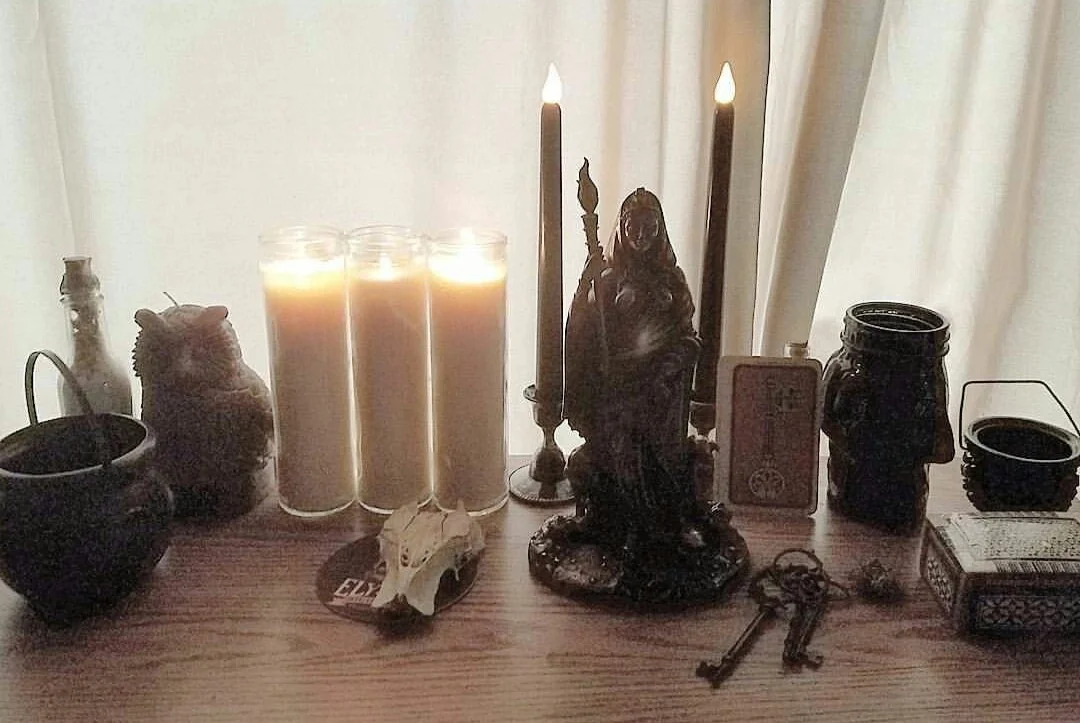
Most mornings I sit for a little while in front of a small altar to Hecate before the day gets its hands on me. There is not much on it: a key, a pair of candles, a dish for clean water, an image of her three faces. I do not usually ask her for anything in particular. I sit, and I let the quiet settle, and more often than not the thing I have been avoiding all week is what surfaces first. That is the part of her I have come to trust. Hecate does not look away from what is difficult, and over the years she has taught me not to look away either.
That habit of not looking away is the whole of why I bring shadow work to her in particular. This page is about that pairing: who Hecate is in the old tradition, why she suits the work of meeting your own buried material, and how you might begin a practice with her of your own. I will keep the history honest and the practice plain.
One thing to set down at the start. This is devotional and reflective practice, a way of working with a deity and with yourself, and it is not therapy. It sits alongside that kind of help; it does not stand in for it. I will come back to where that line falls, because it matters more here than almost anywhere else.
Who Hecate Is
In Greek tradition she was a goddess of the crossroads and the threshold, of boundaries and doorways and the uneasy ground between one place and the next. The World History Encyclopedia describes her domain as the liminal: witchcraft and magic, the moon, doorways, boundaries and the meeting of roads. She belonged to the night and to the creatures of it, and she kept company with the restless dead; offerings to her were left at crossroads and junctions, at any sort of boundary or threshold. In her later images she is triple-formed, three bodies standing back to back so that she faces every direction at once, and she carries torches and keys and is followed by dogs. Britannica records the same crossroads pillars raised in her name, the burning torches, the packs of barking dogs, and her standing as the goddess presiding over magic and spells.
It is worth holding the keys and the torches in mind, because they are not decoration. A key opens and a key shuts. A torch is carried into the dark by someone who means to come back out of it. These are the tools of a goddess who works at thresholds, and they turn out to be the right tools for this work too.
Why Hecate Suits Shadow Work
Here is where it becomes more than mythology to me. The shadow, in the sense the wider guide uses, is the disowned part of a person: the traits, needs and griefs we decided long ago were not acceptable and pushed underground. You do not meet that material in the bright middle of your life. You meet it at the edge, at the threshold, in the half-lit places you would rather walk past. And the threshold is exactly where Hecate stands.
Most descriptions of shadow work ask you to descend alone. Light your candle, open your page, go down into the dark by yourself and come back up with whatever you found. I have done it that way, and it works, but it can be a lonely arithmetic. Working with Hecate reframes the shape of it. You are not climbing down into the dark on your own; you are being accompanied to the boundary by the one figure in the old stories who does not flinch at what waits there. She is not going to do the work for you, and she does not rescue. But she stands at the crossroads while you look at what you came to look at, and that company changes how much you can bear to see.
She does not make the dark smaller. She makes it less lonely to stand at the edge of.
The pillar calls the real aim of this work integration: not banishing the exiled part but letting it back inside the circle of who you are willing to be. Hecate, to me, is a fitting patron for that turn. She is a goddess who holds opposites together without forcing them to resolve, who keeps the gate between the living and the dead and is diminished by neither. Sitting with her, the point stops being to get rid of the difficult thing and becomes to bring it home.
A Thin Place
There is a place in London I go when I want this work to have a little more weight than my own front room can give it. In Brompton Cemetery, off the Old Brompton Road, there is a Victorian mausoleum that people know as the Courtoy Mausoleum. It stands where several paths cross, a heavy bronze door set into pale stone, and it is the resting place of three women. Three rowan trees ring it, and there are almost always crows somewhere nearby: on the roof of it, in the branches, or stepping about on the grass with that unbothered way they have.
I do not need to spell out the resonance. Three women, three rowans, a tomb on a crossing of paths, the dark birds: anyone who has spent time with Hecate will feel the shape of it without my pointing. I will say only that it is the kind of place where the symbolism arranges itself, and leave the meaning to you.
There are stories told about the spot, and I want to be careful to give them as stories. Some say it sits on a line that joins it, leyline-fashion, to the Tower of London and to the mound where Boudicca is supposed to be buried, and a few go further than that, into talk of the mausoleum being a sealed time machine and stranger things besides. I have no idea whether any of that is true, and I rather suspect not. What I can tell you is only what I feel when I am there, which is that the border between one kind of space and another seems thin, the way it does in a few old places. That is a personal sense and nothing more. I offer it as mine, not as fact.
So I sit with it. I find a quiet bench within sight of the stone, and I let the cemetery be what it is: the crows, the wind in the rowans, the particular hush a large old burial ground keeps even with the city running close on every side. I do my sitting, and I keep what passes between me and the place to myself, as I think this kind of thing is mostly meant to be kept. You do not need this cemetery, or any cemetery, to do the work that follows. A thin place is a gift when you find one. It is not a requirement.
How to Begin Shadow Work with Hecate
Most of this practice belongs at home, in whatever space you can make quiet. Here is how I would start if I were starting now.
Make a space. It does not have to be elaborate. A shelf, a corner of a table, a cloth laid down for the occasion: somewhere you can return to that is set apart from where you answer emails. If you want to mark it as hers, her old symbols are easy and undemanding ones to keep: a key, a candle or two for her torches, a dish of clean water. Keep any offerings simple and respectful. A candle lit for her and fresh water are enough; you are beginning a relationship, not paying a toll.
Choose her time. The dark moon, the night before the new crescent when the sky gives nothing back, has long been the witch's inward phase, and it suits this work and this goddess both. It gives the practice a natural container: one night a month you sit with her, and the rest of the month you let the work rest. The calendar paces you so that willpower does not have to.
Sit before you speak. I begin with a few minutes of plain meditation, long enough for the day to loosen its grip. Then a simple address, in your own words, is worth more than a borrowed invocation you do not feel. Tell her honestly why you have come. Set your intention as company rather than rescue: ask to be accompanied to the edge of what you are avoiding, not to be spared the looking. That distinction is most of the practice.
Then do the reflective work itself. This is where shadow work proper begins, and a set of prompts grouped by theme will give you somewhere honest to start. Pick one, not ten. Write the first answer rather than the tidy one. Let her presence be the thing that lets you stay with a question a little longer than you would alone.
Close deliberately. Her keys are not only for opening. When you are done, shut the work as cleanly as you began it: thank her, put the candle out, and let the threshold close behind you. I find this matters more with deity work than without it. The gesture tells a part of you older than language that the gate is shut and the digging has edges, so the shadow does not trail you into the rest of your day.
Pacing and Respect
Two things to hold the whole way through, and I would rather over-say them than leave them out.
The first is pacing, and it is the same caution the prompts guide gives. Shadow work has no prize for depth reached quickly, and the company of a deity does not change that. If a session opens something larger than the night can hold, that is the signal to stop, not to press deeper. Close the work, put the candle out, and do something ordinary and grounding: a glass of water, a walk, the washing up. And if what surfaces is more than reflective practice was built to carry, if you find yourself returning to memories that overwhelm rather than inform you, or thinking of hurting yourself, then the next step is not a deeper working. It is a person: a therapist, your doctor, someone trained to hold what a journal and a candle cannot. Working with Hecate does not replace that help, and reaching for it is not the practice failing. It is self-knowledge doing its job.
The second is respect. Working with a deity is a relationship, not a vending machine. You approach with humility, you give honestly, and you accept that you are not owed a particular result for your trouble. I make no promises here about outcomes, and I would be wary of anyone who does. What I can say is that approached this way, as a relationship rather than a transaction, the work tends to deepen on its own terms and in its own time.
Questions
Do I have to be a Hellenic polytheist to work with Hecate?
No. Plenty of people who work with Hecate come to her from outside Hellenic polytheism, and she has a long history of being met by witches and folk practitioners who hold no formal pantheon at all. What matters more than the label is the respect you bring. Read a little about who she was in the tradition, approach her honestly, and let the relationship teach you the rest.
When is the best time to do shadow work with Hecate?
The dark moon is the natural choice: the night before the new crescent, when the sky gives nothing back, has long been the inward phase of the witch's month, and it pairs well with both this goddess and this work. It also paces you, one night a month rather than every night. That said, the calendar is a help and not a rule. If you need to sit with her at another time, the work will still meet you.
What can I offer Hecate?
Keep it simple and sincere. A candle lit for her, a dish of clean water, perhaps a key kept on her altar are all traditional and undemanding. The older sources mention food left at crossroads, but you do not need anything elaborate or specific to begin. An honest offering given with attention is worth more than a lavish one given to tick a box.
Is working with Hecate safe for beginners?
For most everyday material, yes; this is gentle and steadying work, and beginners are welcome to it. The thing to watch is not the goddess but your own response to what surfaces. If each session leaves you more unsettled rather than steadier, slow down, and bring in another person rather than digging further alone. Begin small, close each session deliberately, and let the practice build slowly. There is no prize for rushing.
I still keep my own practice plain: a few quiet minutes in front of her three faces, one honest question, the first answer rather than the tidy one. Hecate has not made the dark any smaller. She has only made it less lonely to stand at the edge of, and that, it turns out, was most of what I needed.
If you keep a practice like this, it asks for a private and contained place to live. Grimoire's Shadow Work space keeps your prompts, your sessions and your devotional notes together and stored only on your device, with a Deity Journal close at hand for the relationship that grows alongside the work, so the page you write on stays as private as the work deserves.
Sources
- Mark Cartwright, Hecate, World History Encyclopedia (2017): goddess of crossroads, boundaries and the liminal, associated with the moon, the night and the restless dead, carrying torches and keys and followed by dogs, with offerings left at crossroads and thresholds, worldhistory.org/Hecate
- Hecate, Encyclopaedia Britannica: the chief goddess presiding over magic and spells, triple-formed, with crossroads pillars (Hecataea), burning torches and accompanying dogs, britannica.com/topic/Hecate
- Carl Jung, Aion: Researches into the Phenomenology of the Self, Princeton University Press (1951, Collected Works Vol. 9, Part II): the shadow as the disowned material a person must meet and integrate to become whole, Internet Archive
More from the Blog

Shadow Work Prompts: 30 Questions to Begin (and How to Use Them)
Shadow work prompts for solitary practice: thirty questions grouped by theme, plus how to use them safely and pace the work. A gentle, grounded guide.
Cord Cutting: How to Release an Attachment Without Severing the Person
Cord cutting meditation and ritual for releasing an old attachment: what it is, what it cannot do, and a simple practice for taking your energy back.
Begin your practice
Grimoire is available now on Android and as a web app. Start today.