Astrology
Eclipse Season 2026
Rowenna
Solitary witch and the founder of Grimoire. Built the app she couldn't find anywhere else. Writes about the craft with primary sources, honest lineage notes, and a low tolerance for vague correspondences. Based in the UK with more herbs than shelf space.
· 9 min read
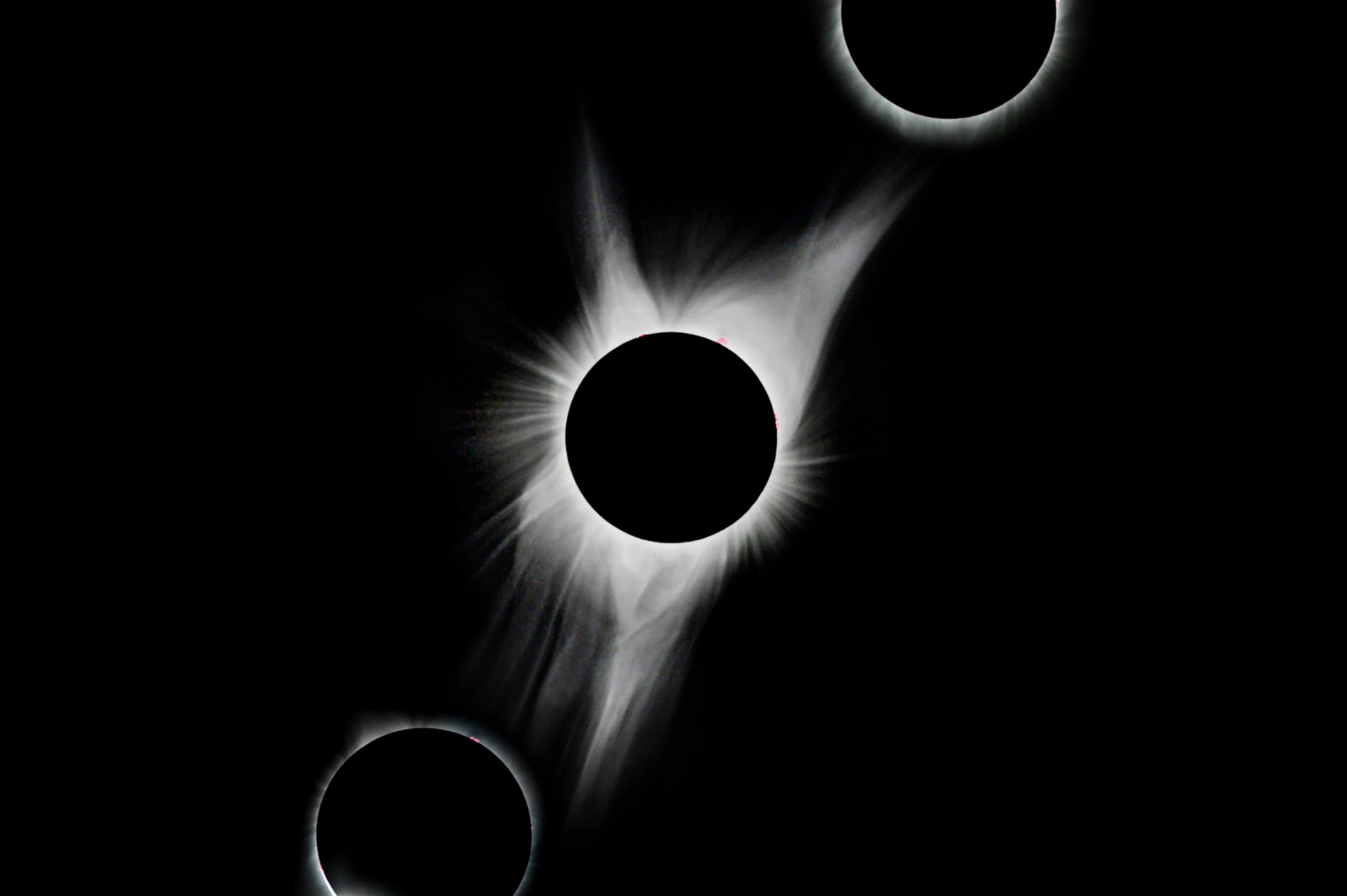
Tomorrow, 12 August, a solar eclipse crosses Leo at 20°. On 27 August, a lunar eclipse closes at 4°53' in Pisces. These two eclipses bracket the month and together constitute one of the year's most structurally significant astrological moments: the closure of one eighteen-month nodal cycle and the opening of another. If you want to work with August intentionally rather than be caught off guard by it, this piece is the briefing.
Eclipses this year follow on from the seasonal work in Cancer Season and Leo Season, and their themes continue into Virgo Season, which opens on 22 August. All three seasonal pieces carry eclipse context. This one carries the eclipse coverage itself.
What eclipses actually are
An eclipse happens when the Sun, Earth, and Moon align at one of the lunar nodes: the two points where the Moon's orbital path crosses the ecliptic, the Sun's apparent path through the sky. At a solar eclipse, the Moon sits directly between the Earth and Sun, fully or partially blocking the Sun's light. At a lunar eclipse, the Earth sits between the Sun and Moon, and the Earth's shadow falls across the full Moon. Both are ordinary astronomical events. What makes them astrologically significant is where in the zodiac they fall.
The lunar nodes move slowly and retrograde through the zodiac, spending roughly eighteen months in each sign pairing. During that eighteen months, every new moon and full moon that falls close enough to a node becomes an eclipse. The solar eclipses (which fall at new moons) tend to carry more initiating energy; the lunar eclipses, at full moons, tend to carry more releasing energy. And because the nodes define the axis, every eclipse on a given axis is part of a family of related events stretching back and forward across years. A solar eclipse at 20° Leo does not arrive without precedent, and it will not leave without consequence.
The standard teaching in modern astrology is that an eclipse plants a seed (or cuts one) whose full implications take up to six months to unfold, with another six months for integration. When an eclipse falls close to a sensitive point in your natal chart, the timing can be precise and the effect pronounced. When it falls in open sky with no natal contact, you may feel only the ambient intensity of the season rather than anything specific. Both experiences are normal.
The Solar Eclipse in Leo: 12 August, 20°
This is the first eclipse on the new Leo/Aquarius nodal axis, which opens properly in mid-2026 and will run through March 2028. That makes tomorrow's eclipse a genuine beginning: the first event in a cycle that will produce eclipses across the Leo/Aquarius polarity for the next eighteen months. Whatever is initiated under it (in the world, in collective patterns, and in individual lives where the eclipse hits a natal point) will develop and resolve across that entire period.
The themes of Leo are self-expression, visibility, creative confidence, and the courage to occupy the space you are entitled to. Leo rules the heart, the will, and the performance of the self: not performance in the pejorative sense, but the genuine and necessary act of letting what is inside become visible outside. A solar eclipse in Leo intensifies precisely these questions. Where have you been dimming yourself? What would it cost you to be fully seen? What creative impulse have you been treating as too small to take seriously?
Its axis partner is Aquarius, and the Leo/Aquarius polarity is always about the tension between the individual and the collective: between the person's singular expression and the community or systems they belong to. Over the next eighteen months, eclipses on this axis will repeatedly ask where those two things are in conflict and where they could be in alignment. The individual voice finding its place in the larger conversation. The single creative act finding its audience.
If you have natal planets or angles between roughly 15° and 25° of Leo, Aquarius, Taurus, or Scorpio (the fixed signs) this eclipse is most likely to be personally precise. For guidance on reading eclipses against your own chart, see How to Read Your Natal Chart.
The Lunar Eclipse in Pisces: 27 August, 4°53'
Where the Leo solar eclipse opens a new cycle, the Pisces lunar eclipse closes one. The Pisces/Virgo nodal axis, which began generating eclipses in 2024, is reaching its end. This is one of the final eclipses on that axis, and a full moon eclipse at that: the most releasing kind.
The themes of Pisces are dissolution, surrender, deep intuition, and the softening of the boundaries we keep around the self. Pisces is where the individual consciousness edges toward something larger and less defined. A lunar eclipse here asks what you have been holding onto that no longer needs a defined container: what grief, what role, what story you told about yourself during the Pisces/Virgo years that has done its work and can now be let go.
The Virgo side of the axis is the counterweight. Virgo is the editorial mind, the discerning eye, the intelligence that sifts and refines. The Pisces/Virgo cycle that started in 2024 has been asking, in its own way, how intuition and analysis cooperate: where the dreaming mind and the working mind serve each other rather than fighting for the wheel. The lunar eclipse on 27 August is the formal close of that conversation. What it releases, it releases completely.
The 27 August eclipse also carries particular astrological density. It falls within hours of Mercury's annual cazimi in Virgo: the moment when Mercury aligns exactly with the Sun and reaches its peak of clarity. The Pisces eclipse and the Virgo Mercury peak land on the same day, which creates an unusual juxtaposition: the unconscious surfacing fully at the precise moment the rational mind is at its sharpest. What you notice on 27 August, you are equipped to understand. Write it down.
How to work with an eclipse season
The most useful thing to know about eclipses is also the thing most eclipse content gets wrong. Eclipses do not predict events. They intensify what is already in motion.
What an eclipse typically does is remove an obstacle, force a decision that was already implicit, or accelerate a development that was already underway. The job or relationship that ends under an eclipse was already under strain; the opportunity that arrives was already in the field. The eclipse did not manufacture the outcome; it removed the delay. This is an important distinction, because it means that preparing for an eclipse is not a matter of bracing for catastrophe. It is a matter of being honest about what is already in motion in your life, so that when the acceleration comes you are meeting it with your eyes open rather than your hands over your face.
The practical corollary is that the eclipse window is not a time for major initiations. Most working astrologers advise against launching significant new ventures, signing important contracts, or making major commitments in the weeks around an eclipse: not because the eclipse will curse them, but because the ground is genuinely unstable. Things you believe to be settled may shift. What looks like a clear path may bend. Waiting for the energy to settle before you act is not timidity. It is accurate timing.
The eclipse window for August runs from roughly late July through mid-September, with the most concentrated intensity between now and 27 August. During this window, favour observation over initiation. Take notes rather than taking action. Let what needs to move, move. The witch who tracks eclipses as attentive witness tends to get far more from them than the witch who tries to drive.
For lunar practice around the eclipse dates, see Working with the Moon. Note that eclipse new moons and full moons are generally not the moment for standard lunar spell work; the energy is too volatile to direct cleanly. Reserve those dates for observation, journalling, and honest accounting of what is moving in your life.
Common questions
Do I need to do anything on eclipse day? Not in the spell-working sense. The most valuable eclipse practice is keeping a journal in the days around each eclipse, noting what is shifting, what surfaces, what feels suddenly urgent or suddenly finished. The pattern often only becomes legible in retrospect, but the journal gives you something to read.
Are eclipses dangerous? No more than any other intensified moment. The "eclipses cause disasters" framing is a misreading of the tradition. What eclipses do is accelerate what was already in motion; and that can be difficult, or it can be liberating, depending entirely on what was in motion. The energy is not malevolent. It is simply fast.
What if the eclipse doesn't hit any of my natal planets? You will likely feel the ambient intensity of the season (the general sense that things are moving) without a specific personal event. That is a normal and perfectly valid eclipse experience. Not every eclipse is personally precise for every person.
Should I do a ritual on the eclipse? The eclipse new moon on 12 August and the eclipse full moon on 27 August are better held lightly than worked heavily. Sit with them. Observe. If you feel compelled to mark them, a simple candle and journal session is more than enough. Save the active working for after the season clears.
What comes next
The Leo/Aquarius nodal cycle that opens with tomorrow's eclipse will continue generating events (personal and collective) through March 2028. The individual and the collective, self-expression and the systems that contain it: these are the questions the next eighteen months will keep returning to. Virgo Season, opening 22 August, carries both the Mercury cazimi peak and the Pisces lunar eclipse's close. The full astrological picture of the season is in Virgo Season 2026.
Sources
Eclipse dates and degrees are per standard astronomical ephemeris. The interpretive framework draws on the modern horoscopic tradition, particularly the nodal-cycle and eighteen-month-resonance teachings standard in contemporary astrological practice. For natal chart work alongside eclipse transits, see How to Read Your Natal Chart.
Grimoire is a digital practice companion for the solitary witch: a natal chart tool, daily tarot, sacred calendar, herbology, deity work, and a private grimoire journal, all in one place. Now available on Android.
More from the Blog

Leo Season 2026: A Witch's Guide to the Sun in Leo
Leo Season 2026 (22 July to 22 August). What the Sun in Leo means, why this year's season carries unusual depth with the South Node entering Leo and a total solar eclipse on 12 August, and how to work with it in your practice.

Virgo Season 2026
Virgo Season opens 22 August and brings the year's most important window for editing, refining, and making the work precise. A complete guide to 2026's Virgo Season — the Mercury cazimi and lunar eclipse on 27 August, the Jupiter-Saturn trine on 31 August, rituals, correspondences, and how to use the season well.
Begin your practice
Grimoire is available now on Android and as a web app. Start today.