Astrology
How to Read Your Natal Chart for the First Time
Rowenna
Solitary witch and the founder of Grimoire. Built the app she couldn't find anywhere else. Writes about the craft with primary sources, honest lineage notes, and a low tolerance for vague correspondences. Based in the UK with more herbs than shelf space.
· 10 min read
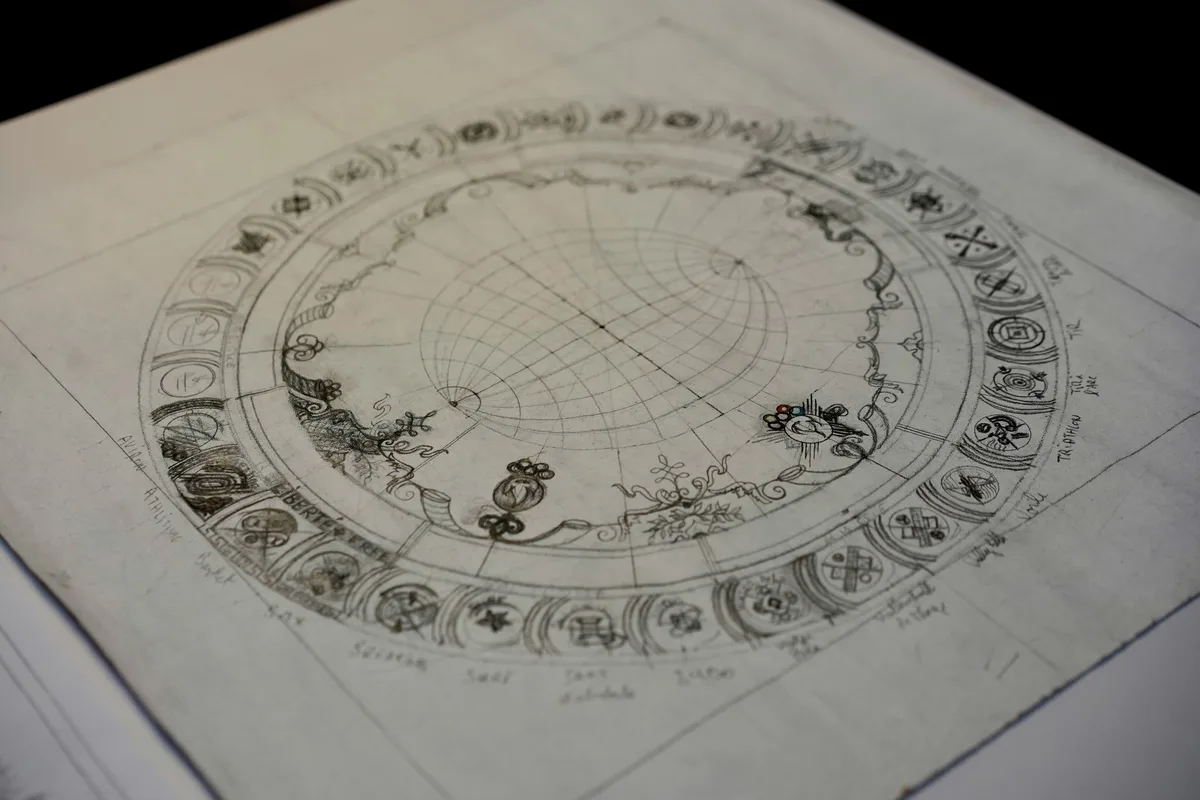
There is a map of the sky at the exact moment you were born.
It records where the Sun was, and the Moon, and every planet then visible. It notes which sign was rising over the eastern horizon at your precise location and time. It divides the sky into twelve houses, each corresponding to a different domain of life. Every natal chart ever drawn has been unique to the person it describes; even twins born minutes apart will have charts that differ in meaningful ways.
This is the natal chart: not a personality test, not a prediction, and not a fixed sentence about who you are. It is a symbolic map. Learning to read it is learning a language: one that has been in continuous development for over two thousand years.
A brief history
The natal chart as we know it is a Hellenistic invention. According to the Internet Encyclopedia of Philosophy, the earliest surviving horoscopic chart pertaining to an individual is dated 410 BCE. The system emerged from a synthesis of Babylonian astronomical observation, Egyptian stellar tradition, and Greek philosophical inquiry: a convergence made possible by Alexander the Great's conquests in the 4th century BCE, which brought these cultures into sustained intellectual contact.
The foundational text of the Western astrological tradition is Claudius Ptolemy's Tetrabiblos (c.150 CE), written in Alexandria. It codified the zodiac signs, the twelve houses, the planetary rulerships, and the system of aspects into a framework that, as Wikipedia notes, "enjoyed almost the authority of a Bible among the astrological writers of a thousand years or more." Ptolemy's system was transmitted through Islamic scholars, reintroduced to medieval Europe via Latin translation in the 12th century, and taught in European universities through the Renaissance.
The practice has evolved considerably since then, but the core architecture of the natal chart (signs, houses, planets, aspects) remains Ptolemaic at its foundation.
What you need to begin
Generating your natal chart requires three pieces of information: your birth date, your birth time (as precise as possible), and your birth location.
The birth time is the most critical and the most often unknown. It determines your Rising sign and the arrangement of your houses: the most individually specific parts of your chart. Without it, you can still work meaningfully with your Sun and Moon placements, but a significant layer of the map is missing. Check your birth certificate if you're uncertain. Even an approximate time (morning, afternoon, late evening) gives you something to work with.
For chart calculation, Astro.com is the free resource used by professional astrologers worldwide; it calculates charts using the Swiss Ephemeris, the most precise astronomical data available. Inside Grimoire, the Horoscope feature generates a full natal chart and surfaces your Big Three placements automatically, which is useful if you want the chart in the same place you keep the rest of your practice.
The Big Three: Sun, Moon, and Rising
The three most important placements to understand first are your Sun sign, your Moon sign, and your Rising sign (also called the Ascendant). Together they are sometimes called the "Big Three": the core architecture of the chart.
The Sun represents your central identity: the self you are consciously building toward, your life's primary theme. It is the placement most people know. Sun sign horoscopes, which have dominated popular astrology since the early 20th century, are built on this placement alone, which is why they so often feel partial. The Sun is important, but it is one voice in a larger conversation.
The Moon represents your emotional nature: how you process feeling, what makes you feel secure, the inner life that exists beneath the surface of how you present. For many people, the Moon sign resonates more deeply than the Sun sign as a description of who they are, particularly those who live a rich inner life or who feel their Sun sign description misses something essential. If you want to deepen your Moon sign work specifically, Working with the Moon covers the daily lunar practice that pairs naturally with knowing your Moon sign.
The Rising sign (the Ascendant) is the zodiac sign that was on the eastern horizon at the exact moment and location of your birth. Ptolemy called it the horoskopos (the "hour marker") and considered it foundational to the chart's entire structure. It is the lens through which the whole map is read: your Rising sign determines the arrangement of your twelve houses, making it the most individually specific part of your chart. It also describes how you move through the world and how others first experience you: the "cosmic front door," as modern astrologers sometimes put it.
If you resonate with none of the standard Sun sign descriptions, try reading your Rising sign. Many people find it more accurate.
The twelve houses
Once you have your Rising sign, the twelve houses of your chart are arranged in sequence around the wheel. Each house governs a different domain of life. The sign on the cusp of each house, and the planets placed within it, describe how that domain of life tends to operate for you.
The first house is the house of self: the body, the physical appearance, the outward personality; it begins at the Ascendant. The second house governs resources, finances, and the things you value. The third covers communication, short journeys, and siblings. The fourth is the foundation: home, roots, family, the private self. The fifth is pleasure, creativity, romance, and children. The sixth covers health, daily work, and habits.
The seventh house is the house of partnerships: both romantic and professional. The eighth covers shared resources, transformation, and the depths: it is associated with inheritance, psychology, and the hidden dimensions of life. The ninth is the house of philosophy, long journeys, and higher learning. The tenth is the Midheaven: career, public reputation, and the life you build in the world's eyes. The eleventh covers community, friendships, and collective aims. The twelfth is the house of solitude, the unconscious, and what lies beneath the visible surface of the life.
You do not need to memorise all of this at once. Begin with whichever houses hold your Sun, Moon, or Rising, and work outward from there.
Planets
Beyond the Sun and Moon, your natal chart contains the positions of Mercury, Venus, Mars, Jupiter, Saturn, Uranus, Neptune, and Pluto (and, in some systems, asteroids and other sensitive points). Each planet represents a different principle or function of the self.
Mercury governs communication, thought, and the way you process information. Venus governs love, beauty, pleasure, and what you attract. Mars governs drive, desire, and how you take action. Jupiter governs expansion, philosophy, and where you tend toward abundance. Saturn governs structure, discipline, and the areas of life where you are asked to build slowly and with care.
The outer planets (Uranus, Neptune, Pluto) move slowly enough that entire generations share the same sign. Their house placement is where they become personal.
For the planetary rulerships in working practice (including which stones, herbs, and rituals correspond to each planet) see Astrology and Crystals: Beyond the Birthstone.
How to begin reading your chart
The most common mistake when first encountering a natal chart is trying to absorb everything at once. The chart is dense. Twelve signs, twelve houses, ten or more planets, and the angular relationships between them: this is a lifetime's study, not an afternoon's.
A better approach is to begin with a single question and follow the thread.
Start with your Rising sign: look at the sign on the first house cusp, and the planet that rules that sign. Where is that ruling planet in your chart? What house does it occupy? What sign? This single thread (your Ascendant and its ruler) will tell you more about the overall shape and direction of your life than almost anything else in the chart.
Then sit with your Moon sign. Read its description not as a personality label but as a question: where do I feel most at home? What does my inner world actually look like? The Moon describes the emotional needs that underlie all your behaviour.
Then your Sun: not as a fixed description but as a question about direction. What am I here to develop? What does it look like when I am fully myself?
From there, notice which houses hold multiple planets. Clusters indicate areas of life that carry particular weight for you.
Making it useful to your practice
A natal chart becomes most useful when read alongside direct experience. The chart offers a symbolic map; your life offers the territory. The relationship between the two is where understanding grows.
Track planetary transits (the movement of current planets across your natal positions) in your Daily Pulse. When a significant transit activates a natal planet, note what is happening in your life and how it correlates to the house and planet involved. Over time, these correlations build into a personal vocabulary.
Record your observations in My Craft. Astrology, like all practice-based knowledge, rewards documentation. What activated what. What coincided with what. Where the map matched the territory, and where it didn't. Your personal record of engagement with your chart becomes, over years, more useful than any textbook.
I have kept notes on my own transits for fifteen years. The most useful thing I learned early on was to stop trying to predict what a transit would bring and start noticing what actually happened. Saturn transiting my fourth house did not do what any book said it would do; it did what it did in my specific life, with my specific fourth house contents. The documentation is where the vocabulary becomes personal.
The summer solstice (Litha) is one of the most powerful times of the year to sit with your natal chart. The Sun at its most powerful moment, the light at its longest: it is a good time to ask which parts of your natal Sun placement you have most fully inhabited, and which parts are still waiting to be grown into. The solar deities of Litha are good company for that question.
Where the language begins
Every planet, sign, and house is a word in a symbolic language. You do not learn a language by memorising every word in the dictionary. You learn it by reading, by speaking, by making mistakes, by returning to the page.
Your natal chart will not tell you what will happen to you. It will tell you something true about the shape of your attention, the texture of your interior life, and the territory you are here to explore. That is a different kind of knowledge from prediction, and, for most practitioners, a more useful one.
Begin with the Rising sign. Begin tonight.
Sources
- Internet Encyclopedia of Philosophy, Hellenistic Astrology (earliest surviving natal chart dated 410 BCE): iep.utm.edu/hellenistic-astrology
- Wikipedia, Tetrabiblos (Ptolemy's foundational text, historical influence): en.wikipedia.org/wiki/Tetrabiblos
- Wikipedia, Hellenistic astrology (synthesis of Babylonian, Egyptian, and Greek traditions): en.wikipedia.org/wiki/Hellenistic_astrology
- Astro.com (free natal chart calculator using the Swiss Ephemeris): astro.com
- Claudius Ptolemy, Tetrabiblos (public domain English translation): sacred-texts.com
Further reading: this piece is the anchor of the Astrology category on the Grimoire blog. For working with the planetary correspondences in stone work, see Astrology and Crystals: Beyond the Birthstone. For the closely related self-knowledge practice of angel numbers (rooted in numerology rather than the sky) see the angel numbers pillar. For lunar work that pairs with your Moon sign, see Working with the Moon.
More from the Blog

Gemini Season 2026: A Witch's Guide to the Sun in Gemini
Gemini Season 2026 (May 20 to June 20). What the Sun in Gemini means as Uranus begins its 84-year transit through the sign, and how to work with Mercury retrograde during its own season.
Cancer Season 2026: A Witch's Guide to the Sun in Cancer
Cancer Season 2026 (21 June to 22 July). What the Sun in Cancer means as Jupiter leaves Cancer for Leo, Mercury stations retrograde in Cancer, and the season's emotional themes intensify.
Begin your practice
Grimoire is available now on Android and as a web app. Start today.