Herbology
Herbs of Litha: Working with the Plants of the Summer Solstice
Rowenna
Solitary witch and the founder of Grimoire. Built the app she couldn't find anywhere else. Writes about the craft with primary sources, honest lineage notes, and a low tolerance for vague correspondences. Based in the UK with more herbs than shelf space.
· 8 min read
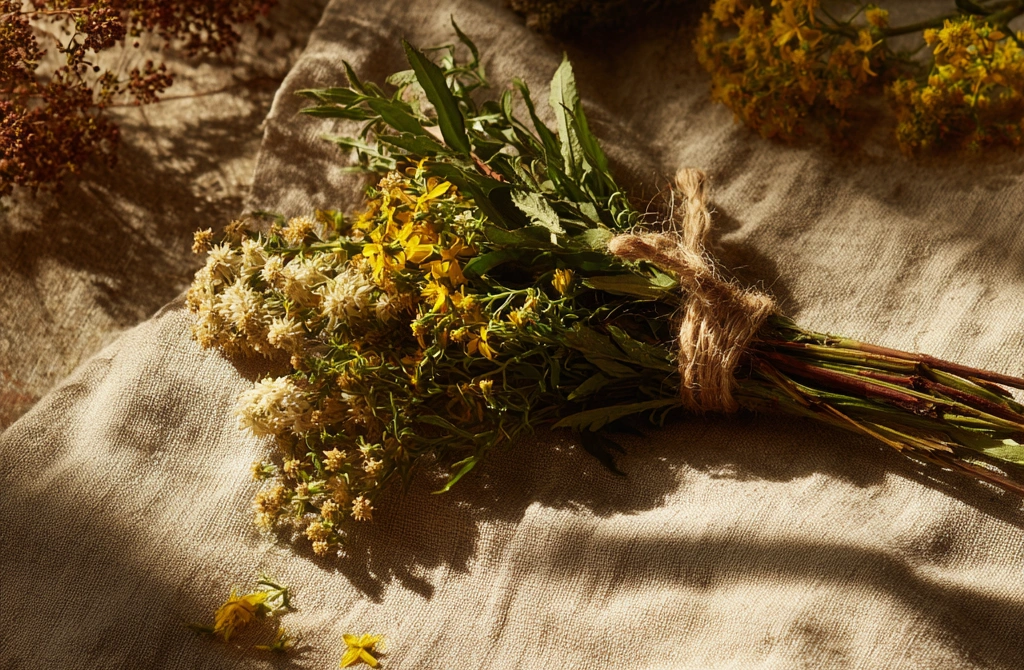
Every sabbat has its plants: the herbs, flowers, and trees that are in season, that carry the energetic signature of the moment, that have been used in folk practice at these times for generations. Litha's plants are the plants of midsummer: sun-charged, blooming at their peak, gathered on the eve of the solstice across European folk tradition for centuries, and used for protection, divination, and the strange concentrated power that the longest day was believed to confer.
Working with Litha herbs is one of the most accessible ways to mark the sabbat. The plants are mostly common. Many of them are growing nearby right now if you live anywhere in the temperate Northern Hemisphere. The work is in attention rather than acquisition: find them, note them, gather what is appropriate to gather, and let the plants themselves do the teaching.
St John's Wort
St John's Wort (Hypericum perforatum) is the quintessential Litha herb. The plant blooms a vivid yellow at midsummer, and its name comes from St John the Baptist, whose feast day (24 June) falls just after the solstice. The Christian overlay is recent in the long history of the plant; the protective and folk-magical use of Hypericum predates the Christian saint by centuries, and the herb's association with midsummer fire festivals across pre-Christian Europe is well attested.¹
The Latin name perforatum refers to the translucent oil glands visible in the leaves when held to light, which look like tiny perforations. These glands hold the active compounds that have made St John's Wort one of the most studied medicinal plants of the modern era: used in some traditions for mild-to-moderate depression, with significant peer-reviewed evidence behind that use.²
The folk use is older and more varied. Gathered on the eve of the solstice (or on St John's Eve, 23 June, in the Christianised calendar), bundles of St John's Wort were hung in doorways, over windows, and from rafters to protect against evil spirits, the evil eye, and witchcraft. The Latin folk name fuga daemonum means "the flight of demons." For modern witches working with the herb, the protective tradition is the deepest one. Hang dried St John's Wort over a doorway. Keep a sprig on the altar. Burn it as part of a Litha incense blend.
A note on safety: St John's Wort interacts with a remarkable number of common medications: antidepressants (especially SSRIs), hormonal birth control, blood thinners, immunosuppressants, and some heart medications. The interactions are well documented and clinically significant. Internal use (teas, tinctures, capsules) requires research and ideally consultation with a pharmacist. Ritual use (burning, hanging, carrying) does not carry these concerns.
Vervain
Vervain (Verbena officinalis) was one of the most sacred herbs in the Druidic and Roman magical traditions of the ancient world. Pliny the Elder, writing in the first century CE, described the Roman use of vervain at length in his Natural History, calling it herba sacra (the sacred herb) and recording that the Druids of Britain and Gaul had their own elaborate harvest practices for it. Pliny specifies that the plant should be gathered at the rising of the dog star (Sirius), at a moment when neither sun nor moon was visible, with the left hand, and with offerings of honey to the earth in compensation for the harvest.³
This is one of the most precisely recorded ritual herb-gathering practices to survive from the classical world, and it gives modern practitioners an unusually direct window into how the plant was approached. The instructions are not arbitrary. They are about marking the harvest as sacred, slowing the practitioner down, requiring deliberation. The frame works for any herb gathering. Use it as a template for your own Litha harvest, even if you adapt the specifics.
In folk magic, vervain is associated with love, protection, purification, and the bardic tradition. Crowns of vervain were worn by ancient bards. The plant is often burned as incense at Litha for its purifying smoke, scattered on altars, or carried in charm bags for protection. Vervain tea (gentle, not contraindicated for most adults) is a traditional herb for clarity before divination.
Yarrow
Yarrow (Achillea millefolium) takes its genus name from Achilles, the Greek hero whose myths recorded that he used yarrow to staunch the wounds of his soldiers at Troy. The plant has been called soldier's woundwort, knight's milfoil, and herba militaris in various European folk traditions, all references to its long-standing use in battlefield medicine.⁴
At midsummer, yarrow's white-pink-red flowering reaches its peak, and the plant is traditionally gathered on the solstice or in the days surrounding it. The folk-magical uses are wide. In some Chinese traditions, dried yarrow stalks are used in I Ching divination: a tradition stretching back at least two thousand years. In English and Scottish folk magic, yarrow under the pillow on the eve of the solstice was said to bring dreams of one's future spouse. Carried in pockets or hung over doorways, the plant was used for general protection.
For modern Litha practice, yarrow is one of the easiest and most rewarding herbs to gather. It grows in meadows, on roadsides, and in gardens across the British Isles and Northern Europe. Cut a small bundle on the eve of the solstice, hang it to dry, and use the dried flowers throughout the year for divination work, protective charms, and Litha-energy workings. The fresh flowers can also be added to seasonal altars.
Mugwort
Mugwort (Artemisia vulgaris) appears in this guide as it appears in the Herbs of Beltane: because mugwort is a year-round witch's ally that the wheel of the year keeps returning to. The Litha angle is different from the Beltane one.
At midsummer, the folk practice was bonfire-related. Across northern and central Europe, girdles of mugwort were woven and worn around the waist on the eve of the solstice, then thrown into the midsummer bonfire as the night peaked. The girdle was called the cingulum Sancti Johannis (St John's Girdle) in the Christianised tradition, but the practice is older than the saint's day attached to it. Sir James Frazer's The Golden Bough documents the custom across multiple European countries.⁵
The symbolic logic of the practice is that whatever burdens or concerns the wearer had carried over the year were transferred to the girdle and released into the fire. For modern witches, the practice translates easily. Make a small braid or bundle of mugwort. Wear it during a brief ritual on the eve of the solstice. Burn it safely (in a cauldron or fire-safe vessel) as the fire is at its peak.
Mugwort is also one of the nine sacred herbs of the Anglo-Saxon Lacnunga (an early medieval medical and magical manuscript from around the year 1000) where it appears in the Nine Herbs Charm alongside plantain, betony, and others, and is invoked as the eldest of herbs.
A note on safety, repeated from the Beltane piece because it remains relevant: Mugwort should not be used internally during pregnancy, as it may stimulate uterine contractions. Smoke and topical use carry lower risk, but caution is warranted.
Oak
The oak (Quercus robur and Q. petraea, the two native British oaks) is the tree of Litha. In modern Wiccan tradition, the Oak King rules from Yule to Litha (the half of the year of growing light) and is defeated at the solstice by the Holly King, who reigns through the dark half until Yule.⁶ The mythology is modern, drawn largely from Robert Graves's The White Goddess (1948), but it builds on much older associations.
The deepest associations are Druidic. The English word Druid itself may derive from a Proto-Indo-European root meaning "knower of the oak," and Pliny the Elder records the famous Druidic harvest of mistletoe from oaks, performed with a golden sickle on the sixth day of the moon: one of the most-quoted passages in the entire history of Western occultism.⁷ Across Indo-European mythology, the oak is the tree of the thunder gods: Zeus's tree, Jupiter's tree, Thor's tree, Perun's tree, Taranis's tree. It is the tallest, longest-lived, and most lightning-struck tree in much of Europe, which is part of why the connection to thunder gods runs so consistently across unrelated traditions.
For Litha, working with oak is more accessible than with most sacred trees. Gather oak leaves for the altar. Collect a few acorns to keep until autumn or to bury as a Litha intention. Sit beneath an oak in the days around the solstice and listen for what arises. If you have an old oak in your local landscape, walking to it on the morning of the solstice is a more powerful practice than most of what is suggested in modern witchcraft books.
Working with Litha herbs
The Apothecary in Grimoire is built for tracking your herbal practice across the wheel of the year. Note what you gathered, when, where, and how it felt to work with it. Over time, the notes become a personal herbal: a record of your relationship with these plants, built one solstice at a time.
You do not need to work with all of these herbs. Choose one or two that resonate, that you can source easily, that feel right for your practice this year. The most meaningful Litha working is the one that feels true to where you are right now.
For the wider Litha practice (the fires, the sunrise, the threshold work) see Litha for Solitary Witches. For the divine figures of the season, see Litha Deities. For the energy of the sabbat and how to work with it in intention-setting, see Litha Energy and Intentions.
Sources
- Wikipedia, Hypericum perforatum (St John's Wort): botany, etymology, and folk-magical history including the protective tradition and the connection to midsummer fire festivals. en.wikipedia.org/wiki/Hypericum_perforatum
- National Center for Complementary and Integrative Health (NCCIH), St. John's Wort: Usefulness and Safety: peer-reviewed summary of clinical evidence and the documented drug interactions. nccih.nih.gov
- Pliny the Elder, Natural History, Book XXV (first century CE): the passages on vervain (verbenaca) and the Druidic harvest practices, in the public-domain English translation by John Bostock. Project Gutenberg
- Wikipedia, Achillea millefolium (Yarrow): botany, the Achilles etymology, and the herb's role in classical and folk-magical traditions including the I Ching. en.wikipedia.org/wiki/Achillea_millefolium
- Sir James Frazer, The Golden Bough: A Study in Magic and Religion (1890–1915): the chapter on the fire-festivals of Europe documents the mugwort-girdle tradition across multiple national folk-customs. Project Gutenberg
- Wikipedia, Oak King: Robert Graves's The White Goddess as the modern source for the Oak King / Holly King mythology, and the broader pre-modern oak symbolism. en.wikipedia.org/wiki/Oak_King
- Pliny the Elder, Natural History, Book XVI: the famous passage on the Druidic harvest of mistletoe from oaks, performed with a golden sickle on the sixth day of the moon. Project Gutenberg
More from the Blog
Herbs of Beltane: Working with the Plants of the Fire Festival
Beltane's herbs are the plants of late spring: flowering, fragrant, and full of the season's expansive energy. Here's how to work with them in your practice.
The Witch's Guide to Lavender
Lavender has been a ritual herb since the Romans named it after washing. The botany, folklore, magical correspondences, practical uses, and simple workings for the most familiar witchcraft herb in the Western tradition.
Begin your practice
Grimoire is available now on Android and as a web app. Start today.