Herbology
The Witch's Guide to Lavender
Rowenna
Solitary witch and the founder of Grimoire. Built the app she couldn't find anywhere else. Writes about the craft with primary sources, honest lineage notes, and a low tolerance for vague correspondences. Based in the UK with more herbs than shelf space.
· 11 min read
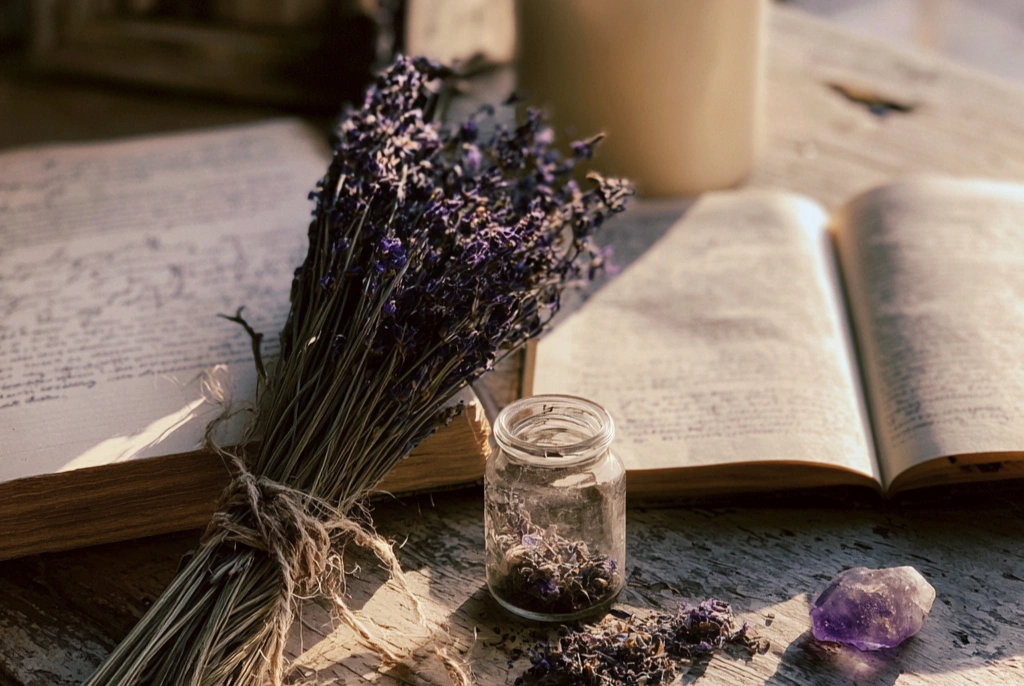
Lavender is the most familiar witchcraft herb in the Western tradition, and the most often used without understanding. Almost every witch has it (in a sachet, as an oil, dried in a jar on the altar shelf) but the herb's actual history and working properties are usually reduced to "sleep and calm," which is accurate as far as it goes and misses most of what lavender is.
This piece covers the full picture: the botany, the documented historical use, the magical correspondences and the honest disagreements within them, the practical applications worth knowing, and three simple workings. This is the first piece in the Grimoire blog's single-herb series: a set of deep dives that take one herb at a time and give it proper treatment.
Botany
Lavandula angustifolia (true lavender, sometimes called English lavender despite its Mediterranean origins) is a small, woody-stemmed perennial in the Lamiaceae family (the mint family, which also includes rosemary, thyme, sage, and basil). Native to the dry, rocky slopes of southern France, Spain, and Italy, it grows best in poor, well-drained soil with full sun. It is drought-tolerant once established and handles the British climate reasonably well, flowering in June and July at the peak of summer.
The common name "English lavender" is a historical misnomer; the plant is not native to England. What happened is that L. angustifolia was extensively cultivated in English kitchen gardens and perfume farms (particularly in Surrey and Worcestershire) from the sixteenth century onward, which gave it a strong English cultural identity despite its Mediterranean roots. This is worth knowing for sourcing: most Lavandula sold in garden centres as "English lavender" is L. angustifolia, which is the variety most used in culinary and magical practice.
L. angustifolia is distinct from L. latifolia (spike lavender, broader leaves, sharper scent, higher camphor content) and lavandin (L. × intermedia, a hybrid between the two with higher essential-oil yields). These distinctions matter more for commercial perfumery than for magical use, but they explain why different lavender products smell different.
The name lavender derives from the Latin lavare, "to wash." The Romans added lavender to baths. The naming is both practical and significant for how the herb has been used ritually across two thousand years.
Folklore
Roman use. Roman bath culture is the earliest well-documented use of lavender as a deliberate aromatic addition to water for both hygiene and ritual preparation. The bath in Roman practice was not only practical but socially and spiritually significant: a liminal space between the ordinary and the ceremonial. Lavender in bathwater carried the same dual function: cleansing the body and marking a threshold. The lavare etymology preserves this.
Medieval European practice. Hildegard of Bingen (1098–1179), the German Benedictine abbess and polymath, wrote about lavender in her medical and natural-history texts, recommending it for maintaining "pure knowledge" and for use against the influence of malign spirits.¹ Hildegard's lavender is not primarily a sleep herb; she is more interested in its clarity and protective qualities. This is closer to the full-spectrum magical lavender than the modern "relaxation herb" framing.
In the medieval household, lavender was used extensively for preservation: strewn on floors to repel insects, added to linen storage to protect cloth from moth damage, and used in washing. The preservation function contributed to its longstanding association with protection.
Tudor and Elizabethan England. Lavender-stuffed gloves were considered protective against plague and ill luck, and lavender was a component of vinegar-and-herb preparations used prophylactically during epidemic periods. The Elizabethan "tucker" (lavender-scented kerchief) was carried to ward against unpleasant air and malign influences: a practical and magical application collapsed into one object.
Victorian language of flowers. In the nineteenth-century language of flowers (floriography), lavender carried the meaning of devotion, acknowledgment, and distrust: a more complicated set of meanings than most summaries record. A lavender sprig sent in a letter could express quiet, lasting love or cautious watchfulness depending on context. The Victorian meaning is not so much "love" as "I am paying attention."
English country tradition. The lavender sachet in the linen drawer is the living folk-magic practice that most English people still use without thinking of it as magic. The practice (a small cloth bag of dried lavender placed among stored cloth) is ancient in origin and has never entirely left common use. That most modern people do it for scent rather than protection does not change the structural identity of the working.
Magical correspondences
Lavender's magical correspondences are the subject of genuine disagreement between traditions, and the piece will name the disagreement directly rather than pretend consensus where there is none.
For the correspondences at a glance, see the Lavender reference entry in the Apothecary; what follows is the working detail behind them.
The Mercury reading. Lavender is associated with Mercury by a significant portion of the Western magical tradition. Mercury governs communication, mental agility, clarity of thought, and the nervous system; and lavender's calming effect on the nervous system, its historical use for mental clarity (see Hildegard's "pure knowledge" framing), and its long association with clear speech and honest communication place it naturally in this sphere.
The Saturn reading. Other traditions assign lavender to Saturn, particularly in relation to its protective, preservative, and purifying qualities. Saturn governs discipline, long-term outcomes, structure, and the kinds of protection that hold over time rather than in immediate crisis. The linen-preservation function, the longevity of dried lavender's effectiveness, and its use against persistent negative influences all point toward Saturn.
The working reconciliation. Neither reading is wrong. Lavender is both a herb of mental clarity and calm (Mercury) and a herb of lasting preservation and protection (Saturn). Which correspondence to work with depends on the nature of the working. For communication, sleep, and mental clarity workings, Mercury is the better frame. For lasting protection, purification, and preparation for sustained work, Saturn holds.
In terms of element, lavender is almost universally assigned to Air, matching Mercury's elemental rulership and consistent with lavender's primary action on the mind and nervous system rather than on the body or emotions directly.
Core correspondences: Sleep and dreaming, mental clarity, communication, purification, protection (gentle and sustained), love in its peaceful forms (devotion rather than passion), grief and remembrance.
Practical use
Sleep and dreaming. A dried lavender sachet under the pillow is one of the most effective and best-documented uses of the herb in folk practice. The volatile compounds in lavender (primarily linalool and linalyl acetate) have well-established effects on the nervous system's stress response, and their absorption via inhalation during sleep is supported by substantial research. For magical use: name the intention specifically when making the sachet (clarity of dreaming, restful sleep before difficult work, openness to useful guidance) rather than simply placing lavender and hoping.
Smoke cleansing. Lavender burns sweetly and cleanly, and it is one of the best established smoke alternatives to white sage in the European folk-magic tradition. This distinction matters. White sage (Salvia apiana) is a sacred plant of specific Indigenous American peoples, and its use in commercial witchcraft without cultural grounding is a significant appropriation concern. Lavender has its own two-thousand-year European tradition of use for purification via smoke; it does not need to borrow white sage's cultural authority. Use lavender smoke for purification of space, preparation of objects, and clearing of altar work with full confidence in its own lineage.
Ritual bathing. A handful of dried lavender flowers in a muslin cloth or directly in bathwater carries the herb's full tradition of liminal-space preparation. Use before ritual, divination, or any working that benefits from clear mental state and a marked threshold between ordinary time and working time. Add a tablespoon of sea salt to the bath for enhanced purification effect.
Candle dressing. Lavender pairs well with white or blue candles when dressing for healing, communication, or sleep workings (see Candle Magic: A Witch's Guide). Roll a dried-flower-coated, oil-anointed candle in finely crumbled lavender before any working of this type.
Tea. A simple lavender tea (one teaspoon of dried L. angustifolia flowers per cup, steeped for five minutes) is a mild nervine, suitable for pre-ritual calming, pre-sleep preparation, or any working that benefits from a settled nervous system. Note: lavender herbal tea is considered generally safe for most adults; lavender essential oil should never be consumed internally. These are not the same thing.
Sourcing
L. angustifolia is one of the easiest kitchen-garden herbs to establish in the UK. It requires full sun, poor to moderately fertile soil, excellent drainage, and little water once established. It is genuinely drought-tolerant; it will die in waterlogged soil before it will die in drought. A well-established lavender plant will produce enough flowers for several years of household magical use.
For those without garden access, dried L. angustifolia flowers are available from any decent herbalist, health food shop, or online supplier. Look specifically for L. angustifolia (true lavender) rather than generic "lavender" which may be lavandin. The scent difference is discernible: true lavender is sweeter and lighter; lavandin is stronger and more camphorated.
Harvest at peak bloom (in the UK, June and July) by cutting the flower stalks in the morning before the sun is fully up, when the volatile compounds are most concentrated. Dry by hanging in small bundles in a warm, airy location out of direct sunlight. Dried correctly, lavender retains its scent and working properties for twelve to eighteen months.
Simple workings
A sleep sachet. Fill a small cloth bag with two tablespoons of dried lavender flowers. Add a single amethyst or clear quartz tumble stone if you have one (optional; the herb works alone). Name the intention aloud as you tie the bag: clear sleep, useful dreaming, restfulness through to morning. Place under the pillow or inside the pillowcase. Refresh the dried flowers annually at the summer harvest.
A smoke cleanse for space. Tie a small bundle of dried lavender stems tightly with natural twine. Light one end and allow it to catch, then blow out the flame and work with the smoke as you would with any smoke-cleansing herb. Move through the space from lowest to highest point, paying particular attention to thresholds. Extinguish in a small dish of sand or salt. Use before working in a space that has accumulated difficult emotional residue, before beginning a new project in a space, or as part of seasonal turning-point practice.
A lavender bath for ritual preparation. Run a bath and add either a tied muslin sachet of two to three tablespoons of dried lavender flowers, or five to eight drops of lavender essential oil in a tablespoon of carrier oil first. Add a tablespoon of sea salt. Before entering, speak aloud what you are preparing for: the ritual, the difficult conversation, the working that requires your clearest mind. Soak for at least ten minutes. The threshold is the moment you step out of the bath and into the working space.
Sources
- Hildegard of Bingen, Physica (c. 1150): includes lavender among medicinal plants with recommendations for its clarity-supporting and protective uses. Available in translation: Hildegard of Bingen, Physica: The Complete English Translation of Her Classic Work on Health and Healing, trans. Priscilla Throop (Healing Arts Press, 1998).
- Wikipedia: Lavandula, comprehensive botanical and cultural overview, including the naming etymology from lavare, the Mediterranean native range, and the commercial cultivation history.
- Wikipedia: Language of flowers, the Victorian floriography tradition and its lavender meanings.
- National Center for Complementary and Integrative Health (NCCIH): Lavender, the clinical evidence on lavender's effects on anxiety and sleep, and safety information including the essential-oil internal-use caution.
More from the Blog
Herbs of Litha: Working with the Plants of the Summer Solstice
Litha's herbs are the plants of midsummer: sun-charged, protective, and central to centuries of European folk practice. Here is how to work with them in your craft.
The Witch's Guide to Mugwort
Mugwort is the witch's dreaming herb: the first plant of the Nine Herbs Charm and the most-named herb in this blog. A full profile: botany, folklore, magical correspondences, safe practical use, and three simple workings.
Begin your practice
Grimoire is available now on Android and as a web app. Start today.