Crystals
Astrology and Crystals: A Witch's Guide Beyond the Birthstone
Rowenna
Solitary witch and the founder of Grimoire. Built the app she couldn't find anywhere else. Writes about the craft with primary sources, honest lineage notes, and a low tolerance for vague correspondences. Based in the UK with more herbs than shelf space.
· 7 min read
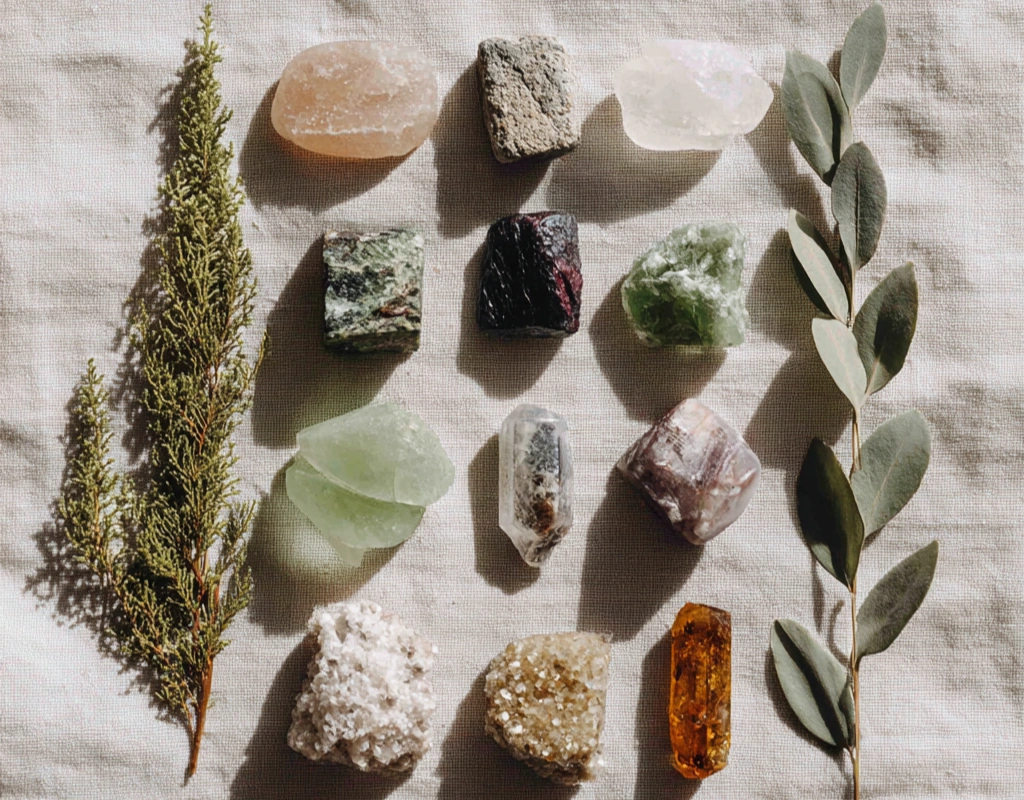
Most people know their birthstone. Far fewer know that the modern birthstone list is a marketing decision made in 1912, not an ancient magical correspondence.¹
The older system predates it by centuries. Crystals have been assigned to planets, moon phases, and natal charts since at least the classical period: a framework of correspondence that is specific, learnable, and considerably more useful in practice than a list sorted by calendar month.
This is a working guide to using crystals astrologically: the planetary system, the lunar phases, and how to read your own chart for stone work.
The birthstone is a starting point
The modern American list of birthstones (garnet for January, amethyst for February, and so on) was finalised in 1912 by what was then the National Association of Jewellers, now Jewellers of America.² It was a commercial standardisation, designed to make selling and gifting easier. Some of the choices reflect older traditions. Many were practical decisions about availability and cost.
This is useful to know. The birthstone is convenient and consistent, but it is shallow as a piece of magical correspondence. It tells you nothing about your moon sign, your rising, the transits you are currently moving through, or the deities you may already be working with.
If you want to work seriously with stones, the birthstone is one data point among many. Treat it as such.
The seven classical planets and their stones
Older Western astrology recognises seven classical planets: the Sun, the Moon, Mercury, Venus, Mars, Jupiter, and Saturn, each with a distinct territory.³ The modern outer planets (Uranus, Neptune, Pluto) were added after their telescopic discoveries and have their own correspondences in modern occultism.
The traditional planet–stone pairings, drawn from Agrippa's Three Books of Occult Philosophy and the wider Hermetic tradition, are:⁴
- Sun: vitality, sovereignty, the self. Citrine, golden topaz, sunstone.
- Moon: emotion, intuition, the cycles. Moonstone, pearl, selenite.
- Mercury: communication, intellect, travel. Agate, fluorite.
- Venus: love, beauty, art, value. Emerald, rose quartz, malachite.
- Mars: action, courage, conflict. Ruby, garnet, carnelian, bloodstone.
- Jupiter: wisdom, expansion, fortune. Lapis lazuli, sapphire, amethyst.
- Saturn: discipline, structure, time, limit. Onyx, jet, obsidian, smoky quartz.
This is the backbone of an astrological crystal practice. Once you know the planet's territory, you know what its stones are for.
Lunar phases and crystal work
Each phase of the moon invites a different kind of work, and a different relationship with stone. A short orientation:
- New Moon: beginnings. Cleanse and dedicate stones for fresh intentions. Clear quartz and smoky quartz pair well here.
- Waxing Moon: growth. Carnelian, citrine, and green aventurine support things in motion.
- Full Moon: culmination, illumination, charging. Moonstone and selenite are traditional. Most stones can be charged on a full moon by leaving them out overnight where the moonlight reaches them.
- Waning Moon: release, reflection, clearing. Black tourmaline, hematite, and obsidian help with what needs to leave.
If you are already working with the moon, this layer integrates without effort.
Working with transits
Astrology is not static. The planets move, and their movement shapes everyday life. Building a crystal practice that responds to current transits is one of the most useful applications of astrological stone work.
Mercury retrograde is the most well-known. Communications stall, contracts wobble, technology fails. Fluorite, smoky quartz, and black tourmaline help with mental clarity, grounding, and reduced anxiety in those weeks.
Saturn transits test endurance, especially the Saturn return at ages 28–30 and 58–60. Onyx, hematite, and jet support discipline, patience, and structural work.
Mars transits raise heat. Ruby and carnelian focus the energy when it needs direction. Smoky quartz tempers it when it does not.
Jupiter transits expand. Lapis lazuli and amethyst are good companions for periods of growth, study, and travel.
You do not need to memorise every transit. You need to know what is currently moving in your chart, and to keep stones on your altar that respond to it.
A natal chart is not a fortune. It is a map.
Reading from your own chart
A natal chart is the position of every planet in the sky at the exact moment you were born. For crystal work, three things matter most.
- Your sun, moon, and rising signs. These are the headlines. Many witches start with a stone for each.
- Your dominant planets. The planet (or planets) most strongly aspected in your chart are the ones whose stones will feel most familiar. Often, this is also the planet ruling your rising sign.
- Your imbalanced house. If a particular area of life feels difficult (career, relationships, the unconscious) find the planet ruling that house and work with its stones.
Free natal chart calculators are widely available if you do not already have your chart. The Horoscope feature in Grimoire generates a full natal chart and surfaces your dominant placements, which makes this work much easier to start. If you want to learn to read it for yourself, our guide to reading your natal chart for the first time walks through every step.
Putting it into practice
The witch's use of astrological stones is not the same as the collector's. The work is integrative, not decorative. I have been running this system for long enough that it has become the grammar of how I set an altar rather than a conscious decision each time.
A few uses that earn their place:
- Altar correspondence. When you are building a spell under a particular planet (Venus for love, Mars for protection, Jupiter for opportunity) its stone goes on the altar.
- Daily anchor. Many practitioners keep a stone for the day of the week by classical rulership: Monday for the Moon, Tuesday for Mars, Wednesday for Mercury, Thursday for Jupiter, Friday for Venus, Saturday for Saturn, Sunday for the Sun. The Daily Pulse shows the planetary hour and day if you want this layer.
- Transit support. Keep a small kit of stones for the transits you find difficult. Fluorite for Mercury retrograde lives on most witches' altars by year three.
- Deity work. Several planets correspond to deities. The Sun to solar gods. Venus to Aphrodite, Inanna, or Hathor. Mars to war gods. Saturn to chthonic ones. The right stone deepens the relationship. If you are keeping a deity journal, the planetary correspondence is worth recording.
Sourcing ethically
Crystals have a sourcing problem, and it took me longer than it should have to take it seriously. Many popular stones come from regions where mining damages ecosystems, exploits workers, or both.⁵ A practice rooted in respect for nature cannot rest on stones taken without it.
The principles are straightforward. Buy from dealers who can name the mine. Favour fair-trade and small-scale operations. Lab-grown stones are a legitimate option for some workings. Vintage and second-hand stones already in circulation carry their own histories and avoid new extraction altogether.
A small, well-sourced collection serves a witch better than a shelf of cheap, untraceable ones.
The older correspondence
The relationship between the stars and the stones is older than any modern witchcraft tradition. Working both at once gives a solitary practitioner a system that is detailed, personal, and that responds both to the chart she was born under and the sky moving above her now. The birthstone, if you want a starting point, is the doorway. The natal chart is the map. What you do with that map is the practice.
Frequently asked questions
What is the difference between a birthstone and an astrological stone?
A birthstone follows your birth month and the standardised list set in 1912. An astrological stone is chosen by planetary, lunar, or natal-chart correspondence. The first is a single recommendation. The second is a system.
Can I use more than one crystal at a time?
Yes. Most working witches keep stones for sun, moon, and rising signs at a minimum, plus stones for whatever transit or working is currently relevant. Crystals layer; they do not compete.
What stones help during Mercury retrograde?
Fluorite, smoky quartz, and black tourmaline are the most reliable. Fluorite for clarity, smoky quartz for grounding, black tourmaline for protection against the general fog.
How do I find my dominant planet?
A natal chart calculator will show every planet's sign and house. The dominant planet is usually the one with the most aspects, the one ruling your sun or rising sign, or the one in your sun sign. The Horoscope feature in Grimoire surfaces this automatically.
Do I have to wear my crystals?
No. Many witches keep their stones on the altar, in pouches, by the bed, or in workings, never as jewellery. The practice is the relationship, not the display.
Sources
- Wikipedia: Birthstone, on the 1912 standardisation by the American National Association of Jewelers and the modern list.
- Jewellers of America: official birthstone history, confirming the 1912 standardisation by the American National Retail Jewellers Association.
- Wikipedia: Classical planet, on the seven luminaries (Sun, Moon, Mercury, Venus, Mars, Jupiter, Saturn) and the later expansion to include Uranus, Neptune, and Pluto.
- Cornelius Agrippa: Three Books of Occult Philosophy (1533), the foundational Renaissance text on planetary correspondences with stones, herbs, and metals. A working summary of Agrippa's planet–stone correspondences and their classical sources is collected at Peter Stockinger's Traditional Astrology Weblog.
- International Gem Society: overview of ethical sourcing concerns in the modern crystal trade.
Further reading: the International Gem Society's history of birthstones traces the longer pre-1912 traditions that the modern list condensed.
More from the Blog
Emeralds: Stones of Rebirth, Protection, and Divine Vision
The May birthstone has been mined for five thousand years, carried by pharaohs and alchemists, and set above all other green stones across nearly every culture that encountered it. Here is why, and how to work with it.
Five Crystals Every Witch Should Own
A working witch's starter kit. Five versatile crystals that earn their place on the altar: what each one does, how to use it, and how to source it ethically.
Begin your practice
Grimoire is available now on Android and as a web app. Start today.