Spells
Knot Magic: A Witch's Guide
Rowenna
Solitary witch and the founder of Grimoire. Built the app she couldn't find anywhere else. Writes about the craft with primary sources, honest lineage notes, and a low tolerance for vague correspondences. Based in the UK with more herbs than shelf space.
· 8 min read
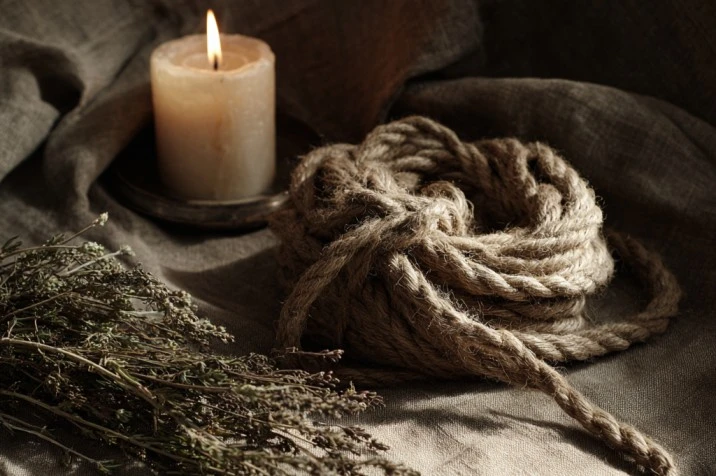
Most modern witches have encountered knot magic as a name without a working — listed in correspondence tables, referenced in historical accounts, mentioned as something practitioners once did. This piece restores it to the working repertoire. Knot magic is not obscure. It is one of the most widely attested forms of folk magic in the Western tradition, documented across cultures and centuries with unusual consistency. You can practise it tonight with nothing more than a length of cord and a clear intention.
This is the seventh piece in the Spells cluster. The Spell Crafting for Beginners pillar covers the foundations all these workings rest on. For the theoretical framework that explains why knot magic works — the sympathetic-magic principles of binding and contagion — see the forthcoming Sympathetic Magic: A Primer.
A genuinely old practice
The logic of knot magic is simple enough to have been arrived at independently across cultures: a knot binds intention into physical form; untying releases it; the cord holds the working in suspension between the casting and the close. The principle is the same whether you are a Mesopotamian physician binding a disease-spirit with wool, a Norse völva working wyrd into a cord, or a Scottish cunning woman selling wind-knots to sailors at the harbour.
The sailor's wind-knot is one of the most consistently documented forms. Across Scottish, Scandinavian, and Baltic folk tradition, the account is remarkably similar: a wise woman could sell a rope with three knots in it to a sailor heading into uncertain weather. Untying the first brought a gentle breeze; the second, a strong wind; the third, a storm. Olaus Magnus described the practice in his Historia de Gentibus Septentrionalibus in 1555. That the same working appears across unconnected northern European seafaring cultures, with the same structure, suggests a practice with genuine depth rather than one folklore source being copied by another.
The binding side of the tradition is equally old. Pliny describes magical knotting in Naturalis Historia. Theocritus's second Idyll — a love magic poem from the third century BCE — includes a knotted cord in the working. Anglo-Saxon medical texts describe binding formulas for disease. The Quran's reference in Surah Al-Falaq to "those who blow on knots" indicates the practice was familiar enough in 7th-century Arabia to be specifically addressed. None of these traditions are in direct contact with each other. The logic of the knot travels independently.
In England, knot magic was substantially a cunning-folk technique. Owen Davies documents cord and knot workings in the professional repertoire of English cunning practitioners from the 16th through the 19th century — protective workings, binding spells against harm, cords tied with spoken charms and delivered to clients for use at home. Like the jar spell, the knot spell was a working a practitioner could give a client to deploy independently, its intention already locked inside the cord.
The witch's ladder — and what we actually know about it
In 1878, during renovations to an old house in Wellington, Somerset, a collection of objects was found concealed in a sealed attic room. Among them was a length of cord with feathers worked into it at intervals — a braided or knotted structure unlike anything in the ordinary domestic record. The objects were sent to the museum at Taunton, and in 1887 they were acquired by the Pitt Rivers Museum in Oxford, where the cord remains today.
The witch's ladder entered popular consciousness primarily through Charles Godfrey Leland — the same Leland who compiled Aradia — who wrote about it in 1892 as evidence of a surviving witch practice for stealing a neighbour's cow's milk or causing magical harm. Leland was enthusiastic, perhaps excessively so, about finding ancient survivals of witch religion in Victorian England. His account should be read with that enthusiasm in mind.
The honest position is this: a real object was found, and it is real and significant. Whether it was made by a cunning person, a folk practitioner, or someone with entirely different purposes we cannot now determine. What is called the "witch's ladder" is a late-Victorian folkloric interpretation of a physical object, not a continuous named practice documented from antiquity. This is not a diminishment — the tradition of knotted cords and worked objects in English folk magic is real and well-documented. It simply means the specific "witch's ladder" as a named practice is a 19th-century coinage rather than an ancient one. Same honest framing the rest of the History cluster applies.
The modern witch's ladder — a knotted cord with objects (feathers, beads, crystals) worked in at intervals, tied with intention at each object — is a living working practice, constructed from genuine folk-magical principles. It works because the principles work, not because it descends from an unbroken ancient lineage.
Materials
Natural fibres — cotton, linen, hemp, wool, silk — are traditional and practical. They tie more securely and feel more present in the hands than synthetic cords. The preference is not arbitrary: synthetic cords exist outside the natural material correspondences that most knot workings draw on.
Colour follows standard correspondence. Black for binding, protection, banishing. Red for passion, courage, and action. Green for growth, abundance, and healing. White for clarity, cleansing, and protection. Purple for psychic and spiritual work. Yellow for communication and mental clarity. Blue for healing and calm. Use what fits the working's purpose.
Length: nine hand-spans from wrist to fingertips is a useful traditional measure — it gives enough cord for nine knots with meaningful space between each. Cut the cord to length before beginning the working.
The nine-knot working
Nine is the traditional number of knots for a significant working in European folk magic — appearing in the Nine Herbs Charm, in folk numerology broadly, and in the general pattern of cord workings documented across the tradition. Three and seven are alternatives for quicker workings; nine is used where the intention needs weight and duration.
The spoken sequence most widely used in modern practice comes through Doreen Valiente's 20th-century witchcraft work, which drew on older folk-numerical principles into a modern mnemonic form. It is not ancient in its current wording; the principles it encodes are:
By knot of one, the spell's begun / By knot of two, it cometh true / By knot of three, so mote it be / By knot of four, this power I store / By knot of five, the spell's alive / By knot of six, the spell I fix / By knot of seven, the stars of heaven / By knot of eight, I seal my fate / By knot of nine, the thing is mine.
Use this if it serves you. Your own words with clear intention work equally well; the mnemonic is a frame, not a sacred formula. What matters is that each knot is tied deliberately, with the intention spoken or held clearly in mind at the moment of tying.
The working itself: State your intention clearly before touching the cord: aloud, specific, present tense. Take the cord in both hands. Tie the first knot at the left end, speaking the first line or your own opening words. Work from left to right, tying each knot with deliberate slowness, feeling the cord pull taut. When all nine are tied, hold the finished cord between both hands and take a breath. The working is sealed. Place it where it needs to be: at a threshold, beneath a pillow, inside a bag, carried on your person. Leave it until the intention is fulfilled or until you choose to release it.
Releasing knot magic
Untying a cord is as deliberate and important a working as tying it. The releasing is not the undoing of a mistake; it is the completion of the working, the moment when what was held is consciously returned.
Untie from right to left: the reverse of the original direction. At each knot, speak the release: simply and plainly, in your own words, that you are releasing the knot and the intention it held. When all nine are untied, the cord is a plain piece of string again. Thank it and dispose of it: bury it in earth for a working that has been fulfilled and completed, burn it for a working you need to fully clear, or keep the cord for future use if it feels clean and neutral.
Two rules worth keeping: do not cut the cord to release a working: cutting severs rather than completes, and the energy ends abruptly rather than releasing. And do not leave a working cord tied indefinitely without attention: if you have tied a significant intention and months have passed with no resolution, revisit whether it should be released or renewed.
Binding cords (tied with the intention of keeping something contained rather than drawing it toward you) may be left tied and buried rather than released. The cord holds the binding in the earth. This is the working closest to the historic witch-bottle tradition: an intention sealed in physical form and placed where it will hold.
A worked example: a protection cord
Materials: a length of black cotton cord cut to nine hand-spans.
Intention: Speak aloud before beginning: "I bind protection into this cord. Each knot holds the intention fast."
The working: Tie nine knots from left to right, speaking the nine-knot sequence or your own words at each one. Work without hurrying. When the final knot is tied, hold the cord in both hands and breathe. Place it: at the front door of your home, under your pillow, inside your bag for travel, or wherever the protection is most needed.
Renewal: Every few months (or when the cord begins to feel flat) untie each knot in reverse order, state that the working is released and thanked, and begin again with fresh cord and fresh intention. Protection workings benefit from renewal rather than being left to run indefinitely without attention.
Common questions
Can knot magic be used to bind a specific person? Binding magic directed at someone to prevent them from causing harm (rather than to compel their will or actions) has a long tradition in folk practice and is not considered universally unethical within it. The line is between containment (holding a harmful force at bay) and compulsion (forcing someone to act against their nature or will). Each practitioner draws that line for themselves; the tradition offers tools, not ethics rulings.
Do I have to use the traditional spoken words? No. The nine-knot mnemonic is a working aid, not a sacred text. Clear, specific intention spoken in your own voice is the whole of the requirement. Use whatever words feel true to what you are casting.
What if I make a mistake mid-working? Untie the knot where the mistake happened and begin again from that point. Do not cut the cord. A brief pause to restate the intention before retying is useful.
Where this sits
Knot magic is binding magic: the physical expression of the sympathetic principle that like affects like and that form can hold intention in suspension. The theoretical framework for why this works, and how it connects to every other technique in the Spells cluster, is in the forthcoming Sympathetic Magic: A Primer.
This piece is part of A Witch's Working Library: The Spells Cluster: fourteen pieces on the practice, theory and seasonal application of spell craft.
Sources
Owen Davies, Popular Magic: Cunning-Folk in English History (Hambledon Continuum, 2003): for the cunning-folk knot and cord working context. Olaus Magnus, Historia de Gentibus Septentrionalibus (1555): for the wind-knot documentation. The Pitt Rivers Museum, Oxford, holds the 1878 Wellington witch's ladder. Doreen Valiente, Witchcraft for Tomorrow (Robert Hale, 1978): for the nine-knot spoken sequence in its modern Wiccan form. James George Frazer, The Golden Bough (1890; 3rd ed. 1906–15): for the cross-cultural binding-magic survey, with the caveat that Frazer's colonial anthropological frame requires critical reading.
Grimoire is a digital practice companion for the solitary witch: a spell builder, sacred calendar, private grimoire journal, herbology compendium, and daily tarot, all in one place. Now available on Android.
More from the Blog

Jar Spells: A Working Guide
Sweetening jars, banishing jars, money jars. Jar spells are among the most widely practised workings in modern witchcraft. A complete working guide: the Hoodoo roots of the tradition, how to engage with them honestly, and three fully worked examples.
Equinox Magic: Spells for Mabon
Five working spells for the autumn equinox: an apple working, an equinox balance ritual, the Mabon harvest accounting, a descent working, and a protection jar for the darkening year. Specific, sourced, and adaptable for solitary practice.
Begin your practice
Grimoire is available now on Android and as a web app. Start today.