Spells
Sympathetic Magic: A Primer
Rowenna
Solitary witch and the founder of Grimoire. Built the app she couldn't find anywhere else. Writes about the craft with primary sources, honest lineage notes, and a low tolerance for vague correspondences. Based in the UK with more herbs than shelf space.
· 9 min read
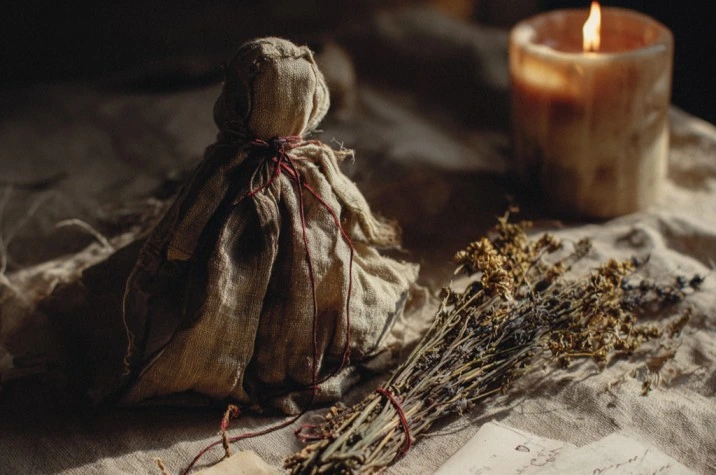
Most spells work the same way. The practitioner is rarely aware of this, because the techniques look different from each other — a jar of honey and herbs looks nothing like a knotted cord, which looks nothing like a carved candle, which looks nothing like a poppet. But beneath these different surfaces, almost every spell in the Western folk-magic tradition operates on one of two principles, or on both simultaneously. Naming those principles makes every spell you have ever worked, and every spell you will ever work, more legible.
This is the ninth piece in the Spells cluster and its theoretical anchor. It does not teach a new working — it explains why the previous workings work. After reading this piece, the Jar Spells, Knot Magic, Equinox Magic, and every other piece in the cluster can be re-read with a sharper frame. The Spell Crafting for Beginners pillar introduced the structural discipline of practice; this piece introduces the structural logic of the working itself.
Frazer's two laws
In 1890, the Cambridge classicist and anthropologist James George Frazer published the first edition of The Golden Bough: A Study in Comparative Religion, later expanded to twelve volumes. In it, he proposed that all magical practice across all human cultures operates on two fundamental principles, which he called the laws of sympathetic magic.
The Law of Similarity — also called Homeopathic Magic or Imitative Magic: like produces like. What resembles something affects it. The operational principle is analogy: if two things share qualities or appearance, they are connected in a way that allows one to influence the other. A red candle for passion because red resembles fire and blood. An image of a person because the image resembles the person. An herb assigned to the moon because its silvery qualities resemble moonlight.
The Law of Contagion: things that have been in contact continue to affect each other after separation. The connection is physical rather than analogical — it arises from actual contact rather than from resemblance. Hair and nail clippings retain a connection to the person they came from. A photograph retains a connection to its subject. Soil from a footprint retains a connection to the person who made it. The object is a thread, and the thread does not break when the object is removed.
Frazer named the combination of these two laws "sympathetic magic" — from the Greek sympatheia, the capacity of two things to feel or respond together across a distance. The operating logic: the connection exists whether or not the practitioner consciously establishes it, and the spell works by activating that connection intentionally.
What Frazer got right — and what he got wrong
The two laws are genuinely useful as descriptive categories. They identify something real about how folk-magical practice is structured across cultures, and they give practitioners a framework for understanding why specific materials and techniques work as they do.
Frazer's broader interpretive framework is a different matter, and it requires the same honest-lineage treatment this cluster has applied to every other historical source.
Frazer was a colonial-era anthropologist working within an evolutionary model of human culture: he believed that human societies progressed through stages from magic (the "primitive" stage) through religion to science (the most "evolved"). Magic, in his framework, was what people did before they knew better. This model is now thoroughly rejected by anthropology. Magical thinking is not a primitive stage of development; it is a structural feature of human cognition that persists alongside and through scientific reasoning in every culture, including the ones Frazer considered most evolved. His condescension toward the traditions he documented does not invalidate his observations, but it should be held in mind when reading him.
His comparative method also flattened enormous differences between traditions by treating all magical practice from everywhere as equivalent instances of the same "primitive" phenomenon. The specific observations about similarity and contagion are useful; the implication that all magic everywhere is the same kind of mistake is not.
What modern anthropologists — Stanley Tambiah in particular, whose work on magical thinking in the 1970s substantially rehabilitated Frazer's empirical observations while rejecting his interpretive framework — have established is this: the laws of similarity and contagion describe structural principles in folk-magical practice with genuine descriptive accuracy. They are not a theory of how magic "really works" in a metaphysical sense. They are a map of the logic that practitioners have consistently used across traditions and centuries, which is a different and more defensible claim.
Work with Frazer's map as a map. It is useful. It is not the territory.
Like affects like — the Law of Similarity in practice
The Law of Similarity is the most widely used sympathetic principle in modern witchcraft, operating constantly beneath techniques that are rarely identified as what they are.
Colour magic is pure similarity. Red for passion, green for growth, black for protection or banishing, white for clarity: each correspondence rests on the analogical connection between the colour's qualities and the working's domain. The connection is not arbitrary; it is built from webs of cultural association, physical experience, and historical use that have accumulated over centuries. Red resembles fire, blood, and the flush of strong feeling. That resemblance is the working.
Herbal correspondences are similarity made botanical. Why does mugwort correspond to dreaming? Its silvery, moonlit quality; its traditional use in night-protective practice; its volatile compounds that genuinely affect sleep. The correspondence is not a lookup table entry — it is an analogical web connecting the herb's observable qualities to the domain of dreaming, built by generations of practitioners noting the resonance. The same logic runs through every herbal correspondence in the tradition, from the Greek Magical Papyri through Agrippa's correspondence tables to the herb lists in modern Books of Shadows.
Image magic is the purest expression of the Law of Similarity. The poppet — a figure made in the image of a person — establishes a working connection through resemblance. By making something that looks like the target, you create an analogical link. This is why poppets appear in almost every folk-magic tradition in the world, and why image magic is used in protective and healing workings as well as harmful ones. The image does not inherently harm; what matters is what you do with the connection it establishes.
Candle dressing — carving intention words, applying corresponding oils, rolling in herbs — is an act of making the candle resemble the intention more completely before the working begins. You are strengthening the similarity between the material and the purpose.
The Law of Contagion in practice
Where similarity works through analogy, contagion works through actual physical connection. The thread is the contact, and it persists.
Hair and nail clippings are the most commonly referenced contagion materials in folk practice across cultures — they came from the person and retain that origin. Used in protective workings (a poppet incorporating the target's hair; a protective jar containing the practitioner's own hair for self-working), in healing traditions, and in the folk-curse traditions the cunning folk were specifically employed to counter.
Personal objects — something a person wore, used daily, or loved — retain a connection through contact. The object belonging to a deceased person on an ancestor altar creates precisely this thread. The watch, the button, the piece of jewellery: each is a point of contact with the person who is gone.
The witch's bottle — covered in full in the forthcoming Witch Bottles: Archaeology and Practice — is perhaps the most elegant historical example of both laws working simultaneously. The classical English witch's bottle contains personal matter from the homeowner (contagion: urine, hair — the connection to the household's inhabitants) AND materials that resemble harm-piercing (iron pins and bent nails — similarity: the pins stab the attacking witch's working as she sent harm to the household). Two laws, one vessel, working in combination.
The Spells cluster mapped
Once the two laws are clear, every technique in the cluster falls into place.
Sigil work is image magic — pure Law of Similarity. You create a symbol that encodes and therefore resembles your intention. The sigil is an image of the working's purpose, compressed into a form the practitioner charges and releases.
Jar spells combine both laws. The written petition is similarity (words representing the intention). Herbs chosen by correspondence are similarity. Personal matter, if included, is contagion. The sealed container is containment magic — holding the working in suspension through physical enclosure.
Knot magic is binding through similarity. The cord is bound as the intention is bound. The knot resembles — is the physical expression of — the binding or sealing you are working toward. Untying releases the binding through the same logic in reverse.
Candle magic is similarity (the colour and dressing) plus temporal magic — the burning as the working's enacted duration. The candle resembles the intention; the flame enacts it in time.
Herb magic broadly — in sachets, teas, smoke, and on the altar — is similarity throughout. The herb's qualities resemble the working's domain, and the resemblance is the mechanism.
Threshold and equinox timing is similarity at the temporal and astronomical level. The equinox resembles — is the literal expression of — perfect balance. Working a balance spell at the equinox is not superstition; it is applying the Law of Similarity to time rather than to material. The Equinox Magic workings are sympathetic workings timed for maximum resonance.
How the framework helps you design better spells
Understanding sympathetic magic as the underlying structure gives a practitioner three practical tools.
Diagnosing a spell that isn't working. Ask: is the similarity strong? Does the material actually resemble the intention, or is the correspondence superficial — a colour from a list rather than a felt resonance? Is the contagion thread genuine — is there actual connection to what you are trying to affect, or is it symbolic without substance? Weak spells are usually weak at one of these two points.
Choosing between materials. When two materials both correspond to your working's domain, ask which resembles it more completely and which carries a stronger contagion connection if one is available. The answer will not always be obvious, but asking the question focuses the choice.
Designing a new working. Start with the principles rather than with a recipe. What resembles this intention? What has been in physical contact with what you are trying to affect? Build from the laws outward, and you will design something that has internal coherence rather than assembling random items from a correspondence list.
The most powerful workings are usually those where both laws are active simultaneously — where the materials resemble the intention clearly AND where there is a genuine contagion thread connecting the working to its target. The witch's bottle is the historical example. The ancestor altar photograph is a daily-practice example. The poppet made with the target's hair is the most charged example. Two laws, one working, combined.
Common questions
Does sympathetic magic require belief to work? The tradition does not require belief in a specific metaphysical framework — it requires intention and the correct structural logic. Whether the mechanisms are psychological, energetic, or something else entirely is a question practitioners answer differently, and the practice does not resolve the metaphysics. What it requires is clear intention applied through the right structural framework. The two laws provide the framework.
Is all magic sympathetic magic? No. Petitionary magic — prayer, offering, and asking a deity or spirit to act — operates differently, through relationship rather than through analogical connection. Divination is not sympathetic magic. Ancestor work is relational rather than structural in the sympathetic sense. Sympathetic magic is the dominant structure in Western folk-magic spell technique, but it is not the only structure.
Did Frazer invent these laws or discover them? He named and codified them from his reading of the ethnographic record. The laws themselves — if they are laws — exist in the practice regardless of whether Frazer named them. Practitioners in every culture he studied were using similarity and contagion principles before Frazer arrived to categorise them. His contribution was the taxonomy, not the practice.
This piece is part of A Witch's Working Library: The Spells Cluster: fourteen pieces on the practice, theory and seasonal application of spell craft.
Sources
James George Frazer, The Golden Bough: A Study in Magic and Religion (1890; 3rd ed. in 12 vols., 1906–1915) — the source for the two laws as a named framework; read with the colonial-anthropological limitations in mind. Stanley Tambiah, Magic, Science, Religion, and the Scope of Rationality (Cambridge University Press, 1990) — the most important modern revision of Frazer's framework, rehabilitating the empirical observations while rejecting the evolutionary model. For sympathetic magic in the historical spell tradition: the Greek Magical Papyri; Agrippa's correspondence tables as documented in the preceding cluster pieces.
Grimoire is a digital practice companion for the solitary witch — a spell builder, herbology compendium, sacred calendar, daily tarot, and private grimoire journal, all in one place. Now available on Android.
More from the Blog

Equinox Magic: Spells for Mabon
Five working spells for the autumn equinox: an apple working, an equinox balance ritual, the Mabon harvest accounting, a descent working, and a protection jar for the darkening year. Specific, sourced, and adaptable for solitary practice.
Banishing Spells: How to Release What's Holding You
Banishing is one of the most practical kinds of spell work, and one of the most confused with cursing. A complete working guide: what banishing actually does, why it is not the same as cursing, three techniques with full instructions, and why aftercare is half the working.
Begin your practice
Grimoire is available now on Android and as a web app. Start today.