Divination
The Minor Arcana for Beginners
Rowenna
Solitary witch and the founder of Grimoire. Built the app she couldn't find anywhere else. Writes about the craft with primary sources, honest lineage notes, and a low tolerance for vague correspondences. Based in the UK with more herbs than shelf space.
· 11 min read
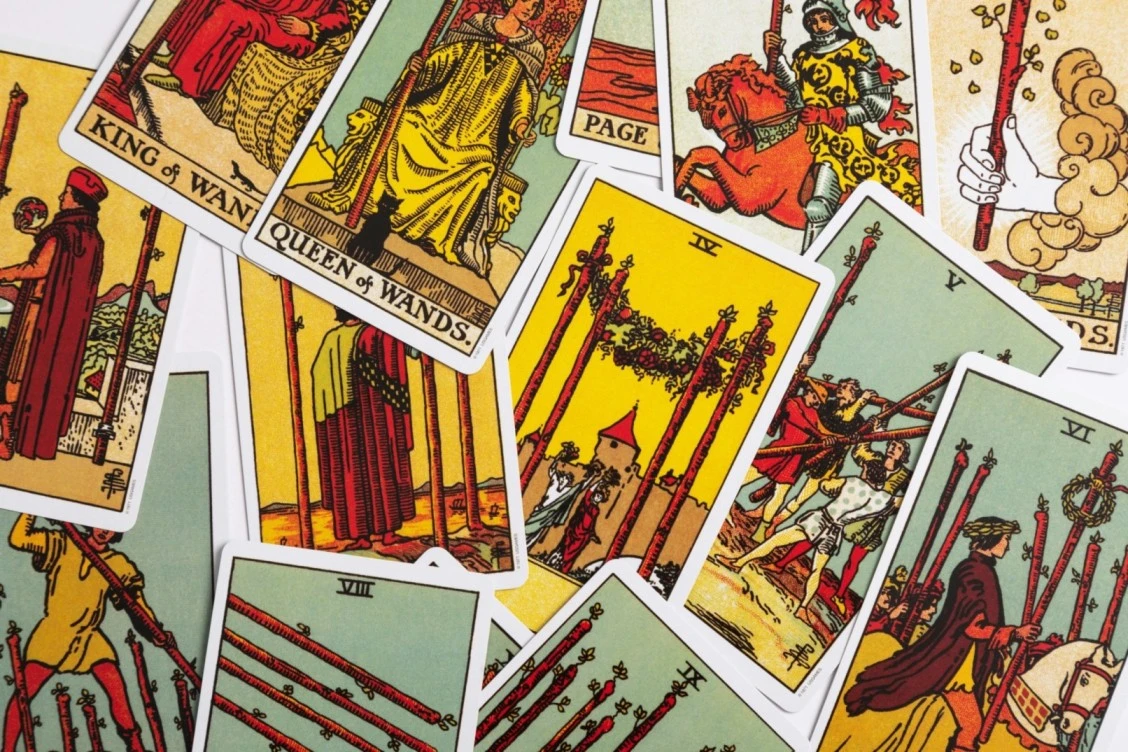
In The Major Arcana for Beginners, the 22 cards that carry the deck's deepest archetypal weight were introduced as the structure everything else hangs from. This piece covers everything else: the 56 cards of the Minor Arcana, which describe not the spiritual themes of a life but the daily textures of one. The Major Arcana tells you that you are moving through a period of the Wheel of Fortune — change beyond your control. The Minor Arcana tells you what that looks like on a Tuesday.
Most beginner Tarot content underweights the Minor Arcana, treating them as secondary to the Majors or as a long list to memorise. This piece treats them as the working core of practical reading — the cards that carry the most actionable information in most spreads, the cards that describe the specific situation with precision the Majors cannot. To read Tarot well is to read the Minor Arcana well.
What the Minor Arcana are
The Minor Arcana comprises 56 cards divided into four suits of 14 cards each. Each suit runs from Ace through Ten — ten pip cards — plus four court cards: Page, Knight, Queen, King. The name "Minor Arcana" means the lesser mysteries: not lesser in importance, but more granular, more tied to the particulars of daily experience than to the great archetypal currents the Majors map.
The illustrated Minor Arcana familiar from the Rider-Waite-Smith deck is a 20th-century development. Earlier decks — the Tarot de Marseille, the Visconti-Sforza — showed the pip cards as pure symbol arrangements: five cups placed on a card, seven swords crossed. Pamela Colman Smith's illustrated scenes for each of the 78 cards in the 1909 RWS deck were innovative, and they are now the basis for most modern reading practice. When you read the Five of Cups as a card about grief, you are responding to Smith's image of a cloaked figure standing over three spilled cups with two still standing behind them. The image is the teaching.
The elemental correspondences that organise the four suits are the other key framework. Each suit belongs to one of the four classical elements, and that element shapes every card in the suit. Understanding the elements gives you a framework to derive any Minor Arcana meaning rather than memorising 56 individual definitions.
The four suits
Wands — Fire
Wands (also called Rods, Staves, or Staffs in different traditions) belong to the element of fire. Their domain is will, passion, creative energy, ambition, inspiration, and the spiritual drive that moves a person toward what matters to them. Wands are the suit of the entrepreneur, the artist in full creative momentum, the person powered by vision and desire.
The character of the suit is fast, energetic, and sometimes volatile. Wands cards often arrive when things are moving quickly, when enthusiasm is high, when action is being taken or urged. Many Wands in a spread typically indicate high energy and momentum — and sometimes the exhaustion or scatteredness that follows when that energy isn't well-managed.
A few specific anchors. The Ace of Wands is pure creative potential — a new impulse or inspiration arriving, the gift of fire in its undiluted form. The Three of Wands is vision extended into the world, waiting for the results of what has already been launched: the ships are at sea, the work is done, the outcome is not yet known. The Eight of Wands is sudden rapid movement — communications arriving, situations accelerating, the energy concentrated into speed. The Ten of Wands is the burden of too much taken on: the finish line is visible but the load is heavy, and the card often asks whether everything being carried actually needs to arrive at the destination.
Cups — Water
Cups (also called Chalices) belong to water. Their domain is emotion, intuition, relationship, the unconscious, dreams, and the inner life. Where Wands describe what you are doing, Cups describe what you are feeling. The suit of the heart, the imagination, and the bonds between people.
Cups cards are deep rather than fast — they invite reflection rather than action. Many Cups in a spread typically indicate emotional weather as the primary concern: what is being felt, what needs to be processed, what the heart wants or mourns. This can mean rich emotional life or it can mean emotional overwhelm; the surrounding cards and the specific positions clarify which.
Anchors: the Ace of Cups is emotional abundance and new beginning — love or connection offered, the heart opened. The Two of Cups is the equal partnership, the genuine meeting of two people, the handshake of mutual recognition. The Five of Cups is grief and loss — with the specific detail that the figure stands over three spilled cups while two remain standing behind them. There is loss; there is also what has not been lost, which the card quietly notes while the figure looks only at the spillage. The Eight of Cups is the quiet leaving — walking away from what no longer serves emotionally, even when leaving is hard. The Nine of Cups is the wish fulfilled: satisfaction, contentment, sometimes smug comfort in what has been achieved.
Swords — Air
Swords belong to air. Their domain is the mind, thought, communication, decision, conflict, truth, and the sharpness of intellect applied to difficult situations. Swords are the suit of the lawyer, the analyst, the person for whom thinking is the primary mode of engagement with the world — and of the person caught in the mental loops that follow when that mode is under stress.
Swords is the suit that beginners most often fear, because its imagery is confronting: swords through hearts, figures huddled in defeat, a blindfolded person surrounded by blades. It is worth being direct about what these cards mean: Swords cards describe the truth of a situation, including painful truths. They are not cursing. The Three of Swords does not cause heartbreak; it names it. The Ten of Swords does not cause endings; it confirms them. A surgeon's instrument is sharp. That is not a flaw.
Anchors: the Ace of Swords is clarity arriving — the truth about to be spoken, the decision becoming possible, the mental fog lifting. The Three of Swords is heartbreak and grief, specifically the sorrow that comes from a truth that could no longer be avoided. The Eight of Swords shows a figure bound and blindfolded, surrounded by swords — but the binds are not tight, the blindfold could be removed, and the swords are arranged around rather than against the figure. The feeling of being trapped is real; the trap itself, on examination, is less fixed than it appears. The Ten of Swords is the ending that is genuinely an ending — painful, definitive, and also complete. From here, there is no further down. That is the card's quiet consolation.
Pentacles — Earth
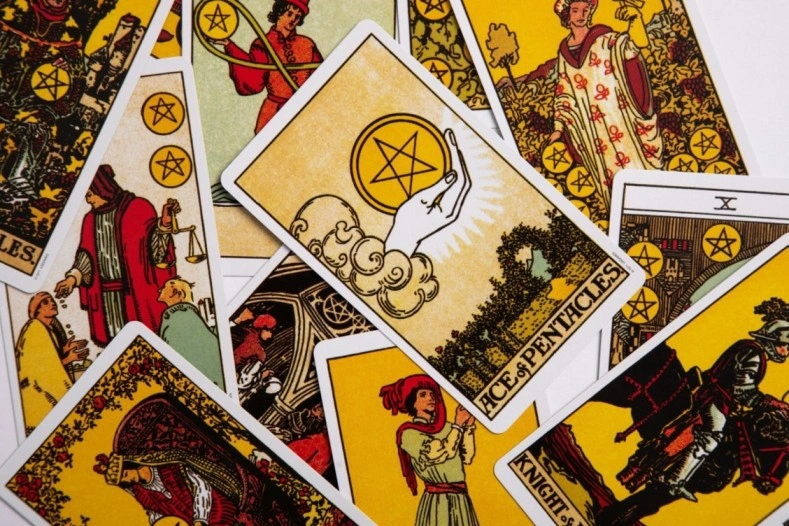
Pentacles (also called Coins or Disks) belong to earth. Their domain is the material world: money, work, the body, health, practical matters, and the patient, methodical accumulation of what endures. Pentacles are the suit of the gardener, the accountant, the craftsperson who builds something over years rather than weeks.
The character of the suit is slow, grounded, and concerned with what actually holds. Pentacles cards rarely arrive with urgency — they describe conditions rather than events, and they ask for attention to the practical foundations of a life. Many Pentacles in a spread typically indicate a period of material focus: what needs to be built, maintained, or secured. They can also indicate a period that is too focused on material concerns at the expense of the emotional, spiritual, or creative dimensions the other suits cover.
Anchors: the Ace of Pentacles is material opportunity — a new beginning in practical or financial terms, the seed of something that will take time to grow. The Four of Pentacles is the energy of holding on too tightly: the figure clutches their coins at chest, feet, and crown, protected but immobilised. Security tipping into hoarding. The Six of Pentacles is the equitable exchange — giving and receiving in balance, generosity that is also just. The Nine of Pentacles is material independence achieved through sustained work: the satisfaction of having built something real, and of being able to stand in the garden of what you built.
The numerical structure
Here is the framework that makes all 56 cards navigable. Each number carries a consistent meaning across all four suits — the suit element colours it, but the number's stage in the cycle holds. If you know the suit and you know the number, you can derive any pip card.
Ace: Pure potential; the gift of the element in its undiluted form; the very beginning of the cycle.
Two: Duality, choice, the first encounter with another; balance sought between two things.
Three: Initial growth, the first fruit of effort, collaboration or creativity in early expression.
Four: Structure, stability, rest, consolidation; the foundation laid.
Five: Conflict, disruption, challenge, loss; the number that unsettles the four's order.
Six: Recovery, harmony returning, generosity, movement toward equilibrium after the five's disruption.
Seven: Assessment, the test before mastery, evaluation of where things stand; often a moment of looking clearly at what has been built.
Eight: Movement, momentum, action; the energy gathered and released.
Nine: The penultimate; near completion, with the element expressed at its most concentrated. Nine of Cups: the wish almost fully granted. Nine of Swords: anxiety at its most acute. Nine of Wands: the exhausted last stand before the finishing line. Nine of Pentacles: the garden in its fullest growth.
Ten: Completion, culmination, the end of the cycle; the Ten always implies the next beginning is implicit in the ending.
Combine any element with any number: the Six of Swords is recovery (six) in the domain of the mind and communication (air/Swords) — the movement away from conflict toward calmer waters, which is exactly what the image shows. The Three of Pentacles is initial growth (three) in the material domain (earth/Pentacles) — the craftsperson at work on a commission, showing their work to those who commissioned it. The framework holds.
The court cards
The sixteen court cards — four per suit — are the most challenging part of the Minor Arcana for beginners, because they resist the numerical framework above. They are not stages in a process. They are character types, energies, or situational roles.
Pages carry the learning energy of their suit — curious, receptive, at the beginning of developing the suit's qualities. They often represent messages, new beginnings with a quality of freshness and inexperience, or an actual young person in the querent's life. The Page of Cups is the emotionally open dreamer; the Page of Swords is the keen but untested intellect; the Page of Wands is creative enthusiasm not yet disciplined into skill.
Knights carry the active, questing energy of their suit — the energy of pursuit, of action taken, of the suit's qualities expressed as movement. Knights are the most action-oriented court cards, and also the most prone to excess: the Knight of Wands pursues with passionate speed and may not notice when the horse is tiring; the Knight of Swords charges at problems directly and may not always consider whether the direction is right.
Queens represent mature mastery of the suit's element expressed inwardly — deep command of the domain, applied with emotional intelligence and inner authority. The Queen of Cups is emotional intelligence and intuition at their most developed; the Queen of Pentacles is the master of the material and domestic world, nurturing and practical in equal measure; the Queen of Swords holds clarity without cruelty, truth spoken with compassion earned through experience.
Kings represent mature mastery expressed outwardly — authority, leadership, and command applied in the world. The King of Swords is clear-minded intellectual authority, the judge or strategist at full power; the King of Pentacles has built something substantial and knows how to maintain it; the King of Wands has the charisma and creative vision to inspire others toward a shared goal.
In a reading, court cards most often represent either an actual person (someone in the querent's life, or the querent themselves) or a quality of energy that the situation is calling for. The Knight of Swords in an advice position is not necessarily a person — it may be a suggestion to move decisively and directly toward the problem. Reading context determines which interpretation fits.
Reading the Minors in a spread
The practical relationship between Major and Minor Arcana in a spread can be stated simply. The Majors identify the large-scale themes and spiritual currents at work. The Minors provide the texture, the specific situation, and the practical information about what is happening and what to do about it.
If the Major Arcana is the genre of the story — "this is a period of the Tower, of structural collapse and rebuilding" — the Minor Arcana is the plot. What is actually happening in the relationship? What is the practical state of the finances? What is the mind churning over at 3am? The Minors answer these questions where the Majors set the frame.
A reading with no Major Arcana is not shallow. It is a reading that is answering questions in the register of daily life rather than deep pattern. A spread full of Pentacles and Cups, with no Majors, is telling you that the situation is primarily about the practical state of things and the emotional weather around them — and that is often exactly the right answer to a grounded, specific question.
Suit dominance is a useful first-pass reading tool. Many Swords: the mind is significantly engaged, possibly under significant pressure. Many Cups: emotional life is the primary arena. Many Wands: energy and movement, possibly scattered. Many Pentacles: practical concerns and material foundations. Court-heavy spreads often indicate that the people in the situation are the most significant variable, rather than the themes or practical circumstances.
How to learn the Minor Arcana
The same principle from the Major Arcana piece applies here: relationship before definition. A card meaning earned from regular encounter with it in readings is more useful than a meaning memorised from a list.
The two-grid approach is the most efficient entry point. Learn the suit characters first — four elements, four domains, four emotional textures. Then learn the numerical stages — ten stages from initiation to completion. With those two frameworks, you can derive the broad meaning of any pip card before you have ever seen it in context. The court cards require separate attention and benefit from being worked with as character studies rather than definitions.
A practical exercise: take the 56 Minor Arcana out of your deck and sort them into four suit piles. Work through one suit slowly, laying each card out in order from Ace to King and reading the numerical stage + suit element for each before you look at the image. The image, when you look at it, should either confirm your derived meaning or complicate it productively. Both outcomes are learning.
For daily practice with the full 78-card deck — Majors and Minors together — see Daily Tarot Practice. The elemental frameworks the Minor Arcana draw on are covered more broadly in the forthcoming Sympathetic Magic: A Primer.
Common questions
Why are there so many difficult-looking Swords cards? The Swords suit belongs to air and the mind, and the mind under difficulty generates conflict, anxiety, and the kind of painful clarity that comes from having to face hard truths. The difficult imagery is diagnostic rather than threatening — the cards describe mental and communicative experience at its most intense. They are not worse cards than the others; they are honest about what difficulty looks like.
Do I need to learn all 56 meanings individually? No — and trying to do so often produces a reader who can recite definitions but cannot actually read. The two-grid approach (suit element + numerical stage) gives you a framework to work from. The specific card meanings deepen with practice rather than with memorisation.
What does it mean when almost all my cards are court cards? Court-heavy spreads typically indicate that the situation is primarily about people and their roles — who is acting, in what capacity, with what motivation — rather than about themes or circumstances. Consider who in the situation each court card might represent, including the possibility that some represent different aspects of the querent themselves.
Are the Minors less important than the Majors? Not in a practical reading. The Majors identify the large current; the Minors carry the specific, actionable information. In most everyday readings the Minors do more of the actual work. "Minor" describes their position in the symbolic hierarchy of the deck, not their significance in reading practice.
Sources
The interpretive tradition drawn on here is primarily the modern horoscopic Tarot tradition as developed through and after the Rider-Waite-Smith deck (1909). For the elemental attribution of the four suits: Arthur Edward Waite, The Pictorial Key to the Tarot (1911); the Golden Dawn correspondence system as transmitted through Aleister Crowley's Liber 777 (1909). For the court-card character framework: Rachel Pollack, Seventy-Eight Degrees of Wisdom (1980; revised 1997) — the most thorough modern treatment of the full deck's character and structure. For daily practice: Daily Tarot Practice.
Grimoire is a digital practice companion for the solitary witch — a daily tarot draw, sacred calendar, private grimoire journal, herbology compendium, and natal chart tool, all in one place. Now available on Android.
More from the Blog
The Major Arcana for Beginners
The 22 cards of the Major Arcana are the spine of the Tarot deck: the ones that carry the deepest archetypal weight and mark the most significant themes in a reading. A complete beginner's guide: the Fool's Journey, every card characterised, and how to actually learn them.
A Beginner's Guide to Tarot for Solitary Witches
Tarot is not fortune telling. It is a mirror, a way of asking better questions.
Begin your practice
Grimoire is available now on Android and as a web app. Start today.