Ancient Occult Texts
Agrippa's Three Books of Occult Philosophy
Rowenna
Solitary witch and the founder of Grimoire. Built the app she couldn't find anywhere else. Writes about the craft with primary sources, honest lineage notes, and a low tolerance for vague correspondences. Based in the UK with more herbs than shelf space.
· 10 min read
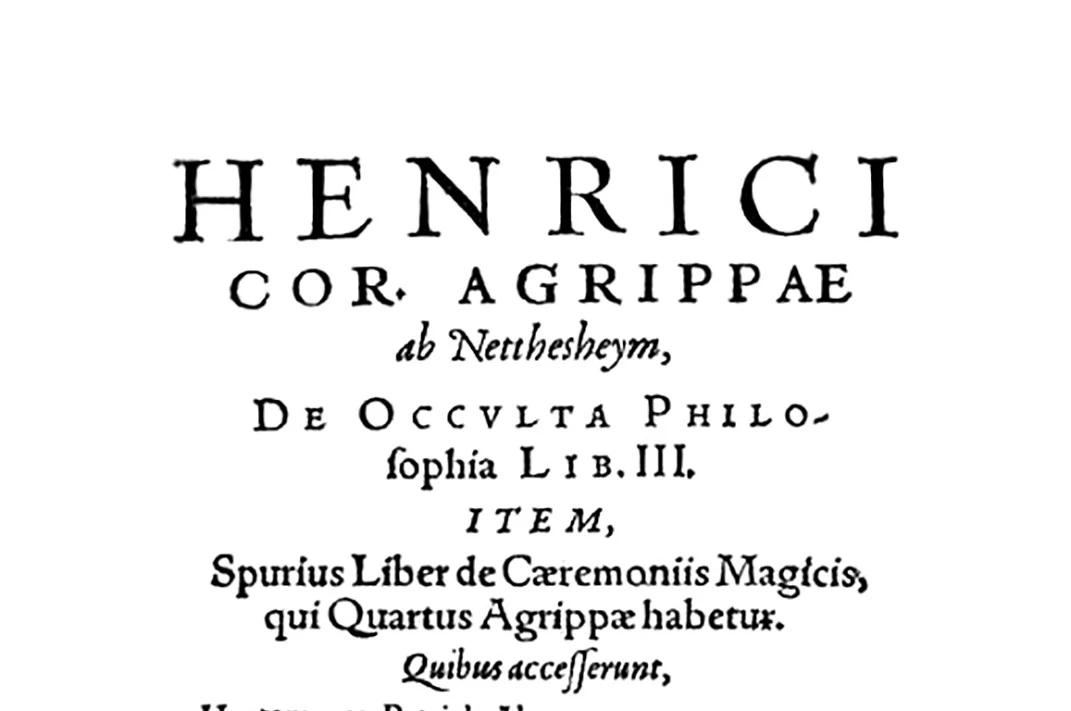
This piece lands on the Virgo new moon — a thematically apt moment to write about the most systematic book in the Western magical tradition. De Occulta Philosophia libri tres, the Three Books of Occult Philosophy by Heinrich Cornelius Agrippa von Nettesheim, published in 1531 to 1533, is the Renaissance synthesis: the work that gathered the entire inheritance of classical natural philosophy, Hermetic mysticism, Jewish Kabbalah, Arab astronomical magic, and Christian theology into a single coherent system. Every major Western magical tradition since (Renaissance ceremonial magic, Christian Cabala, the Rosicrucian synthesis, the Hermetic Order of the Golden Dawn, and through the Golden Dawn, modern Wicca and much of contemporary witchcraft) stands on this foundation, often without knowing it.
This is the fourth piece in the Ancient Occult Texts cluster. The Greek Magical Papyri gave us antiquity; The Picatrix gave us the medieval Arabic synthesis; Aradia gave us the 19th-century modern construction. Agrippa fills the Renaissance gap between the medieval and modern worlds; and fills it with a book that is, among other things, the direct ancestor of the herb-and-planet correspondence tables you may already be using.
Agrippa himself
Heinrich Cornelius Agrippa von Nettesheim was born in Cologne in 1486 and died, probably in Grenoble, in 1535. The "von Nettesheim" is a scholarly honorific he seems to have adopted rather than an inherited noble title: typical of the Renaissance humanist tendency to decorate a reputation. What is not decorated is the life: he served as a soldier, practised and taught medicine, lectured at universities across Europe, worked as a secretary in the courts of Holy Roman Emperors and French queens, was accused of heresy multiple times, and in 1519 successfully defended a woman in Metz who had been accused of witchcraft, using legal argument rather than magic, which is a specific and important detail. He was a man of considerable practical courage as well as considerable theoretical ambition.
He is also, unusually, the author of two apparently contradictory major works. De Occulta Philosophia, the occult synthesis he spent decades developing, and De Incertitudine et Vanitate Scientiarum (On the Uncertainty and Vanity of the Sciences, 1530), a comprehensive satirical attack on all human knowledge, including magic. Scholars have debated for centuries whether the second work represents a sincere recantation of the first. The honest position is more interesting than either side: the two works explore the same territory from different angles, and both are serious. Agrippa was capable of simultaneously building a system and questioning whether any system could hold.
What the three books actually contain
The three books are not three volumes of equal content but three levels of a single ascending argument about how magic works and where its power comes from.
Book I: Natural Magic concerns the magical properties of natural things: the four elements and their qualities; the properties of herbs, stones, and animals; the principles of sympathy and antipathy by which like acts on like across the natural world; the specific correspondences of materials to planets and signs. This is the most immediately practical book and the one with the most direct relevance to modern witchcraft. The elemental and planetary correspondence systems that underpin most modern herbalism, colour magic, and crystal work trace substantially to what Agrippa organised and systematised here.
Book II: Celestial Magic concerns the influence of the stars and planets on the earthly world, and the mathematical and geometrical structures through which those influences can be worked with. This is where Agrippa sets out the planetary hours, the Kabbalistic correspondences of letters and numbers, and (most distinctively) the magic squares, or kameas: numerical grids assigned to each planet whose rows, columns, and diagonals sum to the same number, and which were used in talisman-making. The Saturn square, the Jupiter square, the Mars square: these appear in Agrippa, and they still appear in ceremonial magic practice today.
Book III: Ceremonial Magic concerns the highest level of magic in Agrippa's system: divine names, angelic hierarchies, the operations that work directly with the intellectual and divine world rather than its material or celestial reflections. This is the most explicitly Christian book of the three, and the most distant from modern witchcraft's working practice, though its angelic hierarchies and divine name workings feed directly into the ceremonial magic traditions that eventually reached the Golden Dawn.
The three-tier structure is not arbitrary. It reflects a Neoplatonic cosmology of ascending levels of being: the material world, the celestial world, and the divine intellectual world above both. Magic at each level works through the correspondences of that level. Natural magic works with herbs and stones because they participate in the elemental and planetary influences above them. Celestial magic works with those influences directly. Ceremonial magic reaches for the divine source of all influence. It is a complete and internally coherent system, which is precisely why it remained foundational for four hundred years.
Where it came from
Agrippa was writing at the convergence of several intellectual currents that the Renaissance had brought together for the first time.
Marsilio Ficino, the Florentine philosopher sponsored by the Medici, had translated both the complete works of Plato and the Corpus Hermeticum: a body of texts believed in the Renaissance to be ancient Egyptian wisdom (they are actually Greco-Roman texts from the same late-antique milieu as the Greek Magical Papyri, but the error was productive: everyone treated them as ancient Egyptian, which gave them enormous authority). Ficino's Neoplatonic synthesis made a version of natural magic intellectually respectable for Christian scholars: the world was animated by sympathies and influences that a learned person could work with.
Giovanni Pico della Mirandola had taken this further, arguing that Jewish Kabbalah (studied through Latin translations and the work of Christian Hebraists) was the best possible proof of the truth of Christianity, and that the combination of magic and Kabbalah represented the highest form of natural theology. His Oration on the Dignity of Man (1486) and his Conclusiones set out a framework in which the Kabbalistic divine names and the Hermetic magical principles were unified with Christian theology.
Agrippa absorbed both of these influences, added the Arabic magical tradition (particularly the astral magic of al-Kindi and the Picatrix), drew on classical natural history from Pliny and Dioscorides, and synthesised the whole into the three books. He also wrote in explicit engagement with his predecessors, citing his sources throughout, which is part of what makes the book so valuable as a historical document. You can trace exactly where each element came from.
The honest-lineage move: Agrippa was a Christian
This is the point that most modern witchcraft content either misses or deliberately avoids, and it changes something important about the relationship to the material.
Agrippa was a Christian. De Occulta Philosophia is a Christian book. Its ultimate framework is Christian theology: the three levels of magic correspond to three levels of divine creation; the highest magic works through the names of the Christian God and the angelic hierarchies of Christian theology; the entire enterprise is justified as a form of piety, a more complete understanding of God's work in the world. Agrippa was not writing for pagans or pre-Christian practitioners. He was writing for Christian humanist scholars who wanted to understand the full depth of creation's magical structure within a Christian framework.
The systems he organised (planetary correspondences for herbs, stones, and hours; elemental attributions; colour magic; the structure of the seven planets as a working framework) operate within this cosmology. When those systems were later extracted from the Christian framework by the Golden Dawn, by Aleister Crowley, and eventually by Gerald Gardner and the Wiccan tradition, they were made to work in non-Christian contexts. They do work: the systems are internally consistent and have accumulated enormous practitioner attention. But they carry their origin with them.
The modern witch who assigns rosemary to the Sun and Mars, who works by planetary hours, who uses elemental attributions for the four directions, is using systems that Agrippa organised within a Christian-Neoplatonic-Kabbalistic framework. Knowing this is not a reason to stop using them. It is a reason to use them with a clearer understanding of what they are: a 16th-century Christian scholar's systematic organisation of inherited magical knowledge, later secularised and neopagan-ised through several generations of occultists. The correspondence tables in your spellcraft practice have that history inside them.
The transmission: from Agrippa to your correspondence table
The line from Agrippa to modern witchcraft practice is direct and traceable through named intermediaries.
Agrippa's three books circulated in manuscript from around 1510, twenty years before formal publication: the intellectually active occultist community of the early 16th century had access to them long before the general public. After publication in 1531 to 1533 they were widely read across Europe and repeatedly reprinted. They fed directly into the broader Renaissance ceremonial magic tradition: John Dee, Robert Fludd, and other Elizabethan occultists worked explicitly with Agrippan frameworks.
Through the 17th and 18th-century Rosicrucian synthesis (which drew on Agrippa alongside Paracelsus and later developments) the material reached the 19th-century occult revival. The Hermetic Order of the Golden Dawn, founded in 1888, built its magical system explicitly on this inheritance. Aleister Crowley's Liber 777, which is essentially a comprehensive Agrippan correspondence table organised for Golden Dawn use, became the reference work for ceremonial magic in the 20th century. Gerald Gardner, whose Wicca drew extensively on the Golden Dawn framework, carried the correspondences into the modern witchcraft revival.
Every time a modern witch consults a chart of planetary hours, assigns a herb to a planet, or works with elemental attributions for the quarters of a circle, they are at the end of that chain. The system works because it is consistent and because it has accumulated centuries of practitioner attention. It also has Agrippa at its root, and it is worth knowing that.
The Fourth Book: and a caveat
A fourth book appeared posthumously, attributed to Agrippa, containing more direct practical instructions for working with spirits and demonic entities than Agrippa's three books offered. It was printed alongside the genuine three books for centuries and became influential in ceremonial magic circles. Most modern scholars consider it apocryphal: the style, the approach, and the content do not match the three genuine books closely enough to sustain the attribution. If you encounter references to a "Fourth Book of Agrippa," treat the attribution with scepticism.
Common questions
Do I need to read De Occulta Philosophia to practise modern witchcraft? No. The systems Agrippa organised have been transmitted through many hands and are available in accessible modern forms (planetary correspondence tables, elemental frameworks, herbal attributions) without requiring engagement with a 16th-century Latin scholarly text. But reading at least Book I in translation rewards anyone seriously interested in where modern witchcraft's working systems come from.
Is there a good modern translation? Yes, Donald Tyson's annotated edition, published by Llewellyn, is the standard accessible English translation and includes extensive notes explaining Agrippa's sources and references. It makes a dense text navigable for a modern reader without a Renaissance humanist education.
Does the fact that Agrippa was Christian mean his magic doesn't work for non-Christians? The systems work independently of the cosmology that originally organised them, in the same way that algebra works for people who know nothing about the Islamic Golden Age mathematicians who developed it. What changes when you know the origin is your relationship to the tools: you understand them more clearly, which makes working with them more intentional.
How does this connect to the other Ancient Occult Texts pieces? The cluster's chronological scope now runs from antiquity (the Greek Magical Papyri) through the medieval Arabic synthesis (the Picatrix) through the Renaissance Christian synthesis (Agrippa) to the 19th-century modern construction (Aradia). Each piece is a distinct moment in the transmission of Western magical thought. Read together, they trace a single tradition across two thousand years.
Sources
Heinrich Cornelius Agrippa, Three Books of Occult Philosophy, trans. and ed. Donald Tyson (Llewellyn, 1993): the standard modern annotated English edition. For the Renaissance intellectual context: Brian Vickers, ed., Occult and Scientific Mentalities in the Renaissance (Cambridge University Press, 1984); D.P. Walker, Spiritual and Demonic Magic from Ficino to Campanella (Warburg Institute, 1958). For the Golden Dawn transmission: Ronald Hutton, The Triumph of the Moon (Oxford University Press, 1999) traces the influence through to modern Wicca.
Grimoire is a digital practice companion for the solitary witch — a sacred calendar, private grimoire journal, daily tarot, herbology compendium, deity work, and spell builder, all in one place. Now available on Android.
More from the Blog
The Greek Magical Papyri
The most important corpus of magical texts you have probably never heard of: practical spells from Greco-Roman Egypt, written across seven centuries. Where they came from, what they contain, and why they are the root of the whole Western grimoire tradition.
The Key of Solomon
The Key of Solomon is the most famous medieval grimoire — and the source of almost every magical tool in modern Wicca. The athame, the wand, the cup, the pentacle, the cast circle, the planetary hours. A source-critical account of what the text actually contains, where it came from, and how it reached your practice.
Begin your practice
Grimoire is available now on Android and as a web app. Start today.