Ancient Occult Texts
The Key of Solomon
Rowenna
Solitary witch and the founder of Grimoire. Built the app she couldn't find anywhere else. Writes about the craft with primary sources, honest lineage notes, and a low tolerance for vague correspondences. Based in the UK with more herbs than shelf space.
· 10 min read
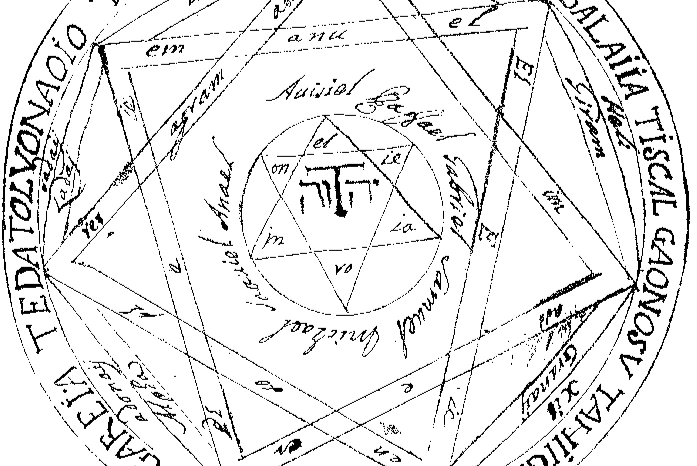
This piece lands on the Libra new moon — a thematically apt moment for the text that brought formal structure and balance to the Western magical tradition. The Clavicula Salomonis, the Little Key of Solomon, is the most famous medieval grimoire in the Western magical tradition, and it is the foundational source that almost no modern witch traces their tools back to.
If you practice Wicca or any modern witchcraft tradition that uses four elemental tools — a knife or athame, a wand, a cup, and a pentacle or disk — you are using implements whose form and consecration derive from the Key of Solomon. If you cast a magic circle, the structure of that circle descends from the Key. If you work by planetary hours, you are following a schedule the Key of Solomon organised. This piece is the fifth in the Ancient Occult Texts cluster, sitting alongside the Greek Magical Papyri, the Picatrix, Agrippa's Three Books, and Aradia. It is the piece the cluster has been building toward — the load-bearing wall of modern Western magical practice.
What the Key of Solomon actually contains
The text as we have it is organised into two books, and the distinction between them is structurally important.
Book I concerns what the magician does: the conjurations, invocations, and procedures for summoning, binding, and commanding spiritual entities. It provides the words to speak, the circles to draw, the protections to observe. This is operational magic in its most systematic medieval form — a working manual for the practitioner who wants to compel spirits to specific ends: finding treasure, obtaining love, healing the sick, defeating enemies. The spirits are organised by planet and purpose; the procedures are detailed and sequential.
Book II concerns what the magician prepares: the consecration of tools, garments, and ritual materials; the timing of operations by planetary hour; the construction of the magic circle and the pentacles. The four primary working tools appear here — the knife, the wand, the vessel or cup, the pentacle or disk — with specific instructions for their materials, manufacture, consecration, and use. Each tool corresponds to one of the four elements in the system that the Golden Dawn and Wicca would later formalise. Each tool is treated not as a symbol but as a working instrument that has been properly prepared and empowered.
The "pentacles" of the Key require a specific clarification: they are not the five-pointed star symbol but talismanic diagrams — complex geometric and textual designs assigned to each of the seven classical planets. The Key contains multiple pentacles for each planet, each with a specific power: the first pentacle of Jupiter for spiritual wisdom, the fourth pentacle of Mars for victory, the sixth pentacle of Saturn for protection. These talismanic designs, reproduced and modified through five centuries of magical practice, are the ancestors of the planetary seals and symbols still used in modern ceremonial magic.
Where the text came from
No single authoritative Key of Solomon exists. What we have is a family of manuscripts — in Latin, Italian, French, and English — dated from approximately the 14th century onward, varying significantly between versions in their content, organisation, and specific procedures. S. L. MacGregor Mathers, the Victorian occultist who published an influential English translation in 1889, drew on several British Museum manuscripts and produced a synthesis that he presented as a single coherent text. It is not. Joseph H. Peterson's modern scholarly edition, which collates multiple manuscript versions and shows their differences, is the current critical standard.
The sources the Key draws on are the same sources that fed the broader medieval magical synthesis. Jewish Kabbalistic and magical tradition contributed the divine names — the Hebrew names of God and angels that appear throughout the conjurations, giving them their theological authority. Arabic magical tradition contributed the astrological framework — the same planetary magic that fed the Picatrix. Hellenistic tradition contributed the spirit-hierarchy framework — the same syncretic currents documented in the Greek Magical Papyri. The overarching Christian theological framework — which justifies the magician's authority over spirits on the grounds of their own faith and righteousness — is medieval European.
The result is a text that is Jewish in its divine names, Arabic in its astrological timing, Hellenistic in its spirit-cosmology, and Christian in its ritual theology. This is the same multicultural synthesis the cluster has identified at every point in the Western magical tradition: it was never monocultural, and the Key is as clear an example as the PGM.
The Solomon attribution — and what it meant
King Solomon, who ruled roughly in the 10th century BCE, had nothing to do with this text. This is not a controversial claim. Nobody in the medieval period who copied or used a manuscript of the Key believed they were holding Solomon's actual manual. "Written by Solomon" was a quality claim, not a historical one.
Solomon's authority as a magical figure comes from the biblical narrative — his wisdom, his power over spirits, his construction of the Temple — and was extensively developed in Jewish, Islamic, and Christian tradition throughout the medieval period. The Quranic tradition gives Solomon command over the jinn. The Jewish mystical tradition elaborated his power over spirits into a full angelology and demonology. By the medieval period, "Solomonic" had become the highest credential a magical text could carry: this is what the greatest magical king who ever lived knew and used.
Pseudo-attributing texts to famous authorities was standard medieval practice — the same convention that gave us pseudo-Aristotle and pseudo-Galen in philosophy and medicine. The Solomon attribution says: this text participates in the most powerful magical tradition available. It does not say: this text was written by a specific person who lived three thousand years ago.
Honest engagement with the text requires holding both facts simultaneously: the attribution is conventional and the content is medieval, and also the content is genuinely powerful, historically significant, and the root of most Western magical practice since the 14th century.
How the Key reached modern witchcraft
This is the section most modern witchcraft content leaves out, and it is the most important.
The Key of Solomon did not pass directly from medieval manuscripts to the altar of a 21st-century solitary witch. It travelled through a specific chain of transmission, and naming the chain is what makes the inheritance visible.
The Victorian occult revival brought the Key into a newly accessible form. Mathers's 1889 translation made the text available to the educated general reader for the first time. The Hermetic Order of the Golden Dawn, founded in 1888, built its entire ceremonial ritual system on Solomonic foundations — the four elemental tools, the consecrated circle, the invocations, the planetary timing. Every Golden Dawn initiate worked with Solomonic material as a matter of course.
Aleister Crowley, a Golden Dawn member before his various departures, carried the Solomonic framework into his own systems. His Liber 777 — the comprehensive correspondence table — is essentially a systematisation of Solomonic planetary and elemental correspondences into a single reference work. When modern witches consult a correspondence table that assigns herbs, stones, and colours to planets, they are using a table whose structure Crowley organised from Solomonic sources.
Gerald Gardner, the founder of Wicca, drew explicitly and directly on the Key of Solomon for Wicca's ritual structure. He cited it in his own Book of Shadows. The athame — Wicca's ritual knife — descends from the Key's black-handled knife (articulately described in Book II). The magic circle cast by the Wiccan high priestess follows Key of Solomon structure. The consecration of tools follows Key process. Gardner synthesised Solomonic ceremonial magic with folk magic, Freemasonry, nudism, and his own innovations, and presented the result as ancient witchcraft. Most of what feels "traditional" in modern Wicca is Solomonic ceremonial magic from the 14th–17th centuries, transmitted through Gardner in the 1950s.
The spell-crafting framework — tools, circle, intention, timing, closing — is this Solomonic structure, simplified and demystified. And the familiar spirits of the grimoire tradition, distinct from the folk-trial familiar, are Key of Solomon spirit-hierarchy material in their high-magic form.
What you are doing when you use Solomonic tools
You are using a 14th–17th century Christian European magical structure that was transmitted to modern witchcraft through the Victorian occult revival and early Wicca. This is not a reason to stop. It is a reason to know.
"Ancient pagan" is not an accurate description of the four-tool altar, the cast circle, or the planetary-hour timing system. The accurate description is: medieval ceremonial magic, of Jewish-Arabic-Hellenistic-Christian synthesis, systematised by the Hermetic Order of the Golden Dawn and adapted for modern witchcraft by Gerald Gardner in the 1950s. That is a less romantic description and a more precise one.
The Solomonic system works because it is internally coherent, because it has accumulated centuries of practitioner attention, and because the underlying principles — sympathetic magic, planetary timing, consecrated space — rest on structures that predate the Key itself. The medieval text organised and systematised what was already present in the tradition. Modern witchcraft adapted and simplified what the medieval text organised. The chain is real and it is traceable.
The cluster now spans its full chronological range: antiquity in the PGM, medieval Arabic synthesis in the Picatrix, medieval European synthesis in the Key, Renaissance systematisation in Agrippa, and modern construction in Aradia. Read together as a sequence, they trace the Western magical tradition across two thousand years — and make the contemporary practice legible as the latest adaptation of a very long inheritance.
Common questions
Is the Key of Solomon safe to read? Yes. It is a historical grimoire, dense and repetitive, with a lot of theological scaffolding that reads oddly to a modern practitioner. The Mathers translation is freely available online; the Peterson edition is the scholarly standard. Reading it is illuminating in the literal sense — you will recognise the structure of things you already do.
Did Gerald Gardner really use the Key of Solomon? Yes, explicitly. He cited it as a source in his Book of Shadows, and the structural parallels between Wiccan ritual and Solomonic ceremonial magic are direct enough that even without the citation they would be apparent. Ronald Hutton documents this in The Triumph of the Moon.
Is Wicca just Solomonic ceremonial magic? No — Gardner synthesised multiple sources, and the folk-magic and hedge-witch elements of Wicca are not Solomonic. But the formal ritual structure — tools, circle, timing, consecration — is substantially Solomonic in origin, filtered through the Golden Dawn. The folk-magic and the ceremonial-magic elements sit together in Wicca without always being distinguished, and knowing which is which makes you a more informed practitioner.
Sources
Joseph H. Peterson, ed., The Key of Solomon the King (Clavicula Salomonis) — the standard modern scholarly edition collating multiple manuscripts. S. L. MacGregor Mathers, trans., The Key of Solomon the King (1889; reprinted frequently) — the Victorian version Gerald Gardner used, freely available in digital form. Owen Davies, Grimoires: A History of Magic Books (Oxford University Press, 2009) — the most comprehensive historical survey of the grimoire tradition. Ronald Hutton, The Triumph of the Moon (Oxford University Press, 1999) — for Gardner's specific use of Solomonic sources in early Wicca.
Grimoire is a digital practice companion for the solitary witch — a sacred-text library, spell builder, private grimoire journal, sacred calendar, and daily tarot, all in one place. Now available on Android.
More from the Blog
Agrippa's Three Books of Occult Philosophy
Heinrich Cornelius Agrippa's De Occulta Philosophia (1531–33) is the load-bearing wall of Western magical thought: the book that gathered the entire inheritance of classical, Hermetic, Kabbalistic, and Christian magical knowledge into a single systematic treatment. Every correspondence table in modern witchcraft has its ancestor here.
Aradia, or the Gospel of the Witches: The Founding Text of Modern Witchcraft
Charles Leland's 1899 Aradia is the most influential and most contested book in modern witchcraft. What the text actually contains, where it came from, and why it still matters.
Begin your practice
Grimoire is available now on Android and as a web app. Start today.