Crystals
Emeralds: Stones of Rebirth, Protection, and Divine Vision
Rowenna
Solitary witch and the founder of Grimoire. Built the app she couldn't find anywhere else. Writes about the craft with primary sources, honest lineage notes, and a low tolerance for vague correspondences. Based in the UK with more herbs than shelf space.
· 8 min read
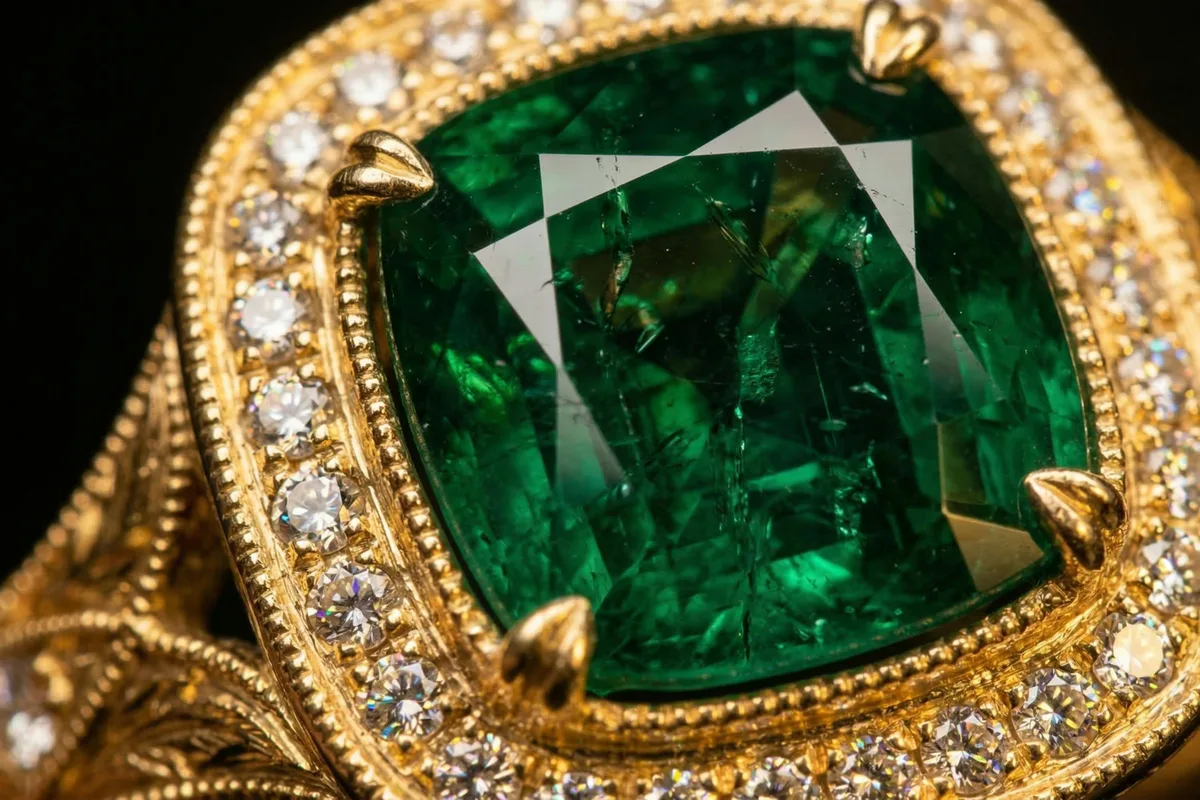
There is a green that exists nowhere else.
Not in moss, not in leaves, not in sea glass or malachite or the first new growth of spring. Pliny the Elder, the Roman author and naturalist, wrote in his encyclopaedic Natural History that "nothing greens greener" than an emerald, adding that "of all the precious stones, this is the only one that feeds the sight without satiating it." He was writing in the 1st century CE, but the sentiment reaches back as far as human record goes. Wherever the emerald has been found, it has been kept.
What an Emerald Is
Botanically, the word "emerald" comes to us from the ancient Greek smaragdos (meaning simply "green gem"), through Latin smaragdus and Old French esmeraude. For centuries, the term was applied loosely to any deeply green stone. But the emerald proper is a variety of the mineral beryl, coloured green by trace amounts of chromium and sometimes vanadium. Beryl in its pure form is colourless. The green is an accident of impurity: a ghost of chromium locked into the crystal lattice, translating light into something extraordinary.
Almost all natural emeralds contain inclusions: the fern-like, wispy formations that gemologists call jardin, the French word for garden. In most gemstones, inclusions are considered flaws. In emeralds, the jardin is part of the stone's character: a record of the conditions under which it formed, sometimes billions of years ago. Some estimates place the oldest emeralds at 2.97 billion years old, predating nearly all complex life on earth. You are holding something that has been waiting for most of geological time.
Cleopatra and the Mines of Egypt
The most famous emerald lover in recorded history is Cleopatra VII, last active ruler of the Ptolemaic Kingdom of Egypt. She claimed ownership of all the emerald mines in Egypt during her reign, the ancient workings at Sikait and Zabara in the eastern desert, known to the Romans as Mons Smaragdus, Emerald Mountain. These mines had been worked since at least 1500 BCE. Egyptian pharaohs were buried with emeralds as symbols of protection and eternal life, the green stone understood as a material embodiment of rebirth: the colour of the Nile's annual flooding, of fertility returning to the land, of life persisting beyond death.
Cleopatra gifted emeralds engraved with her own likeness to foreign dignitaries. She wore them as political statements and personal talismans simultaneously. The GIA (Gemological Institute of America), which maintains the primary scholarly record of gemstone history, documents the Egyptian mines as the world's principal source of emeralds until the discovery of Colombian deposits in the 16th century.
Emperor Nero, whose eyesight was notoriously poor, reportedly used a lens of emerald to watch gladiatorial competitions. Pliny noted this, and also recorded that gem cutters of his era believed that gazing at an emerald rested and restored their eyes between bouts of fine work. The stone had a reputation, across many cultures and traditions, for doing something to the quality of vision: for clearing, sharpening, and opening the capacity to see.
The Emerald Tablet
There is a text in the Western magical tradition older than most of its other foundational documents. It is called the Emerald Tablet, and it is attributed to Hermes Trismegistus, the legendary sage who represents a syncretism of the Egyptian god Thoth and the Greek Hermes, both gods of wisdom, writing, and the transmission of hidden knowledge.
According to the frame story preserved in early Arabic manuscripts, a figure called Balīnūs (the Master of Talismans) discovers a crypt beneath a statue of Hermes Trismegistus. Inside, an old man sits holding a book, with an emerald tablet in his hands. The text inscribed on that tablet (cryptic, compressed, and endlessly interpreted) became the foundational document of Western alchemy and one of the most influential texts in the Hermetic tradition.
As Wikipedia's article on the Emerald Tablet records, emerald was "the stone traditionally associated with Hermes, while quicksilver was his metal and Mercury his planet." The connection is not coincidental: the stone's association with vision, with hidden knowledge made visible, with the capacity to see what is not immediately apparent: all of these are Mercurial qualities. To work with emerald in a magical context is to work with the intelligence behind form, the pattern beneath the surface.
Planetary Associations
In Western astrological tradition, emerald is the stone of Venus: goddess of love, beauty, and the green world's fertility. This is its most common magical attribution, and it is ancient, attested in Roman texts and in sources from the medieval period through the Renaissance.
In Hindu tradition, however, emerald belongs to Mercury: the planet of communication, intelligence, and the swift movement of thought. The stone was understood to sharpen the mind, quicken wit, and enhance the capacity to transmit knowledge clearly.
Both attributions are worth holding. The emerald's history contains both: the love goddess and the messenger, the heart and the mind, the green of fertility and the green of Hermes's hidden tablet. A stone that feeds the sight without satiating it is not only a stone of beauty, but a stone of comprehension.
What Emerald Carries
The magical tradition attached many properties to emerald across its long history. Alchemical sources compiled by George Frederick Kuntz in The Curious Lore of Precious Stones (1913) record that "emerald sharpened the wits, conferred riches and the power to predict future events. To evolve this latter virtue it must be put under the tongue." It was also understood to counteract poison, strengthen memory, and protect against deception: the lover who kept an emerald was said to be able to read the truthfulness of their beloved in the stone's response.
The themes that persist across traditions are these: rebirth and renewal (from Egypt), protection (from the Inca, who kept their mines hidden and considered the stone sacred), and vision in the broader sense: not only physical sight, but the capacity to see clearly, to perceive what is true, to receive what is being offered by the unseen world.
In contemporary crystal work, emerald is associated with the heart chakra: the centre of love, compassion, and the capacity for genuine connection. This makes it both a stone for relationships and a stone for one's relationship with oneself, for seeing one's own worth clearly, without the distortions of fear or diminishment.
Emerald as May Birthstone
The formal standardisation of emerald as the May birthstone was made by the American National Association of Jewelers in 1912, though the association is considerably older. It appears in the biblical tradition, in early Hindu and Arabic gemological texts, and in the long correspondence between the stone's green and the month when the green world is at its most extravagant.
May is when the earth is fully committed to spring, when the season's intention has become growth that cannot be walked back. Emerald, with its associations with rebirth, with Beltane's green energy, with the heart open and the sight clear, is the May stone not because a committee decided it, but because the correspondence was already there. The birthstone list formalised something that had been understood for thousands of years.
Working with Emerald
Emerald is a stone for those who want to see clearly: in their relationships, in their creative work, in their understanding of what is genuinely growing in their life and what is not.
Hold it during meditation when you need to understand what is actually happening, rather than what you fear is happening, or what you hope is happening. Place it on your altar at Beltane alongside the other green stones and plants of the season: it carries the same energy of full-bloomed spring, of life having committed to itself.
For divination, emerald has a long traditional association with truth-telling. It does not soften what it shows. Work with it when you are ready for clarity rather than comfort. I have used it in exactly that context more than once and found it reliable. What it shows is accurate, not kind, which is, of course, a form of kindness.
Record your experiences with it in your Apothecary journal, noting the contexts in which you work with it, what surfaces, and how the stone's energy interacts with your own. Over time, your personal record of a stone's presence in your practice becomes more useful than any general correspondence list.
If you carry it, carry it with the awareness that you are carrying something ancient. The chromium that makes it green was here long before you. The jardin inside it is a map of time that exceeds imagination. Working with emerald is, among other things, a practice in perspective.
Sources
- Pliny the Elder, Natural History, Book XXXVII: primary ancient source on emerald's properties and history; English translation via Perseus Digital Library
- GIA (Gemological Institute of America), May Birthstone: Emerald: gia.edu/birthstones/may-birthstones
- Wikipedia, Emerald (mineralogy, etymology, and alchemical tradition): en.wikipedia.org/wiki/Emerald
- Wikipedia, Emerald Tablet (Hermes Trismegistus and planetary associations): en.wikipedia.org/wiki/Emerald_Tablet
- The Natural Emerald Company, Emeralds in Antiquity (Egyptian mines, Kuntz (1913) on magical properties): emeralds.com/education/emerald-history/antiquity-early-mines-and-connoisseurs
- Britannica, Emerald (etymology and Pliny's smaragdus): britannica.com/topic/emerald-gemstone
Further reading: the Witch's Guide to Crystals and Stones sets emerald in the wider context of stone work, and Astrology and Crystals: Beyond the Birthstone covers emerald's place as a Venus stone in the planetary correspondences. For the working starter kit, see Five Crystals Every Witch Should Own.
More from the Blog
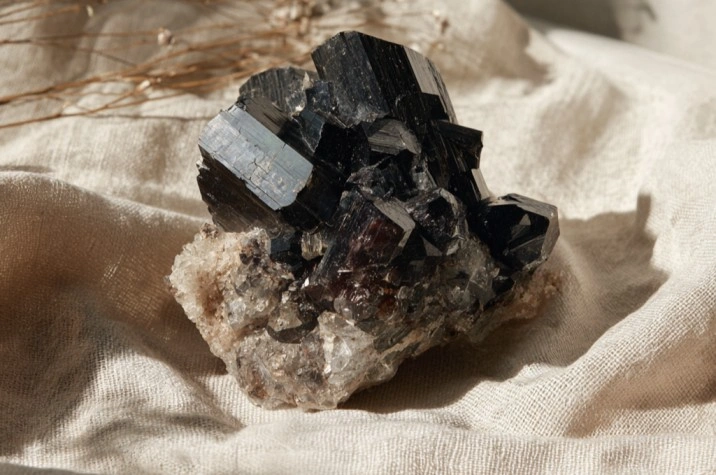
The Witch's Guide to Black Tourmaline
Black tourmaline is the most widely used protective stone in modern witchcraft. A complete profile: mineralogy, magical correspondences, threshold and grounding work, the selenite pairing, the EMF claim examined honestly, and sourcing guidance.
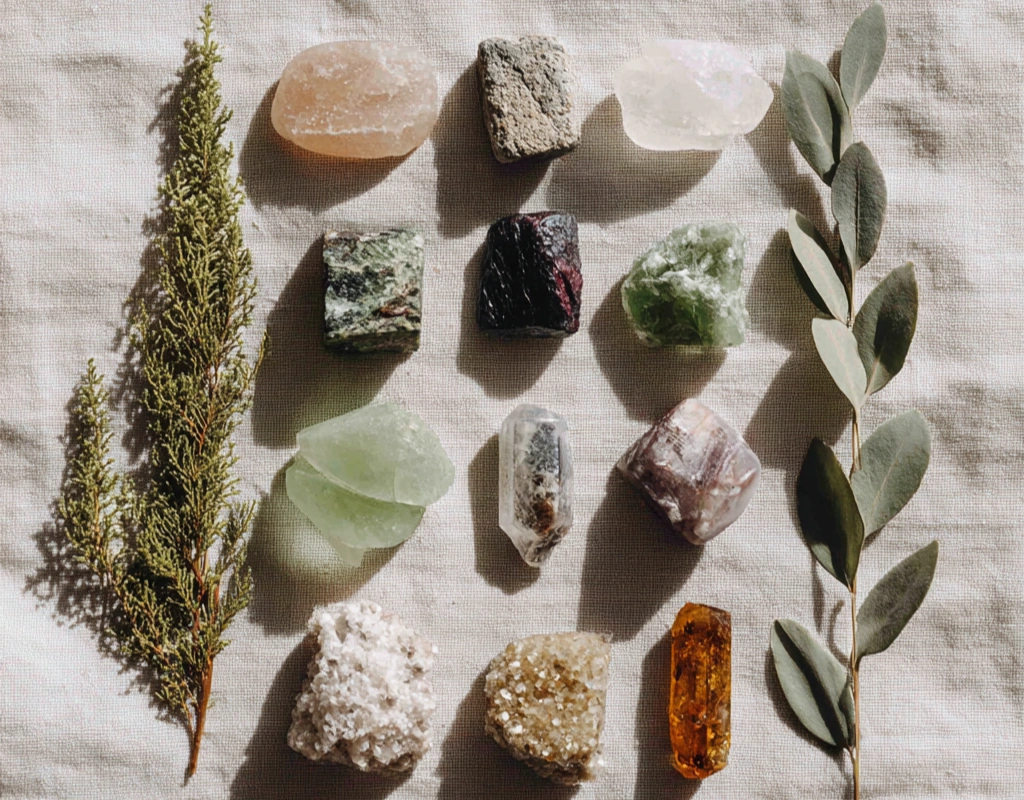
Astrology and Crystals: A Witch's Guide Beyond the Birthstone
How to work crystals astrologically: through the planets, the moon's phases, and your natal chart. A guide for the solitary witch.
Begin your practice
Grimoire is available now on Android and as a web app. Start today.