Crystals
The Witch's Guide to Crystals and Stones
Rowenna
Solitary witch and the founder of Grimoire. Built the app she couldn't find anywhere else. Writes about the craft with primary sources, honest lineage notes, and a low tolerance for vague correspondences. Based in the UK with more herbs than shelf space.
· 9 min read
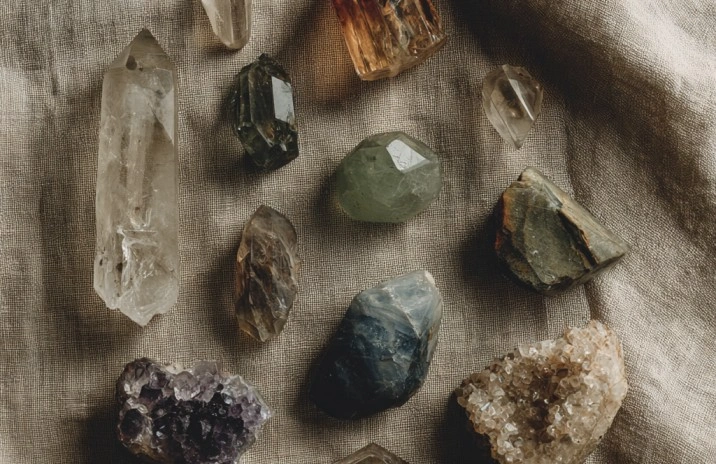
Crystals are one of the most heavily marketed corners of modern witchcraft, and one of the oldest practices within it. Both can be true. The Druids worked with naturally holed stones two thousand years ago. The Surrealists kept gogottes in their studios. Modern crystal shops sell tumbled rose quartz by the kilogram. The witch's question, beneath all of this, is how to use stones well.
This is the working answer. What stones actually do in practice, which ones are worth owning, how to look after them, where they come from, and how to tell the older traditions from the recent ones.
Two traditions, both valid
Most "crystal magic" guides treat crystals as a single tradition. They are not. There are two distinct streams running through the modern witch's relationship to stone, and a solitary practitioner benefits from knowing the difference.
The older stream is folk stone practice. It is the tradition of hag stones, of stones-with-natural-shapes, of stones from sacred landscapes. It runs through Pliny on the Druids, through Welsh and Cornish folklore, and into the working practice of Sussex midwives and Dorset fishermen.¹ The stones are usually free or cheap. The magic rests on the stone being made by something other than human hands.
The newer stream is correspondence-based crystal practice. It draws on Renaissance Hermeticism (Agrippa's planetary correspondences), the late-nineteenth-century occult revival, and the modern witchcraft revival from the 1970s onward.² The stones are usually mined and sold commercially. The magic rests on the stone's mineralogical, colour, or astrological correspondence.
Both work. Most working witches end up with stones from both streams: a hag stone by the door, an amethyst by the bed.
That is roughly where I land. The folk stone tradition is the one I find more interesting as a matter of history; the hag stones piece is the part of this series I had most to say about. But the correspondence system is what I actually reach for when composing a working that needs a stone in it. The two traditions solve different problems.
What stones are actually for
The honest answer is that stones do four things in a working practice, in different combinations depending on the stone.
- Anchor. A stone in the hand or pocket gives the body a physical reference for an intention, an emotion, or a working in progress. This is the simplest function and the most universal.
- Absorb. Some stones, particularly black tourmaline and obsidian, are believed to take on energy that does not belong to the practitioner. The protective stones in the witchcraft canon are mostly absorptive stones.
- Amplify. Clear quartz is the standard amplifier. It does not have a strong character of its own. What it has is the capacity to hold and lift the intention you bring to it.
- Symbolise. A stone can correspond to a planet, a deity, a season, or a sabbat. The correspondence makes the stone useful in altar work even if its other functions are secondary.
Most stones do more than one of these. The skill is knowing which function you need in a given working, and reaching for the stone that does it.
Building a working kit
You do not need a shelf of crystals to practise. A small kit of versatile stones, used regularly, will teach a witch more than a large collection of specialists left untouched.
The standard core is five stones: clear quartz, black tourmaline, amethyst, rose quartz, and selenite. Between them they cover amplification, protection, calm, heart work, and cleansing: most of the daily territory of a solitary practice. Once they are familiar, you will know what gaps your particular path has, and what to add.
The full case for these five, and how to use each one, is laid out in Five Crystals Every Witch Should Own.
Working with stones astrologically
The modern American birthstone list (garnet for January, amethyst for February, and so on) was finalised by the National Association of Jewelers in 1912.³ It is convenient, but it is shallow as a piece of magical correspondence. The older traditions assigned stones by planet, by lunar phase, and by the configuration of the natal chart, and these are the systems that actually work in witchcraft practice.
A short version of the planet–stone pairings, drawn from Agrippa and the wider Hermetic tradition: the Sun for citrine and sunstone, the Moon for moonstone and pearl, Mercury for agate and fluorite, Venus for emerald and rose quartz, Mars for ruby and carnelian, Jupiter for lapis lazuli and amethyst, Saturn for onyx, jet, and smoky quartz.
The full system, including how to read your own chart for crystal work and how to handle Mercury retrograde and the Saturn return, is covered in Astrology and Crystals: A Witch's Guide Beyond the Birthstone.
Cleansing and charging
Cleansing and charging are two different things, often treated as one. Cleansing clears a stone of energy it has picked up. Charging sets a cleansed stone toward a particular purpose.
The methods differ. The simplest is a selenite tray, on which other stones can be placed to cleanse passively. Smoke, sound, moonlight, and running water all work for cleansing, with cautions for water-soluble stones (selenite, halite, kyanite) and for stones that fade in sunlight (amethyst, rose quartz, smoky quartz, citrine, fluorite). Charging happens most often on a full moon, by leaving stones where the moonlight reaches them overnight.
The full guide, including the cleansing methods that quietly damage popular stones, is How to Cleanse and Charge Your Crystals.
The folk stones
Beyond the modern crystal canon sits a much older tradition: stones whose power comes not from mineral correspondence but from how and where they were made.
Hag stones are stones with natural holes through them, found on beaches and in riverbeds. The folk tradition treats them as one of the most powerful protective objects a witch can own. They are hung over thresholds, tied to keys, and used for looking-through scrying. Pliny recorded the Druids venerating them. Welsh tradition called them Glain Neidr, snake glass. The full guide is The Witch's Guide to Hag Stones.
Gogottes are sandstone concretions formed in the Forest of Fontainebleau in France. They have no historical witchcraft tradition in their own right, but the forest that produced them is one of the oldest magical landscapes in Europe, with fairy ponds and Mesolithic rock-art among its contents. The stones are increasingly used as scrying objects and altar pieces. Their story is in Gogottes: The Fairy Stones of Fontainebleau Forest.
Beyond these two, the broader European tradition of stones-shaped-by-nature includes serpentine eggs, fairy crosses (staurolite), thunderstones (prehistoric flint axes once mistaken for fallen lightning), and any stone whose shape suggests the work of something other than human hands. They share a single principle. A stone made by other agencies belongs to those agencies, and carries a fragment of their power.
Stones are patient. The relationship builds at its own pace.
Sourcing ethically
Crystals have a sourcing problem. Many popular stones are mined in regions where labour conditions and environmental practices are unclear. The Guardian reported in 2019 that an estimated 85,000 children were working in Madagascar's gemstone mines: the source of much of the rose quartz, amethyst, and tourmaline sold in Western shops.⁴
A working witch's principles:
- Buy small, buy slow. A handful of well-sourced stones serves a practice better than a shelf of cheap untraceables.
- Buy from dealers who can name the mine. Transparency is rare in the crystal trade and worth seeking out.
- Lab-grown stones are a legitimate option. Particularly for clear quartz and amethyst, which are widely available lab-grown and energetically equivalent for working purposes.
- Vintage and second-hand crystals are good buys. They avoid new extraction, and they often come with their own history.
- Find your own where possible. Hag stones are the obvious case, but pebbles from rivers and beaches that speak to you are also legitimate working stones.
A practice rooted in respect for the natural world cannot rest on stones taken without it.
I buy most of my stones from UK-based mineral dealers who can name the mine. It narrows the selection. It is worth it.
Where to start
If you are new to working with stones, the order to read in is roughly this:
- Five Crystals Every Witch Should Own: the working kit.
- How to Cleanse and Charge Your Crystals: care and maintenance.
- Astrology and Crystals: Beyond the Birthstone: the deeper correspondence system.
- The Witch's Guide to Hag Stones: the older folk tradition.
- Gogottes: The Fairy Stones of Fontainebleau: sacred landscape stones.
If you have been practising for a while and are looking for depth rather than starter material, begin with the hag stones piece. The folk traditions are where most modern crystal guides do not go, and they are where the deepest work happens.
The witch's relationship with stone is older than any modern crystal correspondence and likely to outlast the current commercial moment. Both streams of the tradition (the folk stone practice and the correspondence-based crystal work) have something to offer a working solitary practice. The skill is knowing which is which, and choosing stones that earn their place rather than fill a shelf.
A small, well-sourced collection, used and cleansed regularly, will teach a witch more about stone work than any course. The stones do most of the teaching. The witch's job is to keep showing up.
Questions
Do I need crystals to be a witch?
No. Stones are one tool among many. Some traditions make heavy use of them; others barely use them at all. A working solitary practice can be built around herbs, candles, the moon, deities, divination, and shadow work without a single crystal. Stones are useful, not required.
What is the most important crystal to start with?
If you want a single stone, clear quartz is the most flexible. It can stand in for almost any other stone in a working, holds intention well, and is widely available from reputable dealers. The five-stone kit covered in Five Crystals Every Witch Should Own is the more complete starting point.
Are crystals scientifically proven to work?
The mineralogical claims of crystal practice (that a particular mineral has a particular vibrational frequency that affects the body) are not supported by current science. The practice can still be useful as a focus for intention, a physical anchor for emotion, and a tool for ritual structure. Many witches make peace with this distinction. The stones do something. What that something is depends on the witch.
How do I know if a crystal is real?
Reputable mineral dealers will tell you the origin and any treatments. Common fakes include heat-treated quartz dyed to imitate amethyst, glass sold as obsidian, and resin or plastic sold as polished stones. The lower the price and the brighter the colour, the more careful you should be.
Can I work with stones I find on walks?
Yes. Found stones are some of the most powerful stones in folk tradition. Hag stones are the most distinctive case, but any pebble or piece of rock that speaks to you is a legitimate working stone. The principles are the same as for hag stones.
Do I need a lot of crystals to have a serious practice?
The opposite, usually. The witches with the most considered crystal practices tend to keep small kits and use them often. The witches with sprawling collections tend to use them less. A practice is the depth of the relationship with the tools, not the number of tools.
Sources
- Wikipedia: Adder stone, on the European folk-magical tradition of naturally holed stones, including the Welsh, Cornish, and English regional uses.
- Cornelius Agrippa: Three Books of Occult Philosophy (1533), the foundational Renaissance text on planetary, herbal, and mineral correspondences in Western magical practice. Together with Marsilio Ficino's Three Books on Life, it is the source of most modern Western correspondence systems.
- Jewelers of America: official birthstone history, confirming the 1912 standardisation of the modern American birthstone list.
- The Guardian (2019): investigative reporting on child labour in Madagascar's gemstone mines, the source of much of the rose quartz, amethyst, and tourmaline sold in Western markets.
- Scott Cunningham: Cunningham's Encyclopedia of Crystal, Gem & Metal Magic (Llewellyn Publications, 1988). The standard modern reference for crystal correspondences in Western witchcraft, drawn on extensively across the linked guides.
- Pliny the Elder: Natural History, Book XXIX, on the Druids' veneration of the ovum anguinum (snake's egg / adder stone). The earliest written record of the European folk stone tradition.
More from the Blog
The Witch's Guide to Hag Stones
A working guide to the oldest piece of magical equipment a witch can own. The folklore, the names, the uses, and how to find one.
The Witch's Guide to Moonstone: Lunar Magic, Folklore and Practice
Moonstone is the witch's lunar stone, and has been for two thousand years. The folklore, the mineralogy, and how to work with it in a solitary practice.
Begin your practice
Grimoire is available now on Android and as a web app. Start today.