Crystals
Five Crystals Every Witch Should Own
Rowenna
Solitary witch and the founder of Grimoire. Built the app she couldn't find anywhere else. Writes about the craft with primary sources, honest lineage notes, and a low tolerance for vague correspondences. Based in the UK with more herbs than shelf space.
· 7 min read
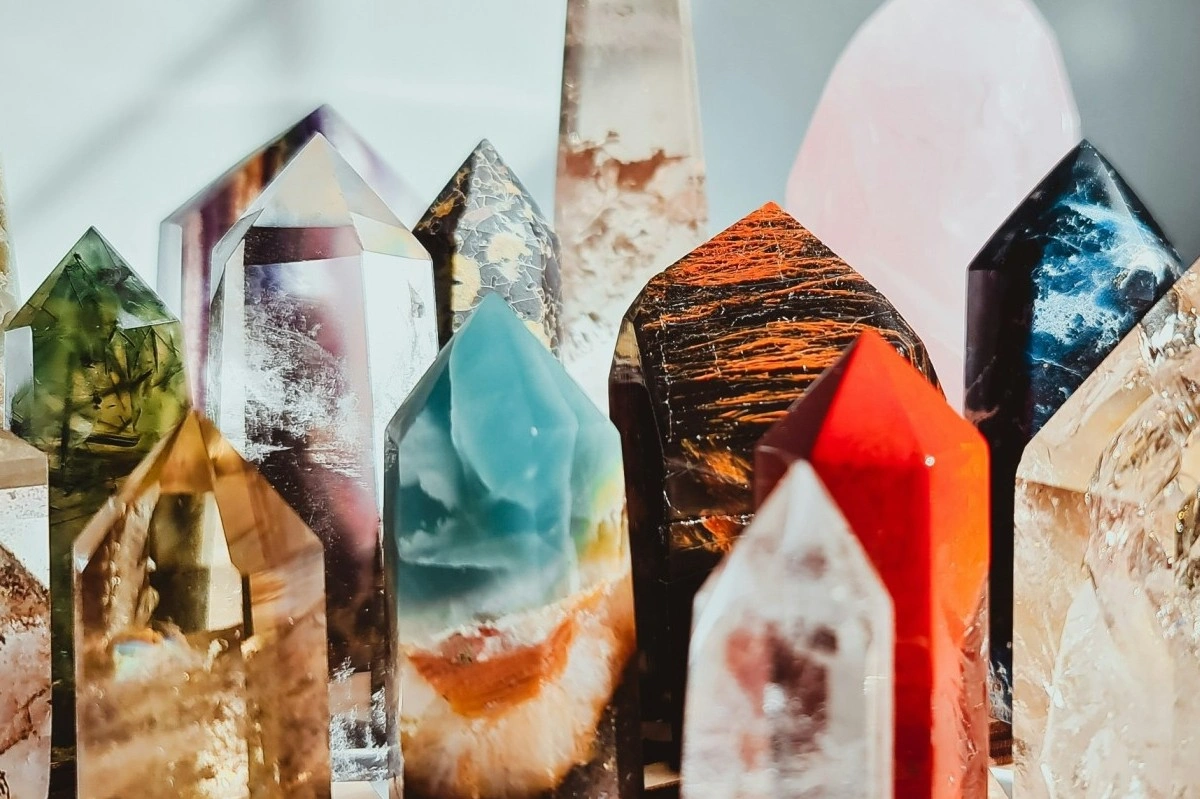
You do not need a shelf of crystals to practise. You need a small set of stones that work hard, in many situations, and that you will actually pick up.
This is a list of five. It is not a definitive list, and many witches keep one or two more, or one or two different. But these five between them cover most of what a solitary practice asks of stone. They are widely available, ethically sourceable with care, and each has earned its place in the modern witchcraft canon over a long stretch of practice.
If you are starting from nothing, start here. These are the five I reach for most consistently after twenty years of practice: not the most unusual stones in the drawer, and not the most beautiful. The most useful.
How to choose crystals that will actually get used
Before the five: a principle. The crystal collection that supports a practice is not the crystal collection that fills an Instagram shelf. The first is built for use. The second is built to be looked at.
Working witches tend to keep a small kit (somewhere between three and ten stones) that covers their most common needs: protection, grounding, calm, heart work, cleansing, amplification. The exact stones vary by tradition and personal affinity, but the principle does not. Versatility wins. A stone that does three things well is more useful than three stones that each do one specialist thing.
The five below are the standard core because they are the most flexible. Once they are familiar, you will know what gaps your particular practice has.
1. Clear quartz: the amplifier
Clear quartz is the most quietly useful stone a witch can own. It does not have a strong character of its own. What it has is the capacity to hold and amplify the intention you bring to it.
In practice, this means clear quartz can stand in for almost any other stone. Program it for protection and it protects. Set it on a spell altar and it amplifies the rest of the working. Held in meditation with a question, it sharpens the question. I use a small point in almost every working that involves other stones; it tends to make the rest of the kit cohere.
Buy a small, clear point or a tumbled piece. Both work. Larger specimens are beautiful but not necessary.
2. Black tourmaline: the protector
Black tourmaline is the working witch's standard protective stone. It absorbs and grounds out energy that does not belong to you: the residue of a difficult conversation, the static of a crowded place, the buildup of a stressful week.
I keep a piece at the front door and one on the windowsill of the room I work in. I replace them when they feel exhausted rather than on a schedule; the ones by the door seem to need it faster. After heavy use, run it under cold water and dry it. The cleansing is part of the relationship.
Black tourmaline is widely available and inexpensive in raw form, which is the form most practitioners prefer for protection work.
3. Amethyst: the quiet mind
Amethyst is the stone of the quiet mind. It slows racing thought and supports the kind of intuitive listening that divination work depends on.
Place a piece by the bed for sleep, on the desk for focused work, or on the altar during tarot practice. Many witches find amethyst the easiest stone to begin a practice with: it is forgiving, and its effects are noticeable without being dramatic.
Be careful when buying. Bright purple specimens with no provenance are sometimes heat-treated quartz dyed to imitate the colour, and a different stone called citrine sold cheaply is often heat-treated amethyst.¹ A reputable mineral dealer will tell you where their amethyst is mined, and what (if anything) has been done to it since.
4. Rose quartz: the heart
Rose quartz is the stone of love work, and the love it speaks to most clearly is not romantic. It is the love of self.
A practice tends to ask a great deal of the practitioner. Shadow work, grief work, the slow unlearning of patterns inherited from family or culture, all of it benefits from a stone that holds steady warmth in the chest. Rose quartz does this. The piece I keep by the bed has been there long enough that I stop noticing it, which is probably the right relationship with a stone whose job is steady background warmth rather than active intervention.
It also works for romantic and relational workings, for healing after loss, and as an offering to deities of love: Aphrodite, Inanna, Hathor. But start with the version closer to home.
5. Selenite: the cleanser
Selenite is the stone you use on your other stones. Place a flat slab or a tumbled piece beneath your working crystals and it clears them. No ritual required, no timing to observe, no water involved. It does not perform; it maintains everything else.
A note on care. Selenite is a soft, water-soluble form of gypsum.² It dissolves in water. Do not cleanse it the way you would clean a quartz, and do not leave it on a damp surface. A dry shelf, a small altar, or a ceramic dish works. Many practitioners keep their selenite as a wand, a tower, or a flat slab beneath their other stones.
A small, well-used kit serves a witch better than a sprawling, dusty collection.
Putting them together
The five stones above cover most of the daily territory of a solitary practice: amplification, protection, calm, heart work, and cleansing. Once you have them, you will start to notice what is missing for your particular path.
A witch who works heavily with lunar cycles will reach for moonstone. Someone working through grief will keep smoky quartz close. A practitioner building Mars-themed spells will want carnelian or garnet. The astrological correspondences are a useful next step once the foundation is in place.
But the foundation is the foundation. Five stones, used regularly, will teach you more about crystal work than fifty stones gathering dust.
Sourcing ethically
Every crystal on this list has a sourcing problem somewhere in its supply chain. Black tourmaline, amethyst, rose quartz, and clear quartz are all mined at scale in regions where labour conditions and environmental practices are not always documented or fair. The Guardian reported in 2019 that an estimated 85,000 children were working in the gemstone mines of Madagascar: the source of much of the rose quartz, amethyst, and tourmaline sold in the West.³
The principles for buying are straightforward. Buy from dealers who can name the mine. Favour fair-trade and small-scale operations. Lab-grown options exist for clear quartz and amethyst, and they are entirely valid for working purposes.⁴ Vintage and second-hand pieces are also worth seeking out, since they avoid new extraction.
A small, well-sourced kit is more aligned with witchcraft's actual values than a large, untraceable one.
Five stones are enough to start, and enough to last for years if your practice does not ask you to expand. Clear quartz amplifies, black tourmaline protects, amethyst calms, rose quartz holds the heart, and selenite cleanses everything else. Between them, they answer most of the questions a daily practice will ask.
Pick them up often. Notice how they feel different in different weeks. The kit grows when the practice asks it to.
Questions
Do I need to cleanse my crystals?
Most witches do, particularly stones used for protective or absorptive work. Selenite handles the cleansing of most other stones. Clear quartz can also be cleansed under cold running water, by smoke, or by leaving it under the full moon. Amethyst can fade in direct sunlight, so cleanse it by other means.
Do I need to charge my crystals?
Many witches charge their stones on a full moon by leaving them where the moonlight reaches them. Others find this unnecessary. The honest answer is to try it and notice if it changes your relationship with the stone.
What if I'm drawn to a stone that isn't on this list?
Trust it. Personal affinity is more reliable than any "essential" list, including this one. The five above are a reasonable starting point. The stones you actually pick up and use are the right ones.
Should I buy raw or polished crystals?
Either works. Raw stones have a stronger aesthetic relationship to the earth they came from. Polished and tumbled stones are easier to carry. Most working witches end up with a mix.
How much should I spend?
Less than you think. A starter kit of these five stones, in modest sizes, can be assembled for under £40 from a reputable dealer. Larger or higher-grade specimens can run into hundreds, but they are not necessary for practice.
Sources
- International Gem Society: overview of common amethyst and citrine treatments, including heat treatment.
- Wikipedia: Selenite (mineral), on the geology and care of selenite as a hydrous calcium sulfate (gypsum).
- The Guardian (2019): investigative reporting on child labour in Madagascar's gemstone mines, the source of much of the rose quartz, amethyst, and tourmaline sold in Western markets. The figure of 85,000 children was drawn from US Department of Labor and ILO estimates and is widely cited in subsequent reporting on the crystal trade.
- Scott Cunningham: Cunningham's Encyclopedia of Crystal, Gem & Metal Magic (Llewellyn Publications, 1988). The standard modern reference for crystal correspondences in Western witchcraft, and a useful starting point for working with stones beyond the five listed here.
Further reading: the Amherst Wire's Five ethical crystal shops to keep your spirituality sustainable covers the supply-chain issues in more depth, with practical alternatives.
More from the Blog
Astrology and Crystals: A Witch's Guide Beyond the Birthstone
How to work crystals astrologically: through the planets, the moon's phases, and your natal chart. A guide for the solitary witch.
How to Cleanse and Charge Your Crystals
Cleansing and charging are two different things, often treated as one. A practical guide for the solitary witch: including the methods that quietly damage your stones.
Begin your practice
Grimoire is available now on Android and as a web app. Start today.