Crystals
The Witch's Guide to Moonstone: Lunar Magic, Folklore and Practice
Rowenna
Solitary witch and the founder of Grimoire. Built the app she couldn't find anywhere else. Writes about the craft with primary sources, honest lineage notes, and a low tolerance for vague correspondences. Based in the UK with more herbs than shelf space.
· 8 min read
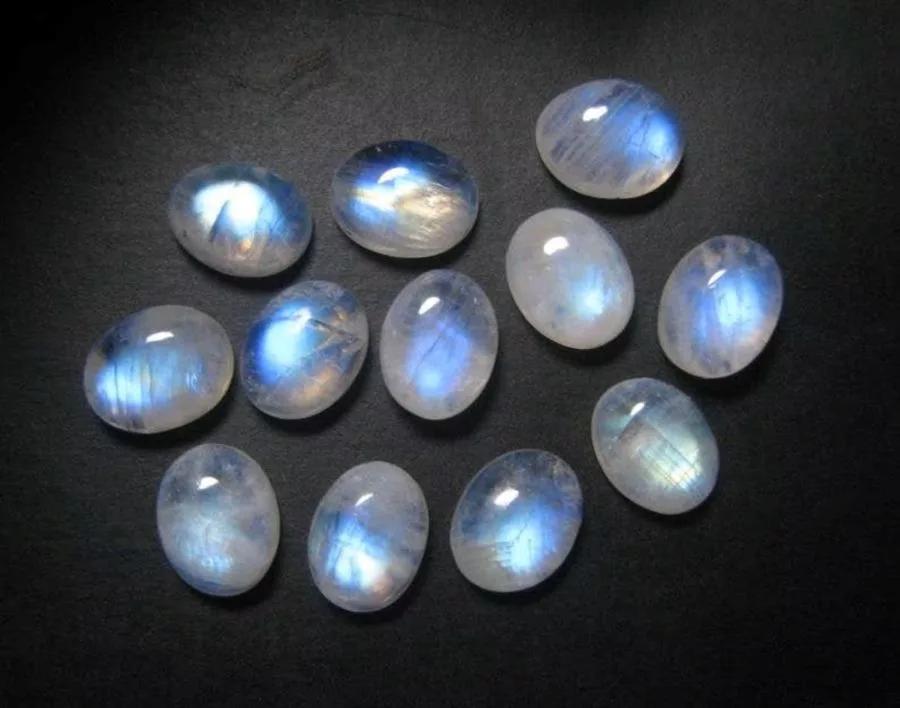
Moonstone is the lunar stone. It has carried that title for at least two thousand years, across more traditions than almost any other gem currently used in witchcraft. Pliny the Elder named it. The Romans wore it as a talisman of the goddess Diana. Hindu tradition treats it as solidified moonbeams, and one of India's most sacred wedding gifts. The European folk tradition gave it to travellers heading out at night.
This piece is a working guide to moonstone. What it is, where it sits in the folkloric record, and how to work with it as a solitary practitioner.
What moonstone is
Moonstone is a variety of feldspar, one of the most common mineral families on earth. What makes it distinctive is an optical property called adularescence: the floating, misty glow that seems to move beneath the stone's surface as you tilt it. The light is real, not painted on. It comes from the way two minerals, usually orthoclase and albite, layer themselves inside the stone and scatter light at slightly different angles.¹
Moonstone occurs in white, grey, peach, and blue. The most prized variety is blue moonstone with a clear adularescent flash, sourced mainly from Sri Lanka and now increasingly rare. India, Madagascar, and Myanmar produce most of the moonstone in the modern market.
A note on rainbow moonstone, which is what many modern witches mean when they say "moonstone." Rainbow moonstone is technically labradorite, a different feldspar, marketed under the moonstone name. It carries similar lunar associations in modern practice, but it is mineralogically a distinct stone, and a reputable dealer will tell you so.
A stone of the moon: the folkloric record
The folklore of moonstone runs deeper than that of most stones in modern witchcraft. Four traditions matter most.
The Roman tradition
The Roman naturalist Pliny the Elder is the earliest written source on moonstone in the Western tradition. In his Natural History, written in the first century, he described a stone whose appearance changed with the phases of the moon, growing brighter as the moon waxed and dimming as it waned.² This belief persisted in European thought into the sixteenth century. The Romans associated the stone with Diana (goddess of the moon, the hunt, the night, and childbirth) and wore it as a talisman of love, fertility, and prophecy.³
The Greek tradition
The Greeks called it Aphroselene, a compound name combining Aphrodite (love) and Selene (moon). One legend held that the stone was formed from the tears of the moon goddess, fallen to earth and hardened in the moonlight. Worn during a full moon, moonstone was said to allow the bearer to see their future love. This is the earliest recorded version of a folk practice that recurs across several traditions: moonstone as the stone of romantic prophecy, particularly when used in conjunction with the full moon.
The Hindu and Indian tradition
In Hindu cosmology, moonstone is one of the most sacred of stones. The Sanskrit name chandrakanta translates to "beloved of the moon," and traditional texts describe the stone as formed from solidified moonbeams.⁴ Moonstone is one of India's traditional wedding gifts and is closely associated with the divine feminine. A particular folk practice held that placing a moonstone in the mouth during a full moon would grant prophetic vision: a tradition that recurs in several other regions and may be one of the older threads in the stone's folklore. The Indian tradition also holds that the stone's lustre waxes and wanes with the moon, echoing the Roman belief.
The European folk tradition
European folk tradition gave moonstone the name traveller's stone. It was carried by anyone setting out on a journey at night, especially by sea, as protection against the dangers of the dark and the disorientation of unfamiliar roads. It was also a lover's stone, given as a gift between partners and worn for fertility, dreams, and divination. The connection between moonstone and women's reproductive cycles (pregnancy, menstruation, menopause) runs through European, Middle Eastern, and Indian traditions alike, and is part of why the stone is so closely tied to the divine feminine in modern practice.
Working with moonstone today
Moonstone earns its place in a modern solitary practice through the same uses that have carried it for two thousand years.
- Lunar work. Moonstone is the natural altar stone for any working tied to the moon's phases: full moon rituals, esbats, the monthly cycle of intention and release. If you are already working with the moon, moonstone is the stone the practice keeps reaching for.
- Divination and dreams. Place a moonstone under the pillow on the night of a full moon for prophetic dreams. Hold one during a tarot reading on a question about timing, intuition, or the divine feminine. Keep one on a virtual or physical altar for ongoing intuitive work.
- Women's cycles. The connection between moonstone and women's reproductive cycles is one of the most consistent threads in the folkloric record. Carry a moonstone during menstruation, pregnancy, or hormonal transitions. The traditional practice is to wear it close to the body, on a cord or as a ring.
- Travel protection. The old European tradition of moonstone as a traveller's amulet is largely forgotten in modern practice, but it still works. Carry one in a coat pocket on long night journeys, particularly when travelling alone.
- Sleep. Place a moonstone on the bedside table for restless nights. Not a substitute for actual sleep hygiene, but a supportive object on the kind of nights when the mind will not settle.
The simplest charging practice is to leave the stone on a windowsill during the night of the full moon and retrieve it in the morning. Moonstone is one of the few stones that genuinely takes lunar energy on its own, without elaborate ritual.
I keep a piece near the Hecate shrine; it has been there long enough that I stop noticing it as a distinct object and only notice when it is absent. That is the right relationship with this particular stone. It is not dramatic. It works slowly and in the background, the way the moon is always present and you rarely look directly at it.
A moonstone left in the moonlight does not need anything else.
A note on what moonstone is and is not
Moonstone is closely associated with the divine feminine, but it is not the only feminine stone, and feminine is not the only thing it does. Some witches default to moonstone for any working that involves intuition, women's bodies, or the moon, and this can flatten the stone into a single use.
The folkloric record is broader. Moonstone has carried meanings of prophecy, travel protection, romantic divination, fertility, dream work, and the safe passage of nighttime journeys. It is the stone of cycles more than of femininity: the menstrual cycle, the lunar cycle, the life stages, the dreams that return on certain phases of the moon. Working with it as the cycle stone, rather than narrowly as the woman stone, opens up most of its actual range.
The other thing to know is that moonstone is gentle. It is not a stone for grounding, protection from active harm, or rapid change. If you need a grounding stone or a protective one, moonstone is not the right choice. It is reflective rather than absorptive, and it works slowly.
Sourcing ethically
Most moonstone in the modern market comes from India, Madagascar, and Sri Lanka. The supply chain has the same general issues as the wider crystal market: labour conditions and environmental practices vary widely, and traceability is rare. The principles for buying are the same as for any stone:
- Buy from dealers who can name the country and, ideally, the mine.
- Avoid suspiciously cheap "rainbow moonstone" with very strong colour flashes; much of it is dyed quartz or treated glass.
- Vintage moonstone jewellery is often a beautiful and ethical buy, especially Victorian and Art Nouveau pieces, where the moonstone tradition was at its most popular in the West.
Lab-grown moonstone is not currently common in the way lab-grown amethyst or quartz is. The natural stone, sourced carefully, remains the standard.
For a fuller account of cleansing methods and which ones are safe for moonstone, see How to Cleanse and Charge Your Crystals.
Moonstone has been the witch's lunar stone for two thousand years, and the practice has not really changed. The stone takes the moon's light. The witch carries it during cycles, dreams, and night journeys, and reaches for it on full moons. The folklore is consistent across traditions, and the working uses that have survived into modern practice are the ones that have always worked.
Moonstone does not need much. A windowsill on a full moon. A pocket on a long evening walk. A bedside table on a difficult night. The practice fills itself in.
Questions
Is rainbow moonstone the same as moonstone?
Mineralogically, no. Rainbow moonstone is a variety of labradorite, a different feldspar that displays a similar adularescent or labradorescent flash. Both stones are used interchangeably in modern witchcraft and carry comparable lunar associations, but a reputable dealer will distinguish between them. True moonstone is typically white, grey, peach, or blue. Rainbow moonstone has a stronger spectral colour play because it is a different stone.
How do I cleanse moonstone?
Moonlight is the traditional method, and the most appropriate for this particular stone. Leave it on a windowsill overnight on or near a full moon. Brief running water is also safe; moonstone is moderately hard (Mohs 6–6.5), but it has cleavage planes and should not be soaked for long periods. Avoid salt water, sunlight (it can fade), and selenite trays only when you have run out of other options. The cleansing methods covered in How to Cleanse and Charge Your Crystals all apply here, with those exceptions.
Can men work with moonstone?
Yes. The moon's stone is the cycle stone, and cycles are a human universal. The "feminine" framing of moonstone reflects how the stone has been used historically, particularly in connection with reproductive cycles, but the lunar associations (intuition, dreams, night protection, prophecy, travel) are not gendered. Many male and non-binary practitioners work with moonstone routinely. The folkloric tradition supports it.
What is the difference between moonstone and selenite?
They are often confused because of the lunar associations and the soft glowing appearance, but they are very different stones. Moonstone is a feldspar, hard enough to wear as jewellery, and used primarily for lunar work, divination, and cycle work. Selenite is a soft, water-soluble form of gypsum, used primarily for cleansing other stones and clearing space. Selenite cannot get wet. Moonstone can take a brief rinse. They pair well, but they are not interchangeable.
Is there a Native American moonstone tradition?
This is widely claimed in modern crystal content but poorly documented in ethnographic sources. Moonstone is not native to North America in any significant deposit, and there is no established tribal tradition recorded in standard folkloric literature. Some indigenous traditions do work with locally available stones in lunar ceremony, but those stones are not moonstone. The well-attested moonstone traditions are Roman, Greek, Hindu, and European, all covered above.
Sources
- Wikipedia: Moonstone (gemstone), overview of the gem's mineralogy, including its origin as a feldspar variety and the optical phenomenon of adularescence.
- Pliny the Elder: Natural History (first century CE), the earliest recorded Western source on moonstone, including the belief that the stone's appearance changed with the lunar phases. The relevant passages appear in Books 36 and 37 on stones and gems.
- Wikipedia: Diana (mythology), on the Roman moon goddess and her associations with night, the hunt, childbirth, and lunar protection. The connection of moonstone to Diana is recorded in several Roman sources and persists through medieval and early modern lapidary tradition.
- American Gem Society: The Folklore & Legend of Moonstone, including the Hindu chandrakanta tradition, the full-moon prophecy practice, and the broader Indian use of moonstone as a sacred wedding gift.
- International Gem Society: History of Birthstones, covering moonstone's status as a June birthstone (one of the original 1912 list) and the broader Western folkloric tradition, including the traveller's stone use.
Further reading: this piece is part of the crystals and stones cluster on the Grimoire blog. For working with moonstone in lunar practice specifically, see Working with the Moon: A Practical Guide. For the broader starter kit, see Five Crystals Every Witch Should Own.
More from the Blog
The Witch's Guide to Crystals and Stones
How to use stones well in a solitary practice. The two traditions, the working kit, the care, and the older folk lineage that most modern crystal guides leave out.
The Witch's Guide to Selenite: Cleansing, Clarity and Practice
Selenite is the cleansing stone of modern witchcraft. The mineralogy, the historical record, why it cannot get wet, and how to work with it accurately as a solitary practitioner.
Begin your practice
Grimoire is available now on Android and as a web app. Start today.