Sabbats
Herbs of Lughnasadh: The Plants of the First Harvest
Rowenna
Solitary witch and the founder of Grimoire. Built the app she couldn't find anywhere else. Writes about the craft with primary sources, honest lineage notes, and a low tolerance for vague correspondences. Based in the UK with more herbs than shelf space.
· 7 min read
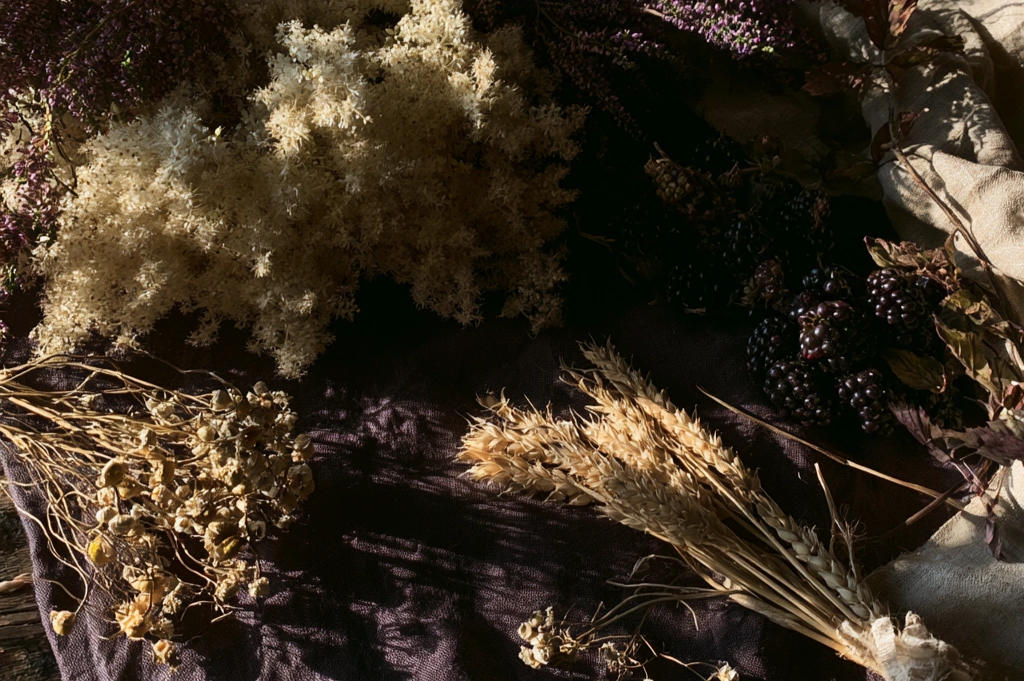
Early August in Britain has a particular botanical quality. The high-summer herbs are finishing (the elderflower is long past, the St. John's Wort beginning to seed) and the first wave of the harvest-season plants is coming on. Meadowsweet foams white along riverbanks and wet meadow edges. The heather is just beginning to colour across northern moorland. The bramble canes are heavy with blackberries that are not yet quite ripe. Chamomile daisy-faces the August sun in open ground.
These are the herbs of Lughnasadh, not exotic or hard to find, but precisely in season, which is the most honest way to work with plant magic. A herb used at its seasonal peak, gathered from a landscape you know, carries more presence than the same herb bought dried from a distant supplier and used out of season. Lughnasadh's plant medicine is in the hedgerows and wet meadows of early August. This piece covers the plants worth knowing, and how to work with them.
Meadowsweet: Filipendula ulmaria
Meadowsweet is the defining herb of the British late-summer meadow. It grows in wet grassland, along riverbanks, in damp woodland edges, and on road verges throughout Britain and Ireland, flowering from June through August with frothy clusters of cream-white flowers that carry a honey-almond scent distinctive enough to be used historically in mead-making. Meadowsweet as a name derives from the meadow, not from sweetness alone, though the scent makes both believable.
In terms of magical associations: meadowsweet belongs to love, joy, peace, and the happiness of good company. It was historically used to scent chambers, strew on floors, and perfume ale. It has also been cited — by Robert Graves in The White Goddess (1948) — as one of the three sacred herbs of the druids, alongside water mint and vervain. Graves's scholarship here is contested and should be held lightly; his druidic herb list derives from a creative reading of Welsh poetry rather than from documented historical sources. What is genuinely documented: meadowsweet was widely used as a strewing herb, a flavouring, and a medicinal plant across Britain for centuries, and it flowers at exactly the moment the harvest season begins.
Practical use at Lughnasadh: Gather fresh meadowsweet stems and lay them on the altar or use them in a vase near the working space. The scent is part of the practice. Dried meadowsweet can be burned as a loose incense on charcoal — it smells sweeter than most dried herbs when burned. A small bundle tucked into the linen of the home carries the Lughnasadh quality of peace and abundance through August.
Safety note: Meadowsweet contains salicylates — the natural compounds from which aspirin was originally derived. Those with aspirin sensitivity, pregnant women, and children should avoid internal use. External use and aromatic use is generally considered safe.
Blackberry: Rubus fruticosus
The blackberry is the first fruit of the hedgerow harvest and the most directly Lughnasadh-aligned plant in the British landscape. In the Scottish Highlands and northern England, the first blackberry picking was a traditional Lughnasadh activity — the first ripe fruits gathered from the bramble canes as August opened, offered before eating as the first fruits of the harvest.
In most of Britain, the blackberries at Lughnasadh (1 August) are not yet quite ripe — they will be in full abundance through August and September. But the first ripe ones appear in early August, particularly in southern England, and gathering the earliest ripe fruits for the Lughnasadh feast is the most seasonally honest plant practice the sabbat offers.
Magically, blackberry belongs to protection, healing, and the abundance of the wild harvest. The plant is specifically protective — the thorned canes were used in British folk practice as a protective boundary (planting brambles along a boundary was both practical and magical). The blackberry also has associations with the underworld in British and Irish folklore, which is appropriate for a plant whose fruiting season overlaps with the deepening of the year toward Samhain.
The English folk tradition that blackberries should not be picked after Michaelmas (29 September) because the devil spits on them is well documented, and usefully seasonal — it defines the harvest window as running from Lughnasadh through to the end of September.
Practical use at Lughnasadh: Gather the first ripe blackberries and include them in the Lughnasadh feast — blackberry crumble, blackberry vinegar, fresh blackberries with cream or honey. Set a small portion aside as the first-fruits offering before eating. The act of gathering from the hedgerow is itself a form of Lughnasadh practice: the physical contact with the wild harvest, the patience of searching for ripe fruit, the thorns.
Heather: Calluna vulgaris
Heather comes into bloom around Lughnasadh, particularly across the moorlands of Scotland, northern England, and Wales. The purple flush of heather across open moorland in August is one of the most characteristic visual experiences of the British landscape at this time of year, and in Scotland specifically, heather bloom is closely associated with Lùnastal (the Scottish Gaelic name for Lughnasadh).
Heather honey — produced from August heather nectar — is distinctive: thicker, darker, and stronger-flavoured than summer flower honey. It is often considered the richest honey of the year. Heather honey has associations with luck, strength, and the particularly Scottish quality of resilience in difficult landscape.
Magically, heather is associated with luck (particularly the Scottish superstition around white heather as a luck bringer), protection, healing, and the energy of the high moorland. It belongs to the same broad solar and fire correspondence as other late-summer plants. White heather specifically is given as a gift in Scotland for good fortune — it was said to mark a spot where no blood had been shed.
Practical use at Lughnasadh: A sprig of heather on the Lughnasadh altar connects the sabbat to the northern British landscape in which it is historically rooted. If heather is not available fresh (it is more accessible in Scotland and northern England than in the south), dried heather is widely available from Scottish suppliers and carries the plant's associations intact. A small jar of heather honey on the altar is both practical and directly seasonal.
Chamomile: Matricaria chamomilla / Chamaemelum nobile
Chamomile — both the German variety (Matricaria chamomilla) and the Roman variety (Chamaemelum nobile) — is in full flower through July and August, its small daisy-faced blooms carrying the apple-honey scent that makes chamomile tea the most recognisable of the calming herbal infusions. It is a sun herb: the round yellow centre, the white rays, the association with solar warmth, calm, and abundance.
Chamomile corresponds to the Sun and Mercury in most traditional systems — sun for its solar appearance and warming quality, Mercury for its use in calming the nervous system and settling digestive upset. It belongs to peace, abundance, gentle attraction, and the domestic magic of the kitchen and the herb garden. It is the herb of the practitioner who wants to work with late-summer solar energy without the intensity of Litha's full midday sun. August sun is softer, and chamomile is softer than St. John's Wort or sunflower.
Practical use at Lughnasadh: Chamomile tea before or after the Lughnasadh ritual working is directly appropriate — it grounds, calms, and settles. Dried chamomile flowers scattered on the altar add their solar quality without overpowering the grain and blackberry notes of the season. Chamomile can also be added to the Lughnasadh bath if you take one as preparation for working.
Yarrow: Achillea millefolium
Yarrow is at its peak abundance through August. It grows along verges, field margins, meadows, and waste ground throughout Britain — the flat-topped clusters of small white or pale pink flowers are easy to identify, and the feathery leaves distinctive. The plant is named for Achilles, who was said to have used it to stanch the wounds of his soldiers at Troy — it is a wound herb, a staunching herb, a herb of the battlefield and the hedgerow in equal measure.
Yarrow's magical associations are broad: divination (particularly in the I Ching tradition, where yarrow stalks are the traditional casting medium), love, protection, courage, and healing. It is a herb that bridges the soft and the sharp — its own feathery softness sits alongside its traditional uses in situations requiring strength and endurance. At Lughnasadh, yarrow's courage and endurance associations are particularly appropriate for the harvest accounting: the honest, sometimes difficult look at what the year has produced.
Practical use at Lughnasadh: Yarrow dries beautifully and holds its form in dried flower arrangements — a bundle of dried yarrow on or near the altar lasts through the autumn. Fresh yarrow can be infused in oil or used in smoke cleansing. The stalks, following the I Ching tradition, can be used for a Lughnasadh divination — a casting at the first harvest to understand what the second harvest (Mabon) will complete.
The grain plants: wheat, barley, oat
No Lughnasadh herb piece is complete without acknowledging the plants that are the sabbat's entire reason for existing. Wheat (Triticum aestivum), barley (Hordeum vulgare), and oat (Avena sativa) are the grain crops whose harvest begins in August across Britain. The UK wheat harvest runs through August and into September. Barley comes slightly later. Oats are the northernmost grain crop, associated particularly with Scotland and Ireland.
These are not the herbs of supplementary magical use — they are the central plants of the sabbat. The John Barleycorn figure is barley personified. The Lammas loaf is wheat. Tailtiu's agricultural sacrifice was the clearing of land for these crops. Grain stalks on the Lughnasadh altar are not decorative; they are the presence of the sabbat's heart plant.
Practical use at Lughnasadh: A small sheaf of wheat or barley stalks on the altar, tied with gold or amber twine. A corn dolly woven from the stalks and kept through winter. Oatcakes baked alongside or instead of a wheat loaf if wheat is not available or not tolerated. The grain plants should be treated as the primary plants of the sabbat, around which the other herbs are arranged.
For the wider Lughnasadh practice, see Lughnasadh for Solitary Witches and Lughnasadh Deities. For the spell workings that use the grain plants directly, see Bread and Grain Magic: Spells for Lughnasadh.
More from the Blog
Lughnasadh for Solitary Witches
Lughnasadh falls on 1 August: the first harvest sabbat, the feast of Lugh, and the beginning of the harvest arc that runs to Samhain. A complete practical guide for the solitary practitioner: rituals, altar, journal prompts, and how to mark the first cutting when you are working alone.
Lughnasadh Energy and Intentions: The Harvest Accounting
The third spoke of the wheel-of-year intention arc. Lughnasadh's mode is accounting: not gratitude, not celebration, but the honest ledger of what was planted, what has returned, and what it cost.
Begin your practice
Grimoire is available now on Android and as a web app. Start today.