Sabbats
Lughnasadh Energy and Intentions: The Harvest Accounting
Rowenna
Solitary witch and the founder of Grimoire. Built the app she couldn't find anywhere else. Writes about the craft with primary sources, honest lineage notes, and a low tolerance for vague correspondences. Based in the UK with more herbs than shelf space.
· 9 min read
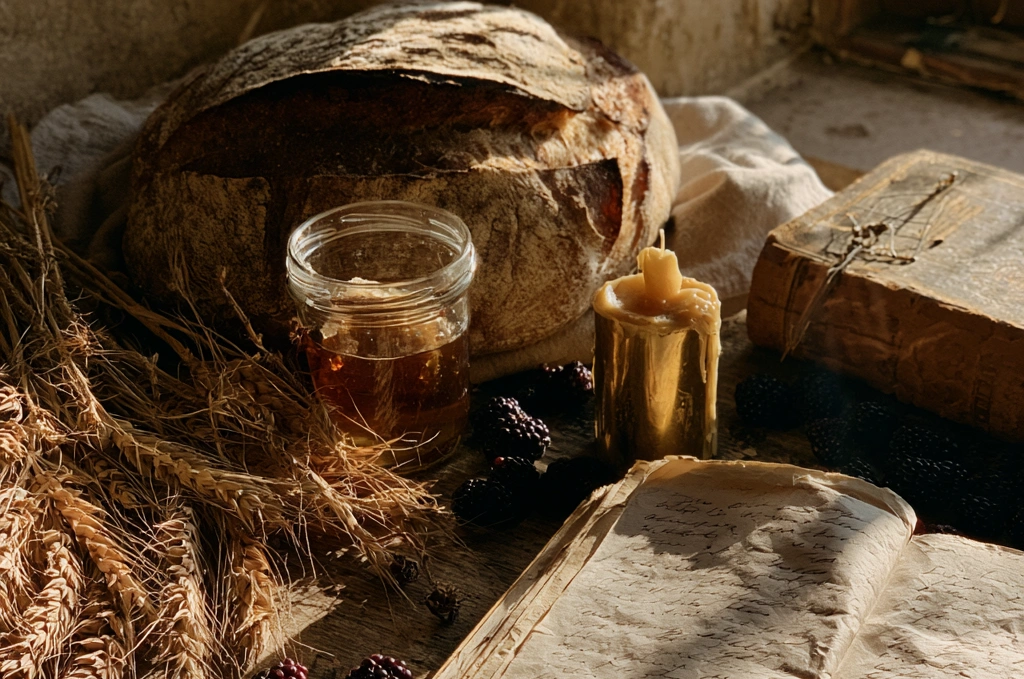
Most Lughnasadh content frames the first harvest as a gratitude practice. Be thankful for what you have. Count your blessings. Celebrate the abundance. This framing is not wrong (gratitude is genuinely part of what Lughnasadh asks for) but it is incomplete, and in its incompleteness it misses what makes the first harvest sabbat useful as an intention practice.
The mode of Lughnasadh is not gratitude. It is accounting.
Accounting is harder than gratitude. An accounting does not begin by naming only what went well. It begins by opening the ledger and looking honestly at everything: what was planted and what grew, what grew and what actually returned, what returned and what it cost to get there, what was expected and what actually arrived. The harvest is not only the good news. The harvest is the complete picture of what the growing season produced: including the losses, the over-expenditures, the things that cost more than they returned, the crops that simply failed.
This is the work of Lughnasadh. Not to be grateful before you have looked. To look first. Then to be whatever you actually are about what you find.
The three modes before this one
This piece is the third spoke of the warm-half arc in the wheel-of-year intention practice. To use it fully, it helps to have the earlier spokes in view.
At Beltane (1 May), the mode was commit. The bet on yourself. The leap across the threshold from knowing what you want into actually planting it: naming the intention specifically, putting it into the ground, beginning. If you worked with Beltane's intention practice this year, you made a specific commitment. If you did not, the harvest accounting is still possible, but it begins with naming what you were actually working toward this year, even if you never formally planted it.
At Litha (20 June), the mode was recognise. What has actually grown? Not what you hoped would grow, what you could see, in the longest light of the year, was genuinely developing. Litha's recognising work was honest seeing: looking directly at the summer's growth without asking for more than what was actually there.
Now, at Lughnasadh (1 August), the first harvest has begun. The accounting is the natural next step: what have you actually brought in?
The first harvest and the second
Lughnasadh is not the full harvest. That belongs to Mabon, the autumn equinox in late September. Lughnasadh is the first harvest: the grain beginning to come in, the first fruits ripe in the hedgerows, the early accounting that tells you how the full harvest will go.
This distinction matters for the intention practice. Some of what you planted at Beltane has fully ripened and come in. That is this accounting's territory. Some of it is still on the stalk, clearly growing, visibly developing, but not yet ready to count as returned. That belongs to Mabon's second accounting. And some planted things have not grown, or have grown into something different from what was intended. That also belongs here: the honest naming of the first harvest's losses alongside its gains.
The Lughnasadh accounting question is not is the harvest good? It is what has the first harvest actually produced? These are different questions. The first invites a verdict. The second invites a look.
The harvest accounting: six questions
Sit with a journal in the days before Lughnasadh, or on the sabbat itself before any ritual working. These are the six questions of the harvest accounting. Work through them in order; each one builds on the one before.
1. What did I commit to at Beltane? Name it specifically. If you did not formally work with Beltane's intention practice, name what you were genuinely working toward this spring: the project, the direction, the version of yourself you were trying to grow toward. One thing. The accounting is more useful when it is specific.
2. What did I recognise at Litha? Looking back at the summer solstice: what had grown? What did you see was actually developing, as distinct from what you hoped was developing? Litha's recognising work is the mid-growing-season picture; the Lughnasadh accounting begins from that picture and moves forward to the first harvest.
3. What has the first harvest produced? Name specifically what has come in. Not metaphorically, actually. What exists now, in late July, that did not exist in May? What has been built, written, earned, grown, established, completed, or begun? The first harvest is specific and countable. Count it.
4. What did it cost? The harvest price is always paid somewhere. What did the growth of this year cost in time, energy, attention, money, sleep, relationship, health? Naming the cost is not complaining about it; it is the honest accounting that keeps next year's planting realistic. A harvest that cost more than it returned is still a harvest. It is also information.
5. What is still on the stalk? What is clearly growing but not yet ready to count? Name the things that are in development, in progress, not yet complete: the things that belong to Mabon's accounting rather than this one. This question keeps the first harvest accounting from trying to count what is not yet in. Lughnasadh does not require you to assess the whole year. Only the first harvest.
6. What did not grow? Some things planted do not return. Some intentions come to nothing, or transform into something unrecognisable, or are overtaken by other growth. Name these honestly. They are part of the harvest picture too. Something failing to grow is information; sometimes it is the most useful information in the accounting.
The John Barleycorn principle
Lughnasadh carries the John Barleycorn tradition: the grain must be cut down to become bread. The thing that looked like it was growing must be harvested (ended in its growing form) to be transformed into something that can actually sustain you.
In the harvest accounting, this shows up as the category of things that had to be abandoned, significantly rethought, or ended in their original form in order to produce something useful. The project that had to be radically restructured before it worked. The relationship that had to go through a difficult clearing before it became what it actually is. The direction that had to be dropped before the right one became visible.
These are not failures. They are harvests of a different kind. The accounting is not complete until they are named alongside the straighter growths.
Lughnasadh 2026: the accounting in eclipse season
Lughnasadh 2026 falls within an unusual astrological window. The South Node entered Leo on 26 July (four days before this piece publishes) beginning an 18-month process of composting Leo patterns: creative performance that substituted for genuine creation, the need for external validation, the leadership that was really ego-display. The total solar eclipse on 12 August falls two weeks after Lughnasadh, on the Leo/Aquarius axis.
What this means for the harvest accounting: the 2026 accounting has particular clarity and weight around creative and expressive work. What creative project was genuinely planted and has genuinely grown this year? What was performance? The eclipse window amplifies whatever surfaces in the accounting, not in a dramatic sense, but in the sense that what is honestly named in early August 2026 will continue to develop and deepen through the eclipse and into the autumn. The accounting done at Lughnasadh this year is not a one-time exercise; it is the opening of a longer reckoning that Mabon will continue and the eclipse will intensify.
The ritual working
The Lughnasadh intention ritual works best in two parts: the written accounting (the six questions, done in the days before the sabbat) and the ritual acknowledgement (a simple working on the sabbat itself that honours what the accounting found).
For the ritual acknowledgement, you need: the bread you have baked or bought for the sabbat (see Lughnasadh for Solitary Witches), a gold candle, and the journal or a single page where you have written the accounting.
Light the candle. Read aloud, from the accounting, the three most significant things that have come in: the three things that are genuinely the first harvest of this year's work. Name each one clearly and with the specific gratitude that follows honest counting rather than preceding it. Cut the first slice of the bread and set it aside as the first-fruits portion that is not yours. Then eat the rest slowly, with attention to the fact that the harvest you have named has been genuinely gathered.
Close by naming, without judgement, one thing from the accounting that cost more than it returned. This naming is not a complaint. It is an honest inclusion of the full ledger in the ritual acknowledgement. The Lughnasadh accounting is not selective.
What to carry toward Mabon
The Lughnasadh accounting closes with a specific forward question: what goes on the Mabon list?
From the accounting, identify what is still on the stalk: the things named in question five. These are what Mabon's integrate mode will work with. The Lughnasadh accounting tells you what is in; the Mabon accounting will tell you what is complete. Write the Mabon list now, while the Lughnasadh picture is clear, and return to it at the autumn equinox.
This piece is part of The Wheel of the Year Intention Practice: an eight-piece series on working with intention across the sabbat cycle. Previous: Litha Energy and Intentions. Next: Mabon Energy and Intentions coming September 2026 to continue the arc.
For the wider Lughnasadh practice this piece sits within, see Lughnasadh for Solitary Witches, Lughnasadh Deities, and Herbs of Lughnasadh. For the spell work of the first harvest, see Bread and Grain Magic: Spells for Lughnasadh, publishing 1 August.
More from the Blog
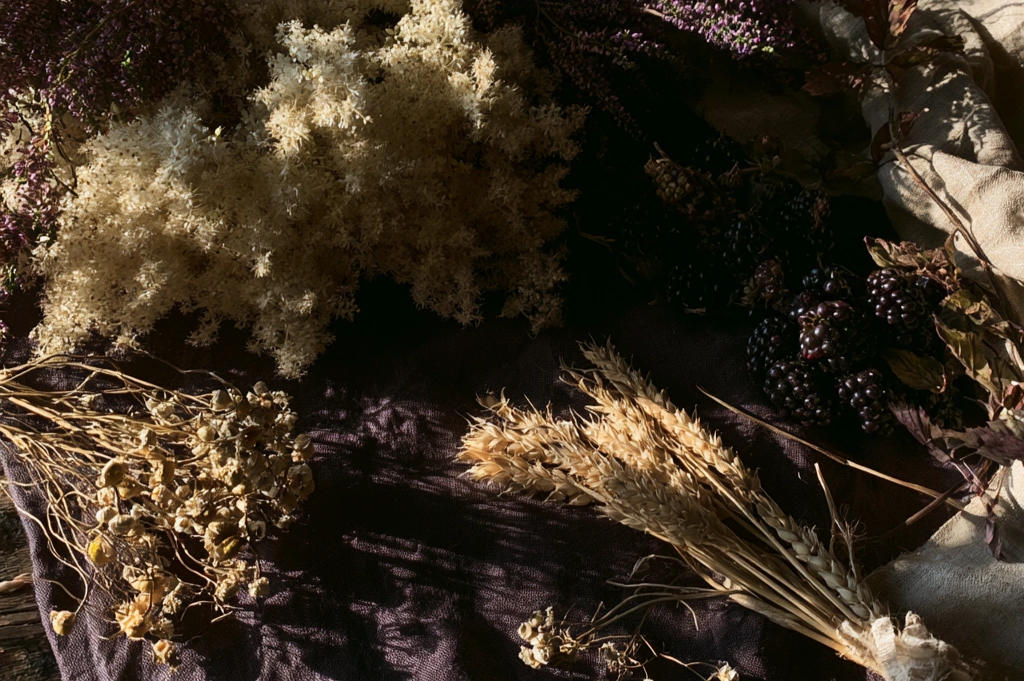
Herbs of Lughnasadh: The Plants of the First Harvest
The herbs of early August: meadowsweet in the damp meadows, heather coming into bloom, the first blackberries in the hedgerows. A guide to the plants of Lughnasadh and how to work with them.
Mabon Deities
The deities of the autumn equinox: Mabon ap Modron, Modron, Persephone and Demeter, John Barleycorn, and the Cailleach. Who they are, where they come from, and how to work with them at the turn of the year.
Begin your practice
Grimoire is available now on Android and as a web app. Start today.