Spells
Bread and Grain Magic: Spells for Lughnasadh
Rowenna
Solitary witch and the founder of Grimoire. Built the app she couldn't find anywhere else. Writes about the craft with primary sources, honest lineage notes, and a low tolerance for vague correspondences. Based in the UK with more herbs than shelf space.
· 9 min read
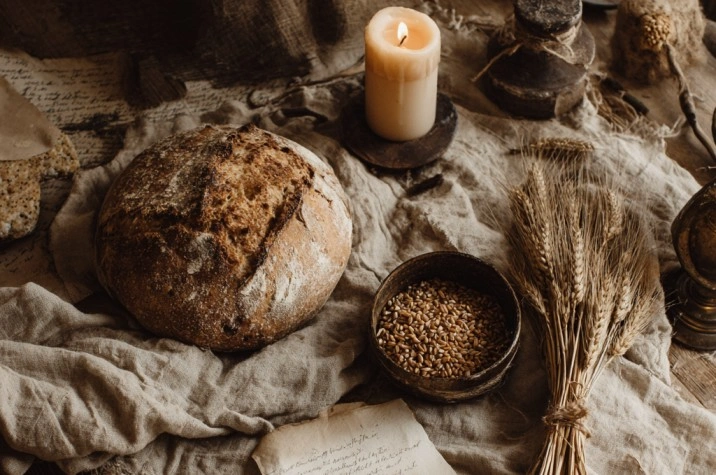
Lughnasadh is the first harvest, and of the four great fire festivals it is the one most concerned with bread. This is not incidental. A loaf, to a witch, is not an afterthought to the magic of the season; it is the magic. Bread is grain that stood through a whole summer of sun, was cut, threshed, ground, and then changed by heat and time into something that feeds a body through the dark half of the year. Few materials you will ever work with carry that much accumulated effort inside them.
This is a working guide to the magic of Lughnasadh. Five spells, drawn from folk practice and adapted for solitary work, each built around grain in one of its forms: the baked loaf, the stored seed, the first cutting, and the small grain figure burned at the year's turning. Every one of them can be performed at home, alone, with materials an ordinary kitchen already holds. They follow on directly from Solstice Sun Magic, the spells we worked at Litha, and they close the same arc those began.
Why bread is the magic of Lughnasadh
It helps to know what you are standing in. The sabbat carries two names, and both are honest.
The older English name is Lammas, worn down from the Anglo-Saxon hlaf-mæsse: "loaf-mass." On that day a loaf was baked from the first grain of the harvest and brought to the church to be blessed. The Christian framing sat on top of something already there: a harvest festival that long predated the mass. Lughnasadh reaches further back still. It is the Irish festival named for the god Lugh, and named more precisely for Tailtiu, his foster-mother, whose funeral games the festival is said to commemorate, she who cleared the plains of Ireland for agriculture and died of the effort. One name remembers the loaf. The other remembers the labour and the loss that the loaf is made of. Modern practice draws on both, and naming the layers is part of working the day honestly rather than borrowing it blind.
What this means for spellwork is simple. Lughnasadh is not a sabbat of asking. It is a sabbat of accounting: of cutting what has grown, weighing it, storing some, eating some, and giving some back. The five workings below each do one of those things.
1. A bread-baking ritual
This is the central Lughnasadh practice, and the oldest. You are not baking a loaf and then doing a spell over it. The baking is the spell.
You will need: a simple bread dough (any recipe you trust, or a soda bread if you would rather not wait on yeast) and a single clear intention for the season ahead.
Choose the intention before you touch the flour. It should be something you want to sustain, not something you want to begin: a steady practice, a relationship kept warm, your own health carried through winter. Bread is sustenance magic. It suits what must last.
As you knead, speak the intention into the dough, quietly, repeatedly, in time with the work of your hands. Folk practice has always understood kneading as a charm in itself: the rhythm, the repetition, the warmth of the hands moving through the material. You are not performing for anyone. Say the words plainly. While the dough rises, let the intention rise with it; the proving time is part of the working, not a pause in it. Before baking, mark the top of the loaf: a sun-cross, a single rune, the first letter of the thing you are holding. When it comes out of the oven, let it cool fully, then eat the first slice yourself, in silence, with attention. To take the intention into your own body is the close of the spell.
2. A grain charm for the stored harvest
Not all of the harvest is eaten at once. The older work of the season was always to set some aside; and a witch sets aside intention the same way.
You will need: a small jar with a lid, a handful of dried whole grain (wheat berries, barley, or uncooked rice), a strip of paper, and a pen.
This is a keeping charm. On the strip of paper write, in a single short sentence, the energy of this Lughnasadh you most want to carry forward into the cold months: the confidence of a good season, a hard-won steadiness, a gratitude you do not want to lose by spring. Fold the paper three times toward you. Place it in the jar and pour the dried grain over it until the paper is covered. Close the lid.
Keep the jar somewhere dark and undisturbed: the back of a cupboard is right. It is doing the same thing a granary does: holding what the warm season produced so that none of it is wasted before it is needed. Open it at the spring equinox, read the paper, and either act on what it says or thank it and let it go. The grain can then be scattered outside for birds.
3. A first-fruits offering
The first-fruits offering is the oldest documented Lughnasadh practice: older than the loaf-mass, older than any name we still use. The principle is unchanged across every culture that has farmed: the first and best of the harvest is not kept. It is given.
You will need: the genuine first or best of something you have grown, gathered, or made: the first tomato off the vine, the first blackberries of the hedgerow, a portion of the loaf from the first working, herbs from your own pots.
Take it outside. Find a spot that means something to you: the foot of a tree, a boundary, a place you return to. Set the offering down and say, in your own words, what you are giving thanks for and what you are giving it back to: the land, a deity you keep, the turning year itself. Do not bargain. An offering is not a transaction, and Lughnasadh in particular is not the day for it. You are acknowledging that the harvest was never entirely your doing, and you are declining to pretend otherwise. Leave the offering where it lies. The working ends when you walk away without looking back.
4. The harvest accounting working
This is the structural heart of the piece, and the close of a much longer arc. At Beltane, the practice we set down in Beltane Energy and Intentions was to plant intention. At Litha, Litha Energy and Intentions asked you to take stock at the peak. Lughnasadh is where you finally cut and weigh.
You will need: your journal, a candle, and a quiet hour.
Light the candle. Turn back to whatever you wrote at Beltane, and if you kept nothing in writing, work from memory, honestly. Then write three lists, and write them slowly.
The first: what I planted. Every intention you actually set this year, named plainly. The second: what grew. What of it came to something: the practices that held, the changes that took, the work that bore fruit. Be specific and be fair to yourself; a witch who only ever records the failures is not keeping honest accounts. The third: what did not. The intentions that came to nothing. For each of these, write one sentence on why, not as self-reproach, but as the kind of plain note a farmer makes about a field that failed. Some seed is bad. Some ground is wrong. Some years the weather does not cooperate. Knowing which is the whole point of an accounting.
When the three lists are done, you have your real harvest in front of you. Close the candle. This working pairs naturally with Spell Crafting for Beginners; the accounting tells you what to plant come the next Beltane.
5. A John Barleycorn release
John Barleycorn is the grain personified: the figure of the old harvest folk-song, the spirit cut down at the reaping, who dies so that the bread and the ale can be made, and who returns the following year in the new green. He is a folk image of the death-and-rebirth that every harvest is. At the first harvest, the witch enacts that cut deliberately.
You will need: a small figure made of grain: a few stalks of dried wheat or barley bound into a rough human shape with twine, a corn dolly if you can make one, or simply a twist of straw. A safe fire, or a patch of earth.
Before the working, name what John Barleycorn is carrying for you this year. It should be something whose ending feeds something else: a habit you are ready to let go of so the energy it consumed can go elsewhere, a season of life you are willing to call finished, an old version of your practice you have grown past. This is not banishing. Barleycorn is not an enemy. He is given up the way the grain is given up: with respect, and because the giving up is what makes the next thing possible.
Speak the naming aloud over the figure. Then either burn it in a safe fire and let the smoke carry it off, or bury it in the earth and let the ground take it. As you do, say plainly that you release it, that you are grateful for what it gave while it stood, and that you trust what its ending makes room for. Walk away. The wheel does the rest.
Working with these spells
You do not have to perform all five. A single one, done with attention, is a full Lughnasadh. If you have an hour, the harvest accounting and the bread-baking together make a complete and satisfying day. If you have only a few minutes, the first-fruits offering asks almost nothing and gives the season its proper shape.
None of these workings need to fall exactly on 1 August. Lughnasadh's window runs comfortably through the first week of the month, and the harvest does not keep a calendar. Work them when the day is yours.
Common questions
Can I use shop-bought bread for the bread-baking ritual? You can use shop-bought bread for an offering or for the John Barleycorn working at a pinch, but not for the baking ritual itself; the kneading and the rising are the spell. If yeast bread feels like too much, a soda bread takes under an hour start to finish and works perfectly.
What if I have no garden and grow nothing? The first-fruits offering only asks for the first or best of something that passed through your hands. The first slice of the loaf you baked counts. So does a jar of something you made, or the first blackberries from a public hedge.
Is Lughnasadh the same as Lammas? They name the same point in the year and are used interchangeably by most modern practitioners. Lammas is the Anglo-Saxon Christian "loaf-mass"; Lughnasadh is the older Irish festival of the god Lugh. Modern practice draws on both traditions.
Where this sits
This piece closes the Lughnasadh cluster. For the fuller picture of the sabbat, read Lughnasadh for Solitary Witches, the deities of Lughnasadh, the herbs of the season, and Lughnasadh Energy and Intentions.
This piece is part of A Witch's Working Library: The Spells Cluster: fourteen pieces on the practice, theory and seasonal application of spell craft.
Sources
Ronald Hutton, The Stations of the Sun: A History of the Ritual Year in Britain (Oxford University Press, 1996): the standard scholarly account of Lammas and the British harvest year. The Anglo-Saxon hlaf-mæsse etymology and the Tailtiu tradition are both treated there. The John Barleycorn material survives most fully in the English folk-song tradition collected from the 17th century onward.
Grimoire is a digital practice companion for the solitary witch: a private grimoire journal, daily tarot, the sacred calendar, herbology, deity work, and a spell builder, all in one place. Now available on Android.
More from the Blog
Sigil Work for Solitary Witches
Sigils are the most modern technique in the Grimoire spells cluster and the one most often taught badly. The Spare method, a complete worked example, the crucial releasing step most content skips, and the honest history of where sigil magic actually came from.

Jar Spells: A Working Guide
Sweetening jars, banishing jars, money jars. Jar spells are among the most widely practised workings in modern witchcraft. A complete working guide: the Hoodoo roots of the tradition, how to engage with them honestly, and three fully worked examples.
Begin your practice
Grimoire is available now on Android and as a web app. Start today.