Sabbats
Herbs of Samhain: Plants for the Thinning Veil
Rowenna
Solitary witch and the founder of Grimoire. Built the app she couldn't find anywhere else. Writes about the craft with primary sources, honest lineage notes, and a low tolerance for vague correspondences. Based in the UK with more herbs than shelf space.
· 9 min read
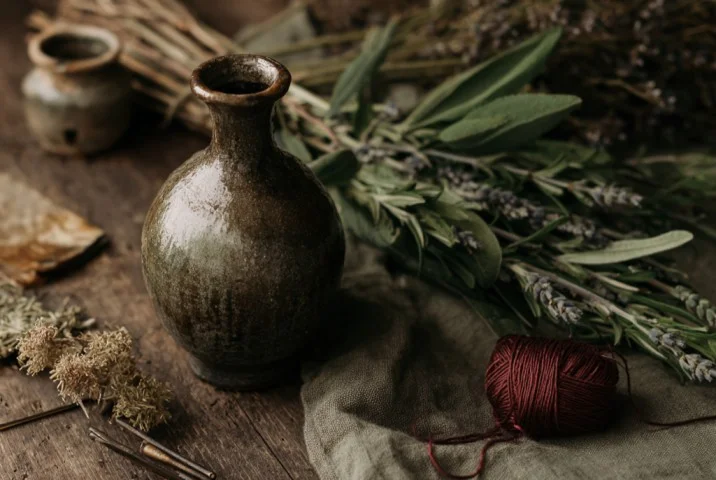
Every sabbat collects its plants, and Samhain has gathered a stranger company than most. Some of its herbs are kitchen-shelf ordinary, the rosemary and the apple. Others are frankly poisonous, the belladonna and the henbane that haunt the flying-ointment stories. Sorting one from the other is not pedantry. With this particular festival, it is the difference between a working you can do tonight and a plant that will put you in hospital.
So this guide is split by use and, more importantly, by safety. The plants you can actually work with come first. The famous poisonous ones come after, as history and folklore only, because they belong to the Samhain story and you deserve to know what they are and exactly why you leave them alone.
Safety first, because Samhain earns it
A handful of the herbs most romantically attached to this festival are deadly. Belladonna, henbane, datura, and mandrake are not difficult plants to misuse. They are difficult plants to survive misusing. Historic "flying ointment" recipes really did contain them, and people really did die. Nothing in this guide is a recipe for any of them. They appear here so you can recognise them in a folklore source and put the book down with your eyes open.
Among the safe-to-handle herbs, two still carry cautions worth stating plainly. Mugwort and wormwood are both traditional Samhain plants and both are best avoided in pregnancy. Mugwort can stimulate the uterus, and wormwood contains thujone, which is toxic in quantity. Burning a little dried mugwort as you would any other smoke is one thing. Ingesting either is where the care comes in, and pregnancy is where the answer is simply no.
The working herbs
Mugwort, the diviner's plant
If Samhain has a single signature herb, mugwort (Artemisia vulgaris) is it. The folk reputation is for vivid dreams and clearer divination, and unlike a great many magical correspondences this one has at least a thread of pharmacology behind it. Mugwort is mildly psychoactive and has a long European history as a dream herb, named for Artemis and tangled with the older Anglo-Saxon plant lore of the Nine Herbs Charm.
For the thinning veil, mugwort is the obvious altar plant. A small bundle of the dried herb burned before a scrying session, or tucked into a dream pillow, sits squarely inside genuine tradition rather than invented correspondence. Keep it out of pregnancy, as above, and you are on safe and well-trodden ground.
Rosemary, for remembrance
"There's rosemary, that's for remembrance." Ophelia was quoting folk knowledge already centuries old when Shakespeare put the line in her mouth, and rosemary (Salvia rosmarinus) has carried the meaning ever since. At a festival built around the dead, a herb that means remembrance is almost too neat to be true, and yet there it is.
Rosemary is the kitchen witch's Samhain plant: cheap, safe, easy to grow, and pleasant to burn. Lay a sprig on the ancestor altar, add it to the bread of a dumb supper, or burn a little while you sit with a photograph. The association is real and old, and the plant asks nothing dangerous of you.
Apple, the otherworld fruit
The apple is so embedded in autumn that it is easy to miss how strange its folklore is. Cut one across the equator and the seeds make a five-pointed star, a fact that fed centuries of association between apples and hidden knowledge. In Celtic myth the apple is an otherworld fruit, the bough that grants passage between worlds, and Samhain games like apple-bobbing carry a faint divinatory shimmer under the party surface.
For practice, the apple is generous. Eat one in honour of the dead, leave one on the altar as an offering, or cut one open to read the star as you set your Samhain intention. No caution required beyond not choking on the pips.
Wormwood, for the veil (handled with care)
Wormwood (Artemisia absinthium), mugwort's bitter cousin, has an old association with summoning, scrying, and contact with spirits. It is the absinthe herb, and its thujone content is exactly why absinthe earned its lurid reputation. Burned in small amounts as part of a veil-thinning incense, it sits within tradition. Drunk, brewed strong, or taken in pregnancy, it does not. As incense smoke, fine. As a tea, leave it.
The graveyard companions: yew and cypress
Neither is an altar herb, but both belong in the Samhain plant story. Yew and cypress are the trees of the churchyard and the cemetery across much of Europe, planted with the dead for so long that their very shape reads as mourning. Yew is highly toxic in every part, so this is appreciation from a respectful distance, not a working. A fallen sprig of cypress on the altar is the safe way to bring the graveyard tree indoors.
The poison path, as history only
No honest guide to Samhain herbs can skip the nightshades, and none should pretend they are workable. These are the plants of the flying-ointment legends, and they are genuinely lethal.
Belladonna (Atropa belladonna, deadly nightshade), henbane (Hyoscyamus niger), datura (thornapple), and mandrake (Mandragora) all contain tropane alkaloids that cross the skin and the gut with ease and cause delirium, then collapse, then death. The early-modern trial records and the later folklore wove them into the image of the night-flying witch, and historians such as Owen Davies have traced how much of that picture is real plant knowledge and how much is confession extracted under torture.
The point of naming them is recognition. If a Samhain ritual you find online lists belladonna or henbane as an ingredient to handle or ingest, you have found a source that does not care whether you live. Close it. The witches of the past who worked the poison path did so with a body of dosing knowledge that is mostly lost and was lethal even when it was not. There is no safe home version, and the tradition is best honoured by knowing the names and leaving the plants in the ground.
Building a Samhain herb altar you can actually use
Strip away the poison-path glamour and a genuinely workable Samhain altar is simple and safe. Dried mugwort for the divination and the dreams. Rosemary for remembrance and for the ancestor work. Apples for offering and for the star. A sprig of wormwood in the incense if you want the deeper veil-work note, kept to smoke and out of any cup. A fallen piece of cypress or yew if you want the graveyard tree present, admired and not ingested.
That is a complete Samhain herbal, every plant of it honest to the tradition and none of it likely to harm you. The dangerous plants make the better stories. The safe ones make the better practice.
Questions
What is the main herb for Samhain? Mugwort is the signature Samhain herb, valued for divination and vivid dreams and backed by a genuine European tradition as a dream plant. Rosemary for remembrance and apple as the otherworld fruit are the other two core associations. All three are safe to handle, with mugwort kept out of pregnancy.
Is mugwort safe to use? Mugwort is safe to handle and to burn as smoke for most people. It should be avoided in pregnancy because it can stimulate the uterus, and it should not be ingested in quantity. As a dried bundle burned before divination or tucked into a dream pillow, it is well within safe traditional use.
Did witches really use flying ointment? Early-modern sources describe ointments containing nightshades such as belladonna and henbane, and historians have taken the accounts seriously while noting how much was shaped by torture and trial propaganda. The plants are real and genuinely lethal, the dosing knowledge is largely lost, and there is no safe modern version to attempt.
Which Samhain herbs are poisonous? Belladonna, henbane, datura, and mandrake are all deadly and appear in Samhain folklore only as history, never as workable ingredients. Yew is highly toxic and belongs to the festival as a graveyard tree to admire, not handle closely. Wormwood is safe as incense smoke but should not be drunk or used in pregnancy.
What herbs can I safely put on a Samhain altar? Mugwort, rosemary, apple, and a little wormwood as incense make a complete and safe Samhain herbal. A fallen sprig of cypress or yew can represent the graveyard tree as long as it is not ingested. Avoid every nightshade.
If you are setting an altar for the thinning veil this year, keep it to the safe herbs and let the dangerous ones stay where they belong, in the folklore. For more on the festival itself, the companion pieces on Samhain deities and solitary Samhain practice will see you through the night.
More from the Blog
Samhain for Solitary Witches
Samhain doesn't celebrate — it marks. The wheel has turned, the dead are present, and the night asks for presence rather than performance. A complete solitary practice guide: the dumb supper, ancestor altar work, divination, the Samhain altar, journal prompts, and the discipline of the vigil.
Beltane Energy and Intentions: What to Manifest at the Fire Festival
Beltane is the sabbat of commitment and full bloom. Here's how to work with its energy intentionally, and what it's most potent for.
Begin your practice
Grimoire is available now on Android and as a web app. Start today.