Sabbats
Samhain for Solitary Witches
Rowenna
Solitary witch and the founder of Grimoire. Built the app she couldn't find anywhere else. Writes about the craft with primary sources, honest lineage notes, and a low tolerance for vague correspondences. Based in the UK with more herbs than shelf space.
· 9 min read
Most sabbats celebrate something. Beltane celebrates the returning fire of summer. Litha celebrates the peak. Lughnasadh celebrates the first harvest. Even Mabon, which tips toward the dark half, carries the satisfaction of the year's accounting. Samhain doesn't celebrate. It marks. The wheel has turned completely, summer is genuinely over, and the dead are genuinely present. The practice of this night is about acknowledgement and attention rather than joy; and for a solitary practitioner, that character is actually well suited to working alone.
This is the most substantive night of the witches' year. It asks more of you than most sabbats, and it gives more back. This guide covers how to work it when you are working by yourself.
What Samhain is
Samhain is the genuinely ancient sabbat. The Old Irish word means "summer's end," and the festival is documented in medieval Irish texts (the Mythological Cycle, the Ulster Cycle) as one of the four great cross-quarter festivals of the Irish year: a time of supernatural activity, dissolved boundaries, feasting, and the presence of the otherworld in the human one. Unlike Mabon, which was named in the 1970s, or Litha, which is a modern application of a Bede month-name, Samhain has continuous attested use as a festival name and a festival practice.
The Christian calendar placed All Saints' Day on 1 November and All Souls' Day on 2 November: a pattern of placing Christian observances near existing folk practice. All Hallows' Eve (31 October) became Halloween, carrying forward the folk associations with the dead, the supernatural, and the threshold between worlds within a Christian framework. Modern American Halloween cultural overlay (the costumes, the candy, the horror aesthetic) is a further layer on top of both the Irish pagan and the Christian traditions.
Modern Wiccan Samhain synthesises all of these layers: the genuinely ancient Irish festival, the Christian All Souls' sensibility (which gave us much of the ancestor-honouring practice), 20th-century Wiccan ceremonial structure, and the popular Halloween aesthetic. The synthesis is recent. The individual ingredients vary in age from three thousand years to fifty. The practice is meaningful regardless of which layer any given element comes from; but knowing the layers makes the practice more honest and more deliberate.
The Samhain Deities piece covers the mythological and deity dimension in full. The Working with Grief piece covers the contemplative practice that runs alongside the ritual. This piece is about the night itself.
Why Samhain suits solitary practice
The sabbats that call most naturally for community are the ones built around fire, movement, and shared celebration. Beltane wants a bonfire and bodies moving around it. Litha wants the full solar high point marked in company. But Samhain's essential character (stillness, attention, the listening that the dead require) is better served by silence than by performance. The presence you are cultivating on Samhain night is not the presence of community. It is the presence of the dead, and the dead do not require an audience.
A solitary practitioner on Samhain night is in the right position. You are not missing anything by being alone. You are, if anything, better placed to do the work the night asks: genuine quiet, genuine attention, the kind of listening that is only possible when there is no one to perform for.
The practices
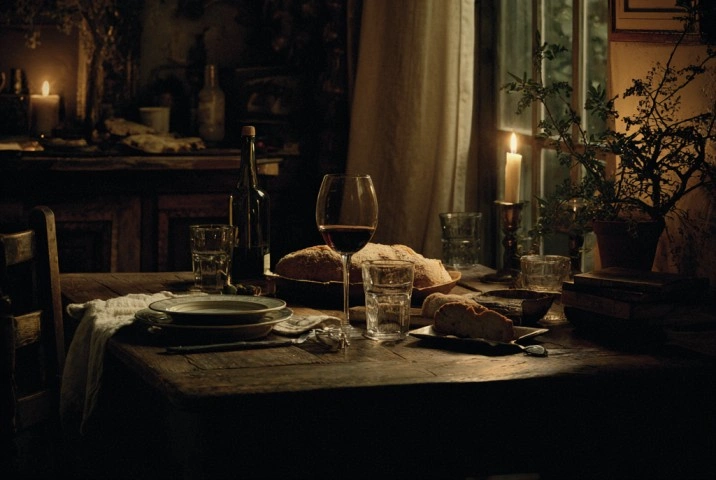
The dumb supper. The dumb supper is the silent meal with the dead: one of the most consistently attested Samhain practices across European folk tradition. You set the table for one extra guest: a place setting for the unseen guest, whoever among your dead you are honouring tonight. A plate of food, a glass of something they would have drunk, a candle lit in their place. The meal is eaten in complete silence, from beginning to end. No phone, no music, no reading. The silence is not grief performance; it is the condition that makes the kind of listening this practice requires possible. When the meal is done, take the food set for the dead outside and leave it as an offering. The practice is as old as the impulse to feed the dead, and it is available to anyone.
The ancestor altar. If you began ancestor work at the autumn equinox as that piece recommended, your altar is already established and inhabited by Samhain. The specific Samhain practice at the altar is simple: light the candle, pour fresh water, and sit in silence. You are not asking for anything. You are not performing anything. You are simply present, and your presence is the offering. What arrives in that silence (memory, feeling, a sense of company, sometimes nothing at all) is what the practice gives you.
Divination. Samhain is the peak divinatory night of the year. The veil is thin, the signals are clearer, and the questions that have been circling through the year tend to answer themselves at this threshold. Whatever divinatory method you work with (tarot, scrying, the wax-and-water reading covered in the Veil-Thinning Magic piece) bring it to Samhain night with the questions you have been avoiding. Not the small questions. The ones you have been circling since spring. Samhain is when the answer tends to come, if you have been honest about asking.
The vigil. Samhain is the one sabbat that specifically rewards not going to bed. The hour around midnight on 31 October (the exact threshold between Samhain and the new year) is the traditional peak of the veil's thinning. The practice of sitting awake at that hour is not elaborate; you do not need to be performing a ritual. Sitting by a candle, or outside in the dark if it is safe and warm enough, or simply awake and attentive at the hour when the worlds are closest: this is the vigil. It asks only your presence and your willingness to be awake when your instinct is to sleep.
The vigil is the hardest Samhain practice for most modern practitioners, because modern life has made midnight feel unreasonable. The unreasonable hour is precisely the point. The night's threshold is at midnight because midnight is the time when ordinary life thins: when the phone is dark and the world is quiet and the particular quality of attention the dead require becomes available.
The Samhain altar
Build the Samhain altar over the week approaching the 31st, letting it accumulate rather than assembling it all at once. The palette is the dark half of the year: black, deep crimson, bone white, the colours of the threshold.
Items: Black candles for the dark half; white candles for the beloved dead. Photographs of the dead: those you are specifically honouring. A glass of clean water, changed regularly (the ancestor altar practice). Salt at the threshold of the altar space. Apples, one cut horizontally to reveal the pentagram of seeds. Pomegranate: Persephone's fruit, the food of the underworld. A pumpkin or gourd with a candle inside: the hollowed lantern, one of the oldest Samhain light-symbols; carved turnips are the older British tradition if you can find one. The cauldron, if you have one: the symbol of transformation and the vessel that receives what is released. Dried herbs: mugwort for dreaming, rosemary for remembrance, wormwood if you are working deeply with the dead, with the caution that wormwood should not be taken internally in quantity.
Crystals: Jet (the traditional British mourning stone, covered in the Crystals series) or obsidian for protection at the threshold. Black tourmaline at the altar's edge.
Journal prompts for Samhain
Work through these on or just before the 31st, one per sitting if possible, rather than all at once.
Who am I honouring this Samhain? Who among the dead deserves a seat at my table?
What am I releasing that belongs to the year that is ending?
What question have I been avoiding asking this year? What would it cost me to ask it tonight?
What do I want to say to the dead that I haven't said?
What am I carrying into the new year that begins at midnight?
What does the year that is ending (from last Samhain to this one) look like, honestly?
Samhain in the wider wheel
Samhain closes the warm half of the year and opens the dark half. The intention arc that began with Beltane, moved through Litha, Lughnasadh, and Mabon closes here and a new one opens. The Samhain Energy and Intentions piece publishes on the 31st with the full dark-half arc structure. Tonight is the hinge point: the close of what has been and the beginning of what will be.
Common questions
Do I have to stay up all night? No. The vigil practice is the midnight hour: from roughly 11pm to 1am. If that window is available to you, use it. If not, the Samhain practices can be done earlier in the evening without loss. The midnight hour amplifies what you bring to it; it does not make the practice impossible if you cannot reach it.
What do I do if I feel nothing at the ancestor altar? Nothing is a valid experience. The practice is the showing up, not the feeling. Some Samhain nights are full of presence and some are quiet. Both are real. The consistency of the practice over years (the fact that you came back again) matters more than any single night's experience.
Can I celebrate Samhain if I have no dead to honour? Everyone has dead: ancestors of blood, however distant; the beloved dead of chosen family; the ancestors of spirit who walked the path before you. If personal loss is not present this year, the ancestors of the craft, the ancestors of the land, and the general dead of the year all have a place at the Samhain table.
Is it appropriate to celebrate Halloween and Samhain on the same night? Yes. They are layers of the same tradition. The folk dress and the children's lanterns and the neighbour's decorations are the popular Halloween layer; your altar, your dumb supper, your midnight vigil are the witches' layer. Both are legitimate. You do not have to choose.
Sources
Ronald Hutton, The Stations of the Sun: A History of the Ritual Year in Britain (Oxford University Press, 1996): the standard scholarly account of Samhain and the autumn festival traditions. For the Irish festival's antiquity: the medieval Irish Mythological Cycle texts as collected and translated in various editions; Máire Herbert's work on Irish seasonal festivals. For the Christian All Souls' and dumb supper tradition: the European folk-catholic practice of feeding the dead documented in the anthropological record. For the modern Wiccan reception: Ronald Hutton, The Triumph of the Moon (1999).
Grimoire is a digital practice companion for the solitary witch: a sacred calendar, private grimoire journal, ancestor work tools, daily tarot, herbology compendium, and spell builder, all in one place. Now available on Android.
More from the Blog
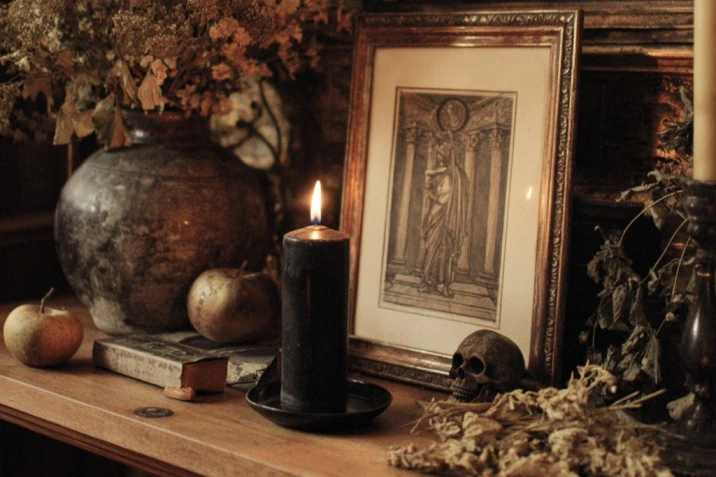
Samhain Deities
Samhain has the richest deity associations of any sabbat: Hekate, the Morrigan, the Cailleach, Cerridwen, Hel, and the leaders of the Wild Hunt. Six deity profiles with mythology, honest historical context, and how to work with each at the crossing of the year.
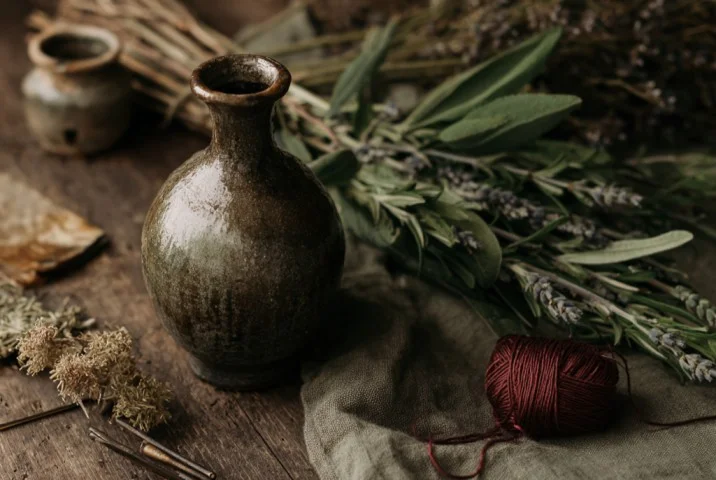
Herbs of Samhain: Plants for the Thinning Veil
Herbs of Samhain, from mugwort and rosemary to the poisonous nightshades of flying-ointment folklore. Their history, their uses, and the safety that matters.
Begin your practice
Grimoire is available now on Android and as a web app. Start today.