Sabbats
Samhain Deities
Rowenna
Solitary witch and the founder of Grimoire. Built the app she couldn't find anywhere else. Writes about the craft with primary sources, honest lineage notes, and a low tolerance for vague correspondences. Based in the UK with more herbs than shelf space.
· 9 min read
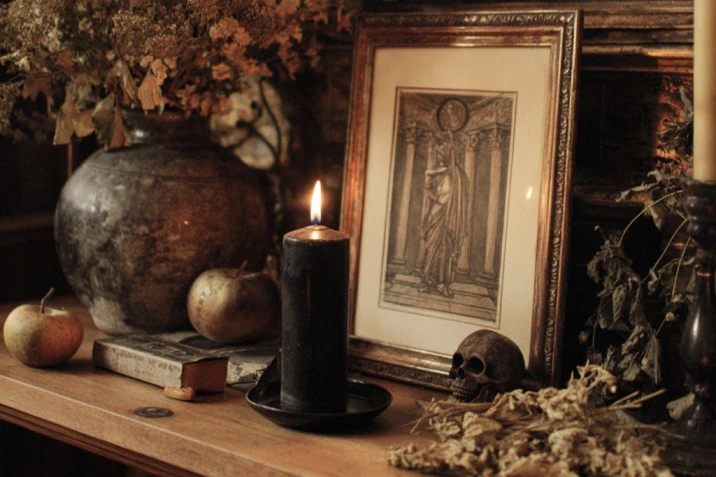
The Samhain cluster opens here, four weeks ahead of the sabbat itself. This piece is longer than the others in the wheel-of-year deity series (Beltane, Litha, Lughnasadh, Mabon) because Samhain carries more deity associations than any other point in the wheel. Six figures are profiled here: Hekate, the Morrigan, the Cailleach, Cerridwen, Hel, and the leaders of the Wild Hunt.
The synthesis, and when it was made
Samhain is the most genuinely ancient sabbat in the modern wheel of the year. The Irish festival of Samhain (Old Irish for "summer's end") is documented in medieval Irish sources as one of the four great cross-quarter festivals of the year, and the archaeological evidence for liminal practices at this point in the calendar predates Christianity in Ireland by centuries. Unlike Mabon (a 1970s naming by Aidan Kelly) or Litha (a modern application of a Bede month-name), Samhain has continuous attested use as a festival name. The honest-lineage move here is an affirmation: the name is old and the association genuine.
What is modern is the particular theology: the specific gathering of Hekate, the Morrigan, the Cailleach, Cerridwen, Hel, and the Wild Hunt into a single Samhain framework. These figures come from Greek, Irish, Scottish, Welsh, Norse, and pan-European folk traditions that have no historical continuity with each other and no documented pre-modern relationship to the Irish festival specifically. Modern Wicca and neopaganism assembled this pantheon in the 20th century, drawing on Frazer, Murray, Gardner, Graves, and the wider comparative mythology project. The assembly is recent. It is also coherent and meaningful in practice. Both are true.
For the ancestor practice dimension of Samhain (the altars, the dumb supper, the thinning of the veil) the ancestors themselves matter as much as any named deity. The figures below are Samhain's mythological companions, not its requirements.
Hekate
Hekate's origins are likely Thracian, absorbed into Greek religion and elevated over centuries into one of its most complex theological figures. She governs the crossroads: specifically the triple crossroads where three roads meet, the *triodion*, where her monthly offering meal was left. She holds torches, a key, and a dagger. She is accompanied by hounds. She moves in the dark.
Her domains are the crossroads, the moon's dark phase, witchcraft, and the dead. As a psychopomp (a guide of souls between worlds) she accompanies the dead toward the underworld and accompanies the living toward the thresholds they need to cross. In later Hellenistic and Roman sources she becomes increasingly identified with necromantic practice: the Hekate of the Greek Magical Papyri is invoked in workings involving the dead, the underworld, and the loosening of boundaries between worlds. The classical sources call her phosphoros (the light-bearer) and chthonia (the one beneath the earth); she is as much a figure of illumination as of darkness.
The Deipnon (the monthly offering meal left at crossroads on the dark moon) is one of the most consistently documented practices associated with Hekate in classical sources. At Samhain, the dark-moon-and-crossroads logic maps directly: the veil between worlds at its thinnest, the threshold open, the meal set for those who cross between. For the Italian folk-witchcraft tradition that Leland documented, the Hekate-Diana syncretism is explicit; Hekate is among the oldest named figures in the Western magical tradition's relationship to witchcraft.
Offerings: food left at the threshold or a crossroads, dark candles, keys, garlic, the number three. Her altar in the home faces outward; she guards the threshold rather than sitting at the hearth.
The Morrigan
The Morrigan is a figure of medieval Irish mythology — the Mor Rioghain, Great Queen or Phantom Queen — who appears in the Ulster Cycle and elsewhere as a shapeshifting sovereign figure associated with battle, fate, and the boundary between life and death. She moves between crow, eel, wolf, young woman, and crone. On battlefields she appears as a crow, counting the dead. She determines the outcome of battles not by fighting but by presence — her favour or her curse is the thing that tips the result.
In medieval Irish sources she is often understood as a triad — Badb the crow, Macha the sovereignty goddess, and Morrigu the phantom queen — though the exact composition varies. The unified "The Morrigan" triple-goddess figure of modern witchcraft is a synthesis; the medieval texts present these as related but distinct. Her relationship with Cú Chulainn in the Ulster Cycle is particularly complex: she offers him love, he refuses, she becomes an adversary, and their interactions define much of the cycle's thematic territory around masculine heroism and its limits.
Her Samhain association comes less from specific Irish festival texts and more from her nature: she is a threshold figure, moving between the worlds of living and dead, battle and aftermath, the time before and the time after. At Samhain, that threshold logic is everywhere. She is not primarily a harvest goddess or a winter goddess — she is a sovereignty and fate goddess, and the year's end is her moment because endings and reckoning are her territory.
Offerings: black feathers, red wine, raw meat, whisky. She does not require gentleness.
The Cailleach
The Cailleach — Old Irish and Scottish Gaelic for "the old woman" or "the veiled one" — is winter itself. She takes the world at Samhain and does not release it until Beltane, when Brigid returns. She strikes the frozen ground with her staff. She shapes mountains and lochs. She is vast, weather-worn, older than the hills she is said to have made.
In Scottish tradition she is the Cailleach Bheur, a blue-faced hag who rides the winter storms. She is not malevolent. She does not hate the living. She is simply the season, and the season does not apologise. Some traditions hold that she and Brigid are the same figure in different aspects — the crone who becomes the maiden when winter turns — but this is a later interpretive layer, not consistent across the folk record.
Her Samhain connection is among the most solidly grounded in this collection: she genuinely is associated with Samhain as the moment of winter's beginning in Scottish and Irish folk tradition. The night she wakes is the night the world tips into cold. Working with the Cailleach at Samhain is working with the season itself, and it asks for honest endurance rather than gentle acknowledgement. She values the ability to look at the dark half directly without flinching.
Offerings: a cup of water left outside on Samhain night, acknowledgement rather than petition, the willingness to go outside in the first cold wind rather than resisting the season.
Cerridwen
Cerridwen comes from Welsh tradition, primarily from the medieval story of Taliesin. She brews a cauldron of Awen — divine inspiration — for a year and a day, intending it for her son Morfran, who has been born ugly and needs supernatural gifts to compensate. The servant-boy Gwion Bach accidentally receives the three drops of wisdom meant for Morfran. He gains cosmic knowledge, flees, shape-shifts through hare, fish, bird, and grain, and is swallowed by Cerridwen in the form of a hen. She gestates him and he is reborn as Taliesin, the greatest of Welsh poets.
The cauldron is the central symbol — the vessel of transformation, dissolution, and rebirth. What enters the cauldron is broken down; what emerges is something new. At Samhain, this logic maps directly onto the thinning of the veil: the year dissolving, the dead returning, the boundary between what was and what will be temporarily removed.
The honest note: in medieval Welsh sources, Cerridwen is more of a powerful sorceress-figure than a goddess. The elevation to deity status is largely modern Wiccan and neopagan practice. This does not make her a fiction — the figure and her cauldron are genuinely ancient and mythologically rich — but the theological status is recent. The Grimoire approach to this is consistent: name the modern elevation without dismissing the practice it enables.
Offerings: water in a dark bowl, grain, offerings of creativity or craft — the product of the Awen she guards.
Hel
In Norse mythology, Hel rules Helheim — the realm of those who die of illness, old age, and ordinary deaths rather than battle. She is the daughter of Loki and the giantess Angrboða, sister of the World Serpent and the wolf Fenrir. Her body is described as half-living flesh and half-decaying or dark — not grotesque, but marking her as the figure who stands at the border of the living and the dead, partaking of both.
She receives the majority of the dead. Valhalla takes warriors; Fólkvangr takes Freyja's portion of the battle-dead; Helheim takes everyone else — which means almost everyone. She is not a punishment. She is simply the place most people go. The sagas describe her as cold, dignified, and implacable rather than cruel. She administers the dead with quiet sovereignty.
The honest note: Norse religious practice did not observe Samhain — that is an Irish festival. Hel's connection to modern Samhain practice is a 20th-century synthesis built on the thematic resonance between the Norse underworld and the Samhain crossing of the veil. The resonance is real; the historical connection is not. Working with Hel at Samhain is meaningful modern practice that should be named as modern. She is the appropriate deity for ancestor work that honours the ordinary dead — those who died quietly, without glory, and are honoured no less for it.
Offerings: food appropriate to the dead of your lineage, quiet rather than ceremonial acknowledgement, a candle lit in the dark.
The Wild Hunt
Across northern and western Europe, winter folklore records the spectral hunt: a company of riders moving through the winter sky, accompanied by hounds, sometimes the dead, sometimes animals, always in pursuit of something or someone. Those who witness the Hunt are at risk of being swept into it, or of receiving an omen of death. Those who treat the Hunt with respect may receive gifts or blessings.
The Hunt's leader varies by tradition. In Scandinavian and Anglo-Saxon lore it is Odin/Woden, riding his eight-legged horse Sleipnir, leading the Furious Host — the Einherjar and the restless dead. In English tradition it is Herne the Hunter, the antlered figure of Windsor Forest. In Welsh tradition it is Gwyn ap Nudd, the Lord of Annwn, the Welsh otherworld. In Central European tradition it is Frau Holle or Holda, a figure simultaneously terrible and generous. The same pattern of spectral riders, winter sky, and dangerous encounter appears across traditions that had no documented historical contact — which suggests either shared deep roots or the near-universal human experience of winter storms as something that moves with intention.
The umbrella term "the Wild Hunt" is Jacob Grimm's 19th-century scholarly coinage applied to these traditions. The underlying folk beliefs are genuine. Samhain is the night the Hunt first rides — the first wild winter night when the boundary is down and the dead move. Leaving an offering at the threshold on Samhain night — bread, water, a token of respect — is the traditional acknowledgement of the Hunt's passing.
Working with these deities at Samhain
Six figures, six distinct traditions, six different requests from the practitioner. Not all of them are appropriate for every practice, and not all of them should be approached at once. Choose by temperament and by what this particular Samhain asks of you.
Hekate for the crossroads work: the divination, the working with the dead, the protection of the threshold. The Morrigan for reckoning and sovereign decision — what the year has ended, what cannot be retrieved, what you are now claiming. The Cailleach for honest endurance of what the dark half actually holds. Cerridwen for the dissolution that precedes transformation. Hel for honouring the ordinary dead, the ancestors who died quietly and are no less present for it. The Wild Hunt for the wild winter night itself — the acknowledgement that some things move in the dark that are larger than we are.
For the full Samhain solitary practice, see Samhain for Solitary Witches, forthcoming 13 October.
Common questions
Is Hekate a Samhain deity or a year-round deity? Both. Hekate is worked with year-round in many traditions — the monthly Deipnon is not Samhain-specific. Samhain amplifies her crossroads and underworld aspects particularly, but her practice is not limited to October.
Can I work with the Morrigan if I don't have a warrior practice? Yes. The Morrigan governs sovereignty and fate as much as battle. The question she tends to ask is about genuine self-governance — where you are claiming your own authority, where you are ceding it unnecessarily — and that question is available to anyone.
Is it appropriate to work with Hel if I'm not Norse? The short answer is that the modern synthesis already makes Norse and Irish elements neighbours at Samhain, and most practitioners working with this full deity assembly are drawing on multiple traditions. The honest-lineage move is to know that Hel's Samhain association is modern synthesis, not historical continuity — and to proceed with that knowledge rather than with a claim of ancient lineage that isn't there.
Sources
For Hekate: Sarah Iles Johnston, Hekate Soteira (Scholars Press, 1990) — the scholarly standard on Hekate's theology. For the Morrigan: Máire Herbert, Iomairmhéid Morrigan and the broader Ulster Cycle scholarship; Rosalind Clark, The Great Queens: Irish Goddesses from the Morrígan to Cathleen ní Houlihan (1991). For the Cailleach: Donald Mackenzie, Scottish Folk Lore and Folk Life (1935) and the wider corpus of Scottish and Irish seasonal folklore. For Cerridwen: the medieval Welsh Historia Taliesin in the Mabinogion tradition. For Hel: the Prose Edda of Snorri Sturluson (c. 1220). For the Wild Hunt: Jacob Grimm, Deutsche Mythologie (1835) as the originating scholarly survey, read with the same caveats applied to all 19th-century comparative mythology.
Grimoire is a digital practice companion for the solitary witch — a sacred calendar, deity journal, daily tarot, private grimoire, and spell builder, all in one place. Now available on Android.
More from the Blog
Mabon Energy and Intentions
The autumn-equinox piece in the wheel-of-year intention arc: Beltane was commit, Litha was recognise, Lughnasadh was account, Mabon is integrate. What Mabon energy supports, how to set an intention at the autumn equinox, and the particular relief that comes from folding the year's work into who you are rather than continuing to work on it.
Beltane Energy and Intentions: What to Manifest at the Fire Festival
Beltane is the sabbat of commitment and full bloom. Here's how to work with its energy intentionally, and what it's most potent for.
Begin your practice
Grimoire is available now on Android and as a web app. Start today.