Practice
The Olfactory Ghost: A Formulation Guide
Rowenna
Solitary witch and the founder of Grimoire. Built the app she couldn't find anywhere else. Writes about the craft with primary sources, honest lineage notes, and a low tolerance for vague correspondences. Based in the UK with more herbs than shelf space.
· 11 min read
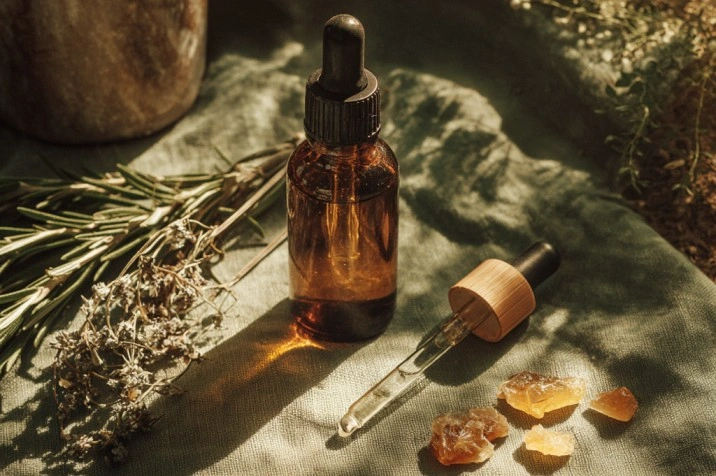
Scent Alchemy, Archival Shadows, and the Architecture of Intention
Most occult books treat scent like a lookup table. Cinnamon for wealth, lavender for peace, sandalwood for meditation. One ingredient, one job, done. It is tidy, and it turns a living sensory craft into paint-by-numbers. It also ignores how we actually smell anything.
We do not experience the world one molecule at a time. Walk into ancient woodland or a cold stone church and your state shifts because you are breathing a whole composition at once: damp earth, leaf litter, dry timber, old stone. To build a scent formula that does real work, you have to leave the single note behind and learn to layer, constructing a specific atmosphere rather than naming one.
Why the single note fails
Pour pure lavender onto a candle and the experience is brief and flat. Lavender is highly volatile: it enters the room in a sharp medicinal burst, hits you, and is gone within about twenty minutes. Your ritual loses its sensory anchor before the work has properly begun.
A layered formula fixes this mechanically. Combine ingredients with different evaporation rates and you get a scent that evolves over hours rather than minutes. This is not about smelling pleasant. It is about sustaining intention: the fragrance changes as the work deepens, revealing new parts of the blend as time passes. For the related practice of working with smoke rather than oil, see our guide to incense magic.
The three tiers
A layered formula balances across three structural tiers. The proportions below are a reliable starting frame, not a sacred law.
| Tier | Share of blend | Volatility | Role |
|---|---|---|---|
| Top note | 15–20% | High | The awakening |
| Heart note | 50–60% | Medium | The current |
| Base note | 20–30% | Low | The anchor |
The top note: the awakening (15–20%)
The first impact. Top notes are thin, sharp, and fleeting. They cut through the mental clutter of the day and pull you into the present moment, then recede.
Materials: bergamot, sweet orange, peppermint, or the sharp camphorous clarity of home-grown rosemary (Rosmarinus officinalis).
Safety: cold-pressed citrus oils, bergamot especially, contain furanocoumarins, which cause severe phototoxicity. Skin wearing these oils must not be exposed to sunlight for at least twenty-four hours, or you risk serious burns and blistering.
The heart note: the current (50–60%)
The engine of the blend. The heart emerges as the top note fades, holding the sustained emotional atmosphere of the work. These are full-bodied botanicals that linger for hours.
Materials: dried mugwort (Artemisia vulgaris), damask rose, clary sage, or black pepper.
Safety: mugwort contains thujone, which is a neurotoxin in high concentration and can trigger convulsions and uterine contractions. Do not ingest it in pregnancy, and dilute its essential oil with real precision rather than by eye. Its history and uses are covered in our beginner's guide to apothecary herbs.
The base note: the anchor (20–30%)
Heavy, dense, terrestrial molecules that evaporate very slowly. They act as a fixative, physically binding the lighter notes to the room and the skin, and they are what grounds the intention into material reality. Long after you leave the workspace, the base remains.
Materials: vetiver, dark patchouli, oakmoss, or tears of Omani frankincense (Boswellia sacra) dissolved in a carrier oil.
Safety: oakmoss is a potent contact allergen. Its sensitising components, atranol and chloratranol, are restricted under IFRA guidelines and tightly limited in EU and UK cosmetics, so source it as a compliant, low-atranol absolute and keep it off broken skin. Patchouli and vetiver are gentler but, like all essential oils, belong diluted in a carrier and patch-tested before use, never applied neat.
A worked example: the archival mind
A generic text tells you to burn mugwort for scrying or deep solitary study. A layered approach is more deliberate. Consider a blend built for archive work.
| Tier | Ingredient | Share | What it does |
|---|---|---|---|
| Top | Rosemary | 20% | Pierces mental fog, supports memory |
| Heart | Mugwort | 55% | Lowers the threshold to the subconscious |
| Base | Frankincense | 25% | Slows the breath, anchors the space |
Introduce this to your space and the rosemary hits first, clearing the day's clutter and sharpening focus. As you settle, the rosemary recedes and the bitter, herbaceous mugwort takes over, easing you into a deeper state. Hours later, only the resinous cold-stone warmth of the frankincense is left, keeping you grounded and calm. Rosemary's link to memory is not just folklore: a 2017 study in the Egyptian Journal of Basic and Applied Sciences associated rosemary aroma with improved short-term memory performance.
Keep a precise record
The real risk in scent work is the unrepeatable miracle. You mix a few drops of this and a splash of that, reach a profound state, and then realise you kept no record of the ratios. The blend is gone, and you cannot find your way back to it.
This is the dull, necessary part of the craft, and it is exactly the part loose scratch paper handles worst. A structured note of what went in, in what order, against what intention, is the difference between a practice that compounds over years and one that starts from zero every time.
On my own altar shelf, beneath a slab of selenite, sits the tool I use to keep this honest: a laptop running Grimoire. I built the Scent Magic feature as a digital olfactory notebook, so you can build your three-tier note pyramids and keep a personal library of botanical correspondences in one place, instead of trusting it all to stained scratch paper and memory.
Questions
Why not just use a single oil if I like the smell?
You can, for ambience. But a single volatile oil fades within about twenty minutes, so it cannot carry a longer working. A layered blend evolves over hours, which is what lets the scent track the arc of the ritual rather than evaporating at the start of it.
Do I have to measure by percentage?
The percentages are a guide, not a rule, and you will adjust them by nose with experience. What matters far more than hitting an exact number is recording what you actually did, so a blend that works can be repeated.
Are essential oils safe to burn or apply directly?
Not without care. Citrus oils are phototoxic on skin exposed to sun, and several herb oils including mugwort are toxic in concentration. Dilute properly in a carrier, patch-test, and never ingest essential oils without qualified guidance.
Sources
- Filiptsova et al.: The essential oil of rosemary and its effect on the human image and numerical short-term memory, Egyptian Journal of Basic and Applied Sciences (2017), associating rosemary aroma with improved short-term memory performance.
- Wikipedia: Note (perfumery), on the volatility-based classification of top, heart, and base notes and their evaporation rates.
- Wikipedia: Phytophotodermatitis, on the phototoxic action of furanocoumarins (notably bergapten in bergamot and citrus) on sun-exposed skin.
- Wikipedia: Thujone, on the neurotoxicity of thujone and its presence in Artemisia species including mugwort and wormwood.
- Robert Tisserand & Rodney Young: Essential Oil Safety (2nd ed., Churchill Livingstone, 2014). The standard reference on essential-oil toxicity, phototoxicity, and safe dilution.
Grimoire is a digital practice companion for the solitary witch: a herbology compendium, crystal guide, sacred calendar, daily tarot, and private grimoire journal, all in one place. Now available on Android.
More from the Blog
Why Witches Take a Craft Name (And How a Name Becomes a Ward)
A name is not just a label; in folk magic it is a link. A grounded guide to name magic, craft names, and warding the name you were given.

Shadow Work Prompts: 30 Questions to Begin (and How to Use Them)
Shadow work prompts for solitary practice: thirty questions grouped by theme, plus how to use them safely and pace the work. A gentle, grounded guide.
Begin your practice
Grimoire is available now on Android and as a web app. Start today.