Spells
Sigil Work for Solitary Witches
Rowenna
Solitary witch and the founder of Grimoire. Built the app she couldn't find anywhere else. Writes about the craft with primary sources, honest lineage notes, and a low tolerance for vague correspondences. Based in the UK with more herbs than shelf space.
· 11 min read
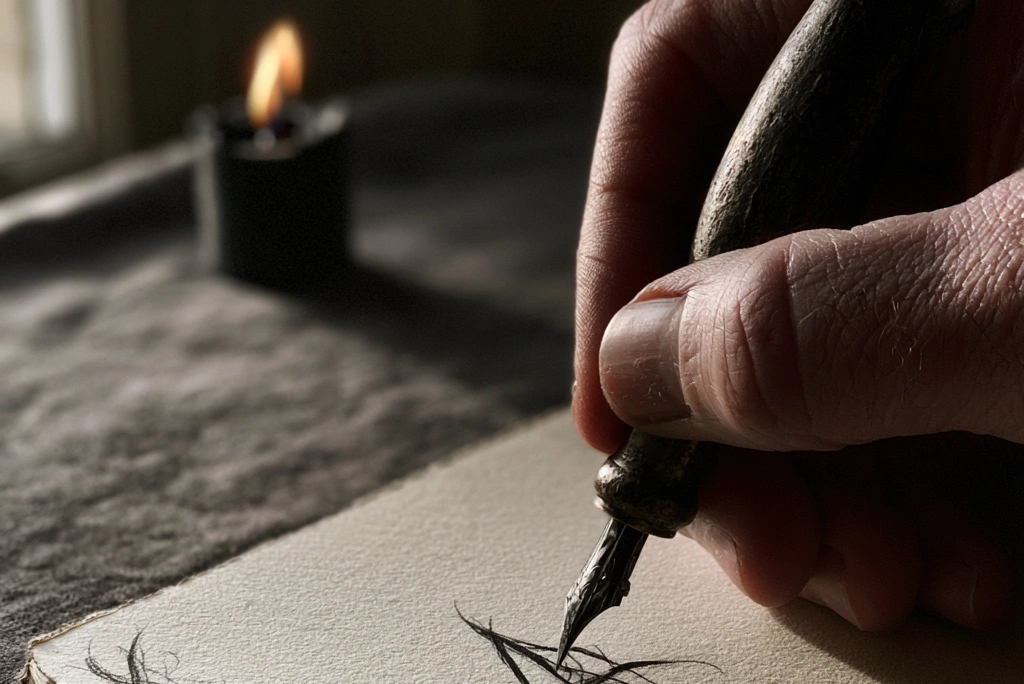
Sigils are the most modern technique in the Grimoire spells cluster and the most subject to bad teaching. Most online sigil content presents the method as either ancient folk magic or as something intuitive and vibe-based, when the specific technique that the majority of modern witches use is neither. It comes from one person, one book, published in 1913, and the technique only works if you follow the step that most tutorials skip.
This piece covers the method properly: where it comes from, how it works mechanically, a complete worked example, how to charge the sigil, and (the step that matters most) why and how you release it afterwards.
What a sigil is
A sigil is a visual representation of an intention: a symbol created specifically to carry a particular desire or working into the world (or into the practitioner's unconscious, depending on how you frame it). It is image magic in the specific sense covered in Sympathetic Magic: A Primer: the sigil resembles the intention (having been constructed from it), and the act of creating and activating it creates a connection between the physical symbol and the intended outcome.
What distinguishes sigils from other kinds of magical symbols (runes, planetary characters, alchemical glyphs) is that they are created for a specific intention by the practitioner themselves, rather than being symbols drawn from an inherited system. You make the sigil. It is yours. That is both the technique's advantage and the thing that most requires understanding.
The Spare method: where it comes from
The sigil method that most modern witches use descends directly from the work of Austin Osman Spare (1886–1956), an English artist and occultist who published it in The Book of Pleasure (Self-Love): The Psychology of Ecstasy in 1913.¹
Spare was not drawing on ancient tradition. He was developing a personal magical system based on his own theories about the unconscious mind and the way desire operates. His central insight (that the conscious mind's anxious attachment to an outcome actually prevents the outcome, and that the unconscious mind is more effective at pursuing goals when the conscious mind stops interfering) has some resonance with certain psychological frameworks, though Spare would not have framed it that way.
The chaos magic movement of the 1970s and 1980s, particularly the writers Peter Carroll and Phil Hine, took Spare's method and systematised it into the accessible form that most modern practitioners encounter.² What is taught as "sigil magic" in the contemporary witchcraft world is substantially the chaos magic adaptation of Spare's original method. This is not ancient folk magic. It is a twentieth-century development. The technique is genuinely effective; the lineage is genuinely recent.
The Spare method: step by step
Step 1: Write the statement of intent.
The statement should be specific, positive in framing, and written in the present tense as if the intention is already in the process of being fulfilled. Not I want to find a better job but I am moving toward work that sustains me. Not I hope to stop being afraid but I am building the courage I need.
The precision here matters, not because the universe is parsing your grammar, but because the act of crafting a precise statement forces you to be clear about what you actually intend. The sigil that follows is only as good as the statement it came from. For a full treatment of intention-setting for spell work, see Spell Crafting for Beginners.
Step 2: Eliminate repeated letters.
Write out all the letters of your statement. Then go through them and remove every letter that appears more than once, keeping only its first occurrence. What remains is a set of unique letters.
Worked example. Statement: I SEEK CREATIVE CLARITY
Writing out the letters and removing repeats produces: I, S, E, K, C, R, A, T, V, L, Y: eleven unique letters, with all second and third occurrences of E, I, A, R, T, and C removed.
Step 3: Form a glyph from the remaining letters.
Combine, overlap, rotate, mirror, and distort the remaining letters until the individual characters are no longer recognisable and the result reads as an abstract symbol rather than as letters. This is the creative stage. There is no single correct result: the glyph that emerges from the same set of letters will look different for every practitioner.
What you are after is a symbol that carries the intention (because it was constructed from the statement) but no longer legibly announces it. The abstraction is the point: the glyph should not be immediately decodable.
The result is your sigil. A unique symbol that exists nowhere else and that encodes your specific intention in a form your conscious mind can work with ritually without over-literalising.
Other methods
The Spare method is not the only way to create a sigil. Two others worth knowing:
Planetary magic squares. The medieval and Renaissance magical tradition used numerical squares (kamea) associated with each of the seven classical planets: the Sun's square is 6×6, the Moon's 9×9, Saturn's 3×3, and so on. Each number in the square corresponds to a letter of the alphabet, and by tracing the numbers that correspond to the letters of your intention across the square, you produce a pattern that becomes the sigil. This method predates Spare by several centuries and has its own lineage running through the Picatrix and Agrippa's De Occulta Philosophia.³
Bind runes. The Norse and Germanic tradition of combining runic characters into a single composite symbol is a form of sigil work with genuinely ancient roots. A bind rune draws on the meaning of each constituent rune, combining them into a single glyph that carries all their combined qualities. This is a distinct practice from the Spare method and should be understood within the Norse magical tradition rather than as a variant of chaos magic sigil work.
Charging a sigil
Charging is the act of activating the sigil: moving it from a drawn symbol into a working. The charging moment is when the sigil is given its energy.
The original Spare method used extreme states of consciousness to charge sigils: physical postures that induced altered states (the "death posture"), sexual arousal and orgasm, or intense focused concentration followed by sudden, complete mental abandonment of the sigil. The common thread is a spike of heightened, intense consciousness at the moment of engagement with the sigil, followed by the complete cessation of that engagement. The sigil was charged at the peak and then the mental engagement dropped instantly and completely.
Modern adaptations generally take less extreme approaches:
- Staring at the sigil with concentrated attention during a ritual or meditative state, then stopping suddenly
- Holding the sigil over a candle flame (for fire sigils)
- Burning the sigil completely at the peak of a working; this combines charging and release into a single act
- Burying the sigil in earth
- Placing the sigil under a candle and letting the candle burn over it
Any of these can work. The critical factor is not the specific method but the quality of attention at the moment of charging: genuine, concentrated engagement with the sigil, followed by release.
Releasing and forgetting: the step that matters most
This is the step most online sigil content skips, and skipping it is why many practitioners find sigil work produces inconsistent results.
Spare's original insight was that the conscious mind's lust for result (the anxious hoping, the checking, the waiting) actively works against the intention. The unconscious mind, once primed toward an intention, works toward it more effectively than the conscious mind can direct. The conscious mind's job, once the sigil is charged, is to get out of the way.
In practical terms: after charging a sigil, put it away. Do not look at it regularly. Do not think about whether it is working. If you burned it, the release is already complete. If you buried it, consider it done. The working is underway; your conscious attention to it is no longer part of the mechanism.
This is structurally different from most other spell forms in this cluster. A candle spell involves sustained, regular attention (re-lighting the candle, maintaining the intention). A knot spell involves the practitioner's continued presence through the knotted cord. Sigil work specifically inverts this: the working runs most cleanly when the conscious practitioner does not attend to it. If you find yourself returning to the sigil repeatedly, wondering whether it is working, the practice is asking you to notice that, and to set the question down.
The most common reason sigil work produces unclear results is not a failure of the charging. It is a failure of the release.
The Grimoire Sigil Forge
The Sigil Forge feature in Grimoire applies the Spare method digitally: input a statement of intent and the feature generates the abstract glyph. It is the most direct application in the Grimoire app of the technique covered in this piece. Whether you use the digital generation or work by hand, the method is the same; the releasing step applies equally.
Conclusion
Sigil work is the most intellectually honest technique in this cluster: it makes no claim to ancient origin (the Spare method is 1913), it has a clearly documented source, and its mechanism (create, charge, release) is transparent about what it is asking the practitioner to do. It is also, in the experience of many working witches, one of the more reliable techniques for practical workings when the releasing step is properly executed.
The method is specific. Write the statement precisely. Form the glyph until it is abstract. Charge it with genuine concentrated attention. Release it completely. Let the working run.
For the foundation of how this technique fits within the broader structure of spell work, see Spell Crafting for Beginners. For the theoretical framework underlying sigil magic as image-based sympathetic working, see Sympathetic Magic: A Primer.
This piece is part of A Witch's Working Library: The Spells Cluster: fourteen pieces on the practice, theory and seasonal application of spell craft.
Sources
- Austin Osman Spare, The Book of Pleasure (Self-Love): The Psychology of Ecstasy (London: self-published, 1913): the foundational text of modern sigil magic. Available in facsimile reprints and digitised editions; the original is in the public domain.
- Peter Carroll, Liber Null & Psychonaut (York Beach: Weiser, 1987): the chaos magic systematisation of Spare's sigil method that became the primary vehicle for its spread through 20th-century occultism and eventually modern witchcraft.
- Wikipedia: Sigil, overview of sigil traditions including the Spare method, planetary magic squares, and bind runes, with the correct lineage distinctions between them.
- Wikipedia: Austin Osman Spare, biographical overview and introduction to Spare's magical system, including his relationship with Aleister Crowley and the development of Zos Kia Cultus.
More from the Blog

Candle Magic: A Witch's Guide
Colour correspondences, dressing candles, timing, reading the burn, and a simple candle spell template. The foundational technique of modern witchcraft, with the honest history of where it came from.
Bread and Grain Magic: Spells for Lughnasadh
Five working spells for the first harvest: a bread-baking ritual, a grain charm, a first-fruits offering, a harvest accounting, and a John Barleycorn release. Specific, sourced, and adaptable for solitary practice.
Begin your practice
Grimoire is available now on Android and as a web app. Start today.