Spells
Candle Magic: A Witch's Guide
Rowenna
Solitary witch and the founder of Grimoire. Built the app she couldn't find anywhere else. Writes about the craft with primary sources, honest lineage notes, and a low tolerance for vague correspondences. Based in the UK with more herbs than shelf space.
· 10 min read
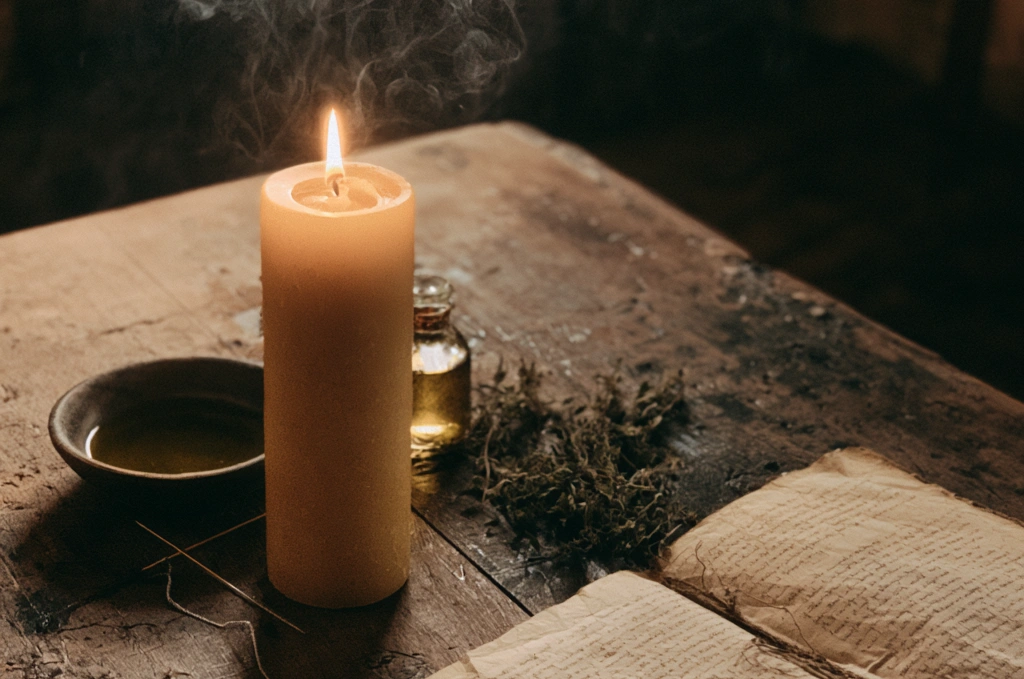
Candle magic is the gateway practice. Almost every modern witch starts here (a candle, an intention, a lit flame) and almost every modern witch underestimates how much there is to it. Not because candle magic is complex, but because the practice has a depth that the surface doesn't suggest. The colour choice matters. The timing matters. The dressing matters. The burn tells you something. What you do when the candle is spent matters.
This piece covers the practice properly: where modern candle magic actually came from, the colour correspondences and their honest lineage, how to dress a candle, how to read the burn, how to time a working, and a simple spell template that ties it all together. If you are new to spell craft, read Spell Crafting for Beginners first for the foundational structure. This piece assumes you have it.
Where candle magic comes from
Candles have been used ritually for as long as candles have existed: Roman votive offerings, church altar lights, the Hanukkah menorah, medieval sympathetic-magic workings. The idea of fire as a ritual medium is ancient and cross-cultural.¹
The specific practice of working candles (anointing them with oil, carving intentions into the wax, choosing colours for their correspondence to specific intentions) is more recent, and its primary modern roots are in Hoodoo and African-American conjure tradition. From the late nineteenth century onward, candle workers in the conjure tradition developed a sophisticated working practice around specific candle colours, prepared oils, and ritual burn patterns that became the template modern witchcraft absorbed substantially in the twentieth century.²
The colour-correspondence tables most modern witches use (red for love and desire, green for money, black for banishing) were systematised for a mainstream witchcraft audience largely by Scott Cunningham and similar writers in the 1980s, drawing on this conjure tradition and on the broader Western magical colour-symbolism it had itself absorbed.³ Most published colour lists are inconsistent with each other and represent a relatively recent attempt to standardise a practice that was never standardised. The correspondences work. They are not ancient.
Naming this directly is not an argument against using colour correspondences. It is an argument for using them with appropriate acknowledgment of where the practice came from, and for holding the tables loosely rather than treating any one published list as definitive.
Colour correspondences
Use the following as a working reference, with the honest note that any colour list represents one tradition's conventions rather than universal truth. Where sources disagree significantly, this table favours the most broadly consistent readings:
- White: purification, clarity, new beginnings, the full moon, Spirit; can substitute for any other colour when the correct colour is unavailable
- Black: banishing, protection, reversal, releasing what is done, the dark moon
- Red: desire, passion, courage, urgency, Mars energy; blood magic in older traditions
- Pink: love in its gentle forms, affection, self-care, reconciliation
- Green: money, growth, abundance, health, Venus and Earth energy
- Blue: communication, healing, peace, emotional truth, lunar wisdom
- Yellow / Gold: success, confidence, the solar will, intellectual clarity, Mercury and Sun energy
- Orange: creativity, attraction, enthusiasm, change in motion
- Purple: spirituality, intuition, psychic work, the higher mind
- Brown: home, stability, grounding, animals, practical earth-work
- Silver: the Moon, feminine mysteries, the dream world, psychic protection
A working note on white. White is the most flexible colour in the canon; it holds no specific correspondence that excludes others, and substitutes cleanly for any colour. If you only keep white candles, you can work any intention.
A working note on black. Black candles are banishing and protective candles, not cursing candles. The conflation of black with harm is a cultural overlay, not a magical one. See Banishing Spells for the longer discussion of this distinction.
Dressing a candle
Dressing means preparing a candle for a specific working before lighting it. There are three main forms:
Anointing with oil. Apply a small amount of oil (any oil you have, though specific ritual oils carry their own correspondences) along the length of the candle. The direction of application carries meaning in the conjure and folk-magic tradition: draw the oil from the base toward the wick for workings that bring things toward you; from wick to base for workings that send things away. Use a thin coating, not enough to create a fire hazard.
Carving the intention. Use a needle, nail, or dedicated carving tool to inscribe a word, phrase, or symbol into the wax. This can be as simple as a single word (abundance, release, clarity) or as elaborate as a full sigil (see Sigil Work for Solitary Witches, forward-positioned for later in this cluster). The carved intention becomes the physical anchor of the working in the candle itself.
Rolling in herbs. After anointing with oil, a taper or pillar candle can be rolled gently in dried herbs chosen for their correspondence to the working. Use finely crumbled rather than whole herbs to prevent fire hazard, and only roll the lower two-thirds of the candle, not the wick end.
Dressing is not required. A plain, intention-stated candle is a valid working. Dressing is the practice of adding specificity and physical materiality to the working, which is consistent with the cluster's foundational principle.
Timing
Candle magic responds to timing more clearly than almost any other technique, because the candle burns in real time and the timing of lighting it can be chosen precisely.
By lunar phase. For workings that draw something toward you (growth, abundance, love, opportunity), light on the waxing moon: from new to full. For workings that release something (habits, situations, relationships that need to end), light on the waning moon: from full to dark. For the most concentrated draw, the full moon. For the most concentrated release, the dark or new moon.
By day of the week. Each day carries a planetary association: Sunday (Sun, success, confidence), Monday (Moon, intuition, home, emotional work), Tuesday (Mars, courage, conflict, urgency), Wednesday (Mercury, communication, study, travel), Thursday (Jupiter, expansion, legal matters, abundance), Friday (Venus, love, relationships, beauty), Saturday (Saturn, discipline, banishing, binding, long-term work). Match the day to the working's intention when you can.
By time of day. Sunrise for beginnings. Noon for the strongest active working. Sunset for releasing. Midnight for the most liminal work.
For a full treatment of timing as a practice, see Working With the Moon.
Reading the burn
The burn pattern of a candle carries information about the working. This is interpretive work (it requires the practitioner's own discernment rather than a fixed code) but the following patterns are broadly consistent across traditions:
A clean, steady flame: the working is clear and moving. The intention is well-formed and the conditions are favourable.
A flickering flame: disturbance. In practical terms, check for draught first; if there is none, the flickering may indicate that the situation the working is addressing is unsettled or that there is more resistance than expected.
A very high, strong flame: intensity. The working has caught, and the energy is moving fast. Watch it.
A dim or struggling flame: the intention may need to be clarified, or the timing is not quite right, or the working requires more of the practitioner's focused attention.
Heavy smoke: something is clouded in the situation. The intention may be obscured or the path forward is not clear yet.
The candle self-extinguishing: a signal to pause. The working may not be ready, or the timing needs reconsideration. Relight with renewed intention or wait for a better window.
The wax pool: when a candle burns out, the shape of the hardened wax can be read as the conjure/candle-reading tradition reads it: is it smooth or cratered? Does it hold the shape of the carved intention? Has anything notable formed? This is the most intuitive aspect of the practice; no two readers will interpret identically.
A simple candle spell
You will need: one candle in the appropriate colour, something to carve with (a needle, a nail, or a dedicated tool), an oil for anointing (optional), a proper holder, matches or a lighter.
The working. Sit with the candle before you begin. Hold it briefly and name aloud, specifically, what this working is for. Not I want things to improve: the specific situation, the specific direction, the specific outcome you are working toward.
Carve the intention into the wax: a word, a symbol, whatever form your intention takes physically. Anoint with oil if you are dressing the candle, applying in the direction that matches the working's intent.
Set the candle in the holder. Sit quietly for a moment before lighting it; this is the moment of full attention that makes the working a working rather than just a lit candle. Then speak the intention aloud, in present tense, and light the wick.
Let the candle burn for as long as the working requires: ideally all the way down, though this is not always practical. If you need to extinguish early, snuff rather than blow (blowing is traditionally considered to scatter the intention). Relight with renewed attention at the next appropriate moment.
Note the burn as it progresses. When the candle is spent, bury or dispose of the remains thoughtfully.
Safety
Candle magic is fire. The same principles apply here as in every other piece in this cluster that involves a flame:
- Never leave a burning candle unattended. This is the most violated rule in modern witchcraft and the source of most house fires that start at an altar.
- Use a proper holder that secures the candle and catches drips. Not a plate, not a makeshift surface.
- Keep the area clear. No fabric, paper, or flammable material within a foot of the flame.
- Keep water nearby. A small bowl is sufficient.
- Do not burn near an open window if there is enough draught to push the flame toward nearby material.
- Trim the wick to 6mm before lighting if it has burned before; a long wick produces a large, unpredictable flame.
- If you are burning a dressed candle with oil and herbs, watch the first few minutes closely. Herbs near the wick can catch; if they do, blow them out immediately and continue with the unherbed portion.
- Keep children and pets out of the room while candles are burning unsupervised.
The aesthetic of candle magic is beautiful. The safety practice is what keeps it so.
Conclusion
Candle magic is the most accessible entry point in the Spells cluster, and the one with the longest continuous working tradition behind it. The colour correspondences are relatively recent systematisations of a practice with deeper folk roots. The dressing methods, the burn-reading tradition, and the working-candle as a format all carry substantial lineage through the Hoodoo/conjure tradition that modern witchcraft absorbed. Using the practice well means using it with that understanding: the correspondences hold because they are concentrated attention, not because they are ancient law.
For the foundational structure of how spells work, see Spell Crafting for Beginners. For the theoretical principles underlying correspondence magic, see Sympathetic Magic: A Primer. For timing in depth, see Working With the Moon.
This piece is part of A Witch's Working Library: The Spells Cluster: fourteen pieces on the practice, theory and seasonal application of spell craft.
Sources
- Wikipedia: Candle, historical and ritual use of candles across traditions, including votive offerings, church practice, and the use of fire as a ritual medium.
- Yvonne P. Chireau, Black Magic: Religion and the African American Conjuring Tradition (University of California Press, 2003): the standard scholarly treatment of Hoodoo and conjure practice, including the candle-working tradition and its influence on broader American folk magic.
- Scott Cunningham, Cunningham's Encyclopedia of Magical Herbs (Llewellyn, 1985) and The Complete Book of Incense, Oils and Brews (Llewellyn, 1989): the most influential 20th-century popularisation of colour-correspondence tables in mainstream English-language witchcraft.
- Wikipedia: Hoodoo (folk magic), overview of Hoodoo practice and its relationship to African American folk religion, including the candle-working tradition.
More from the Blog

Spell Crafting for Beginners: A Witch's Guide to How Spells Actually Work
How spells actually work: the materials, the intention, the timing, and the discipline of specificity. The foundational guide for new witches, and a reference for working ones.
Sigil Work for Solitary Witches
Sigils are the most modern technique in the Grimoire spells cluster and the one most often taught badly. The Spare method, a complete worked example, the crucial releasing step most content skips, and the honest history of where sigil magic actually came from.
Begin your practice
Grimoire is available now on Android and as a web app. Start today.