Crystals
The Witch's Guide to Hag Stones
Rowenna
Solitary witch and the founder of Grimoire. Built the app she couldn't find anywhere else. Writes about the craft with primary sources, honest lineage notes, and a low tolerance for vague correspondences. Based in the UK with more herbs than shelf space.
· 8 min read
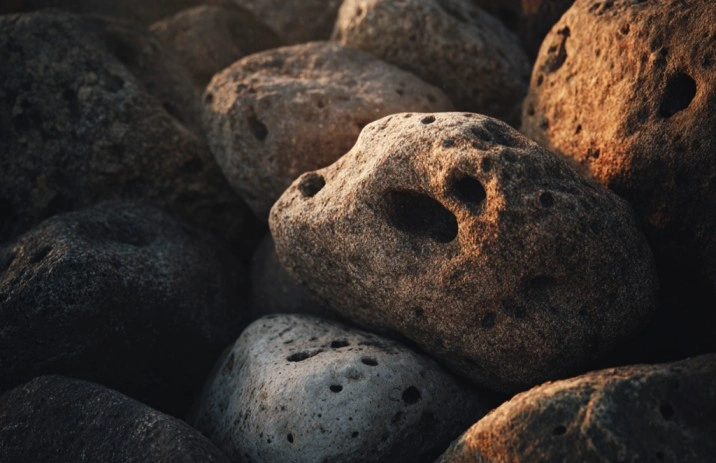
A hag stone is the oldest piece of magical equipment a witch can own, and possibly the cheapest. You do not buy one. You find one. On a beach, in a riverbed, in a field after a storm. The moment you pick it up, you have stepped into a folk tradition that goes back at least to Pliny.
This piece is a working guide to the hag stone tradition: what these stones are, what they have been used for, and how they earn their place in a modern solitary practice.
What is a hag stone?
A hag stone is a stone with a hole through it, made naturally rather than by human hands. The hole can come from water erosion, from burrowing molluscs, or from the slow eating-out of a softer fossil from the harder rock around it.¹
The hole is the entire point. A drilled stone is not a hag stone, no matter how old or how beautiful. The tradition rests on the idea that the work was done by something other than human hands.
Most hag stones are flint, because flint is the most common naturally holed pebble on Western European beaches. But limestone, sandstone, chalk, and ironstone all qualify. The material matters less than the origin of the hole.
The names it has been called
The hag stone has been considered powerful in enough traditions, for long enough, that it carries a small library of names:
- Hag stone, witch stone, fairy stone: common English
- Adder stone, serpent's egg, snake's egg: across Britain
- Glain Neidr ("snake glass") and Maen Magl: Welsh
- Milpreve: Cornish
- Adderstane: Scots
- Gloine nan Druidh ("Druid's glass"): Scottish Gaelic
- Hühnergott ("chicken god"): German
- Holy stone or holey stone: both spellings used, the second probably older²
A stone gathers names the way a working tool gathers nicknames. The number of them tells you the stone has been in active use across a wide territory for a long time.
How the hole is made
Geologically, hag stones are unremarkable. Flint hag stones from English beaches are usually the result of a soft fossil being eroded out by seawater, leaving a hole through the harder silica around it.³ Limestone hag stones are made by burrowing bivalves and marine worms.
The folk explanation is more interesting. Welsh tradition holds that hag stones (Glain Neidr, "snake glass") are formed in spring, when snakes gather in writhing balls and leave a hole in the centre, hardened by their breath or saliva. Pliny the Elder, writing in the first century, recorded the same belief among the Druids and noted that the resulting stones were held in the highest esteem.⁴
This is folk biology, not real biology. But the cosmology underneath it is consistent: a hag stone is a thing made by other-than-human agencies, and that is what gives it its power.
The folk tradition
The hag stone is one of the best-attested folk magical objects in Western Europe. Recorded uses run for at least two thousand years, and many of them are still working uses today.
I keep three. One above the front door on a length of copper wire, one on the windowsill of the room where I work, and one that has been on my keyring long enough that I forget it is there until someone asks what it is. That last one is the most travelled piece of magical equipment I own.
Protection of homes and livestock. Hag stones were hung in stables and barns, and above the doors of houses, to keep witches and ill-wishing from passing through. The same practice protected animals from being "ridden" at night, the older folklore behind what modern medicine calls sleep paralysis.
Protection on the water. Fishermen, especially in the south-west of England, tied hag stones to boat masts and to the ropes used to haul boats up the beach. A boat that did not bring in a good haul was thought to have been witched, and the stone was a practical countermeasure.⁵
Protection of sleep. Hung above the bed, a hag stone was thought to prevent nightmares and "night-hag" attacks. The folk solution survived because it worked, at least in the sense that it gave the sleeper a focus and a feeling of safety.
Health and childbirth. Sussex midwives used hag stones to cure children's diseases and to prevent adults catching them. Welsh tradition associated them with successful childbirth, an extension of the protective and threshold meanings.
Small things, kept safe. Tying a hag stone to a set of keys was held to stop the keys being lost. This is one of the oldest charm practices that still survives, mostly forgotten, in the keychain.
A stone with a hole in it costs nothing, and has been guarding thresholds for two thousand years.
Looking through the hole
The single most distinctive practice associated with hag stones is the act of looking through the hole.
Folklore across multiple traditions held that the hole was a portal: a way of seeing what could not be seen otherwise. A hag stone held to the eye allowed the bearer to see what was otherwise hidden: most often fairies, sometimes spirits, sometimes the malicious workings of witchcraft. The Mabinogion, the great Welsh prose collection, mentions a magical stone of this kind given to Peredur, allowing him to see and kill an otherwise invisible creature.⁶
There is also a practical folk-logic underpinning the protection traditions: a stone with a hole in it cannot be cursed, because magic was held to be unable to work on objects that water could pass through. The hole in the stone is, in this sense, the stone's defence, and by extension the bearer's.
The shape itself (an eye) doubled the meaning. Hag stones served as wards against the evil eye, the same way the carved nazar amulets do across the eastern Mediterranean.
Working with a hag stone today
The traditional uses still work, and a hag stone earns its place in a modern solitary practice without much adaptation.
- As a threshold guardian. Hung by the front door, by the bed, or in the car, the hag stone holds the protective meaning it has held for centuries. A length of cord or copper wire through the hole is enough.
- For looking-through practice. Sit somewhere quiet, hold the stone to your eye, and look through it at a candle flame, the moon, or any object you would normally look at without thinking. Notice what shifts. This is one of the oldest forms of folk scrying, and it still teaches the practitioner something useful.
- As a small-thing guardian. Tie a small hag stone to a keyring or to a piece of jewellery you wear daily. The old logic holds.
- As an altar piece. A hag stone on a protection altar anchors the working in older tradition than most modern crystal correspondences can offer.
The looking-through practice is the one I have found most useful over the years. A hag stone held to the eye in front of a candle flame resolves the light differently, and the practice of holding completely still long enough to focus through a small hole has its own meditative quality. Most people do not look slowly at things. The stone is a simple way of making you do it.
A hag stone in active use does not need much cleansing. Moving water is the traditional method, and the simplest version is to hold it under a tap for a moment. A return visit to the beach where it was found is the deeper version of the same practice.
How to find one
The traditional rule is that you should find your own. The stone reveals itself to you, the saying goes, not the other way around.
In practice, this means a lot of looking. The best places to look are flint beaches in southern and eastern England, including Sussex, Norfolk, and the Kent coast, and any pebble beach that has been worked by the sea for a long time. Riverbeds are also productive, especially after a flood, when stones have been moved and overturned. Some witches find them in fields after ploughing.
A few practical notes:
- Look on shingle beaches at low tide, after a storm if possible.
- The hole must go all the way through. Many almost-hag-stones have a deep dimple but no through-hole. They are still pretty, but they are not hag stones.
- Most working witches accept any hole-through-natural-causes, even a tiny one. The size of the hole does not determine the magic.
- Buying a hag stone someone else found is acceptable in modern practice, though the find-your-own rule still carries weight if you can manage it.
The patience required is part of the practice. A practitioner who has spent six visits to a beach without finding one will recognise the seventh stone the moment her eye lands on it.
I found my first on a flint beach in East Sussex on a walk when I was not looking for one. The second took a deliberate morning of searching. The stone I found by accident was better. I am not sure what to make of this, but I have come to believe it is consistent.
Sourcing and ethics
Hag stones are one of the few magical objects with no sourcing problem. They are not mined. They are not extracted at scale. The supply chain is the beach.
A few guidelines:
- Take only what you will use. A pocketful of hag stones from one beach trip is excessive.
- Avoid removing stones from protected coastlines and Sites of Special Scientific Interest in the UK without permission.
- If buying, choose UK-based small dealers who can name the beach.
- Drilled stones are sold as hag stones in some shops. They are not. Walk away.
A hag stone is older than any modern crystal correspondence, costs nothing if you find it yourself, and works on principles that have not really changed since Pliny was writing. The witch who keeps one is keeping company with two thousand years of fishermen, midwives, and householders who reached for the same object for the same reasons.
The relationship begins the moment the stone catches your eye.
Questions
Can I make a hag stone by drilling a hole through one?
No. The whole tradition rests on the hole being made by something other than human hands. A drilled stone may be useful for other purposes, but it is not a hag stone in any folkloric sense.
What if my hag stone breaks?
A broken hag stone is held to have done its work. The traditional response is to thank the stone, return it to running water or to the earth, and find another. Some witches keep the broken pieces on the altar as a record of the protection received.
How do I cleanse a hag stone?
Running water is the traditional method, and the most appropriate one. A return visit to the beach where it was found is a deeper version of the same practice. Hag stones do not need the elaborate cleansing some other crystals require.
Can I wear a hag stone as jewellery?
Yes. The stone has been worn on cords around necks for centuries, and the practice is still common. A small hag stone on a leather thong or a piece of copper wire is a traditional protective amulet.
What if I never find one?
Keep looking. Some witches find theirs on their first beach trip; others take years. Buying a found hag stone from a small dealer is acceptable in the meantime, and many practitioners do exactly that. The stone you find later remains the more powerful one in your tradition.
Sources
- Wikipedia: Adder stone, on the geology of naturally holed stones and the names by which they are known across Britain and Northern Europe.
- Strandliners: Hagstones, on the etymology of "holey" / "holy" and the folk-magical traditions of stones with naturally formed holes.
- Puffins and Pies: Hagstones, a working naturalist's account of how hag stones form and where to find them on Northern European beaches.
- Pliny the Elder: Natural History, Book XXIX, on the Druids' veneration of the ovum anguinum (snake's egg / adder stone). The passage is the earliest written record of the tradition in Western Europe.
- Folkloric uses summarised in Strandliners and Puffins and Pies above, including Sussex midwives' practice and the use of hag stones by Dorset and Cornish fishermen.
- The Mabinogion (medieval Welsh prose, translated by Lady Charlotte Guest in the mid-nineteenth century): the Peredur son of Efrawg tale, in which the hero is given a magical stone that allows him to see and kill an invisible creature called the Addanc.
Further reading: the Gogottes piece covers the related tradition of naturally formed stones from sacred landscapes, and the five-stone starter kit places hag stones in the wider context of a working witch's collection.
More from the Blog
How to Cleanse and Charge Your Crystals
Cleansing and charging are two different things, often treated as one. A practical guide for the solitary witch: including the methods that quietly damage your stones.
The Witch's Guide to Crystals and Stones
How to use stones well in a solitary practice. The two traditions, the working kit, the care, and the older folk lineage that most modern crystal guides leave out.
Begin your practice
Grimoire is available now on Android and as a web app. Start today.