Herbology
The Witch's Guide to Mugwort
Rowenna
Solitary witch and the founder of Grimoire. Built the app she couldn't find anywhere else. Writes about the craft with primary sources, honest lineage notes, and a low tolerance for vague correspondences. Based in the UK with more herbs than shelf space.
· 8 min read
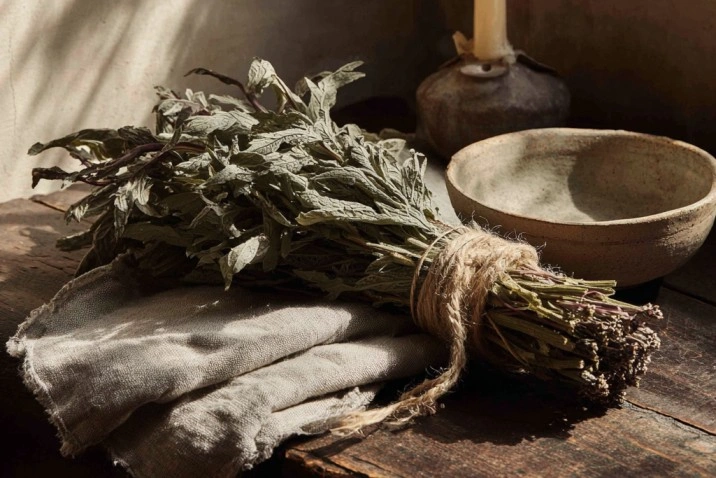
Mugwort appears in this blog more often than any other single herb. It is the smoke in the bonfire release of Solstice Sun Magic. It is named among the herbs of Litha and the herbs of Lughnasadh. It surfaces wherever the practice turns toward dreaming. For a plant that grows unregarded along nearly every roadside and patch of waste ground in Britain, that is a great deal of magical weight to carry; and it has earned every bit of it.
This is a deep-dive on a single herb: mugwort, Artemisia vulgaris, from its botany through its folklore to the workings a solitary witch can build around it. If you have read it named a dozen times and never had it properly introduced, here is the introduction.
A note on safety, first. Mugwort is not safe in pregnancy. It is a uterine stimulant and should be avoided entirely by anyone who is pregnant or trying to conceive, and it is best avoided while breastfeeding. Mugwort belongs to the daisy family (Asteraceae); if you react to ragweed, chrysanthemums, or related plants, treat it cautiously. None of the workings below require swallowing it. The one traditional use that does (dream tea) is the one to leave alone if any of the above applies to you. When in doubt, work with mugwort as smoke or as a dried bundle, not as something you take internally.
The plant itself
Mugwort is tall (often chest-height or more by late summer) with deeply cut leaves that are dark green above and a distinct silvery-white beneath. That pale underside is the surest way to know it: when the wind turns the leaves, a stand of mugwort flashes silver. It is a hardy perennial of roadsides, riverbanks, railway embankments, and disturbed ground across the whole northern hemisphere. The genus name, Artemisia, carries the herb's oldest association already: Artemis, the moon-bright goddess of the wild and the hunt. Mugwort's cousins in the same genus include wormwood and sweet Annie, but mugwort is the gentler relative: aromatic, faintly bitter, never as fierce as true wormwood.
The English name is older than its explanation. "Mug" may come from its use flavouring drinks before hops became common, or from moughte, the old word for moth, since the dried herb was laid among cloth to keep moths off. The honest answer is that nobody is certain. The plant kept the name long after the reason for it was lost.
Mugwort in folklore
Mugwort's standing in the Western magical tradition rests largely on one document. The Nine Herbs Charm is an Anglo-Saxon galdor (a spoken charm) preserved in the Lacnunga, a medical manuscript copied around the tenth or eleventh century. The charm names nine herbs marshalled against poison and infection, and mugwort is named first. The charm addresses the plant directly, as a being with memory and power, and the standard translations render its epithet as Una: the eldest, the oldest of herbs, the first of the nine. To open the most important surviving Anglo-Saxon herb-charm with mugwort is to be told, plainly, where this plant stood in the old esteem.
Two other threads run through its folklore. The first is protection in travel: Roman soldiers and later wayfarers are said to have placed mugwort in their shoes against the fatigue of a long march, and the herb kept a reputation as a guardian of journeys and thresholds. The second is the night. Across medieval Europe mugwort was hung in the home and tucked beneath the pillow against the night-mare: not a bad dream in the modern sense, but the old crushing terror, the figure felt sitting on a sleeper's chest. From warding the night-mare it is a short step to mugwort's strongest modern association of all. The herb that guards sleep became the herb that shapes it.
Magical correspondences
Mugwort is a lunar herb. The silver leaf, the link to Artemis, the long association with sleep and the night all point the same way; most practitioners place it under the Moon, though some give it to Venus. Its powers, as the tradition records them, gather around three themes: dreaming: vivid, lucid, and remembered dreams above all; divination: clarity and receptivity for scrying, tarot, and any drifting, attentive work; and protection, the older association, especially of travellers, sleepers, and the thresholds of a home.
For the correspondences at a glance, see the Mugwort reference entry in the Apothecary; what follows is the working detail behind them.
One point of discernment is worth making, because most herb writing skips it. Mugwort does not manufacture prophecy. What the folk record consistently describes is narrower and more reliable than that: the herb makes dreams more vivid and far easier to recall, and it sharpens the loose, receptive attention that divination depends on. Treat it as a plant that opens a door. Whether anything walks through is between you and your practice.
Working with mugwort
Smoke for cleansing. A dried bundle of mugwort, lit and then blown out so it smoulders, gives a fragrant smoke traditionally used to cleanse a space or to pass ritual tools through before divination. This is worth dwelling on: mugwort is the herb that European folk practice actually used for smoke-cleansing. If you have reached for imported white sage out of habit, mugwort is the local, sustainable, and culturally grounded alternative; and it grows for free on the nearest verge.
A dream pillow. Sew a small handful of dried mugwort into a cloth sachet and place it inside your pillowcase or on the bedside table. It is the simplest and most-attested mugwort working there is: a tool for deeper, more vivid, more memorable dreams. A little dried lavender added to the sachet softens the effect and supports rest if mugwort alone leaves your sleep too busy.
Divination tea. A weak infusion of dried mugwort, taken before scrying or a tarot session, is the traditional way to drink the herb's receptivity into a working. Revisit the safety note above before you consider this one; it is the working to skip entirely in pregnancy. For everyone else: keep the infusion weak, keep it occasional, and expect it to taste bitter, because it does. Some witches forgo drinking it altogether and instead use a cooled mugwort infusion to wash a scrying mirror or crystal before use, which carries the same association with none of the caution.
Gathering and growing mugwort
Mugwort is genuinely everywhere, which makes wild gathering easy, and identification all the more important. The silvery leaf undersides are your key confirmation. Do not confuse mugwort with ragwort, an unrelated and toxic plant whose similar name causes real mistakes; ragwort has bright yellow daisy flowers and no silver to its leaves. Gather from clean ground well away from roadsides, sprayed verges, and dog-walking paths. Harvest as the plant comes into flower in mid-to-late summer (which makes the Lughnasadh season ideal timing) and hang it in small loose bundles somewhere dark and airy to dry.
If you would rather grow your own, mugwort starts readily from seed or cutting and asks almost nothing of you. It spreads enthusiastically, so a large pot rather than open ground is the wise choice unless you want it everywhere.
Common questions
Is mugwort the same as wormwood? No. Both belong to the genus Artemisia and are related, but wormwood (Artemisia absinthium) is far more bitter and more potent. Mugwort is the gentler of the two.
Can I use mugwort instead of white sage for smoke-cleansing? Yes; and there is a good case that you should. Mugwort is the herb European folk practice actually used for this purpose. It is local, sustainable, and sidesteps the sourcing and appropriation questions that surround commercial white sage.
Will mugwort give me prophetic dreams? It reliably makes dreams more vivid and easier to remember. Whether they carry prophecy is a question for your own practice; the herb opens the door, it does not write what you find on the other side.
Where this sits
Mugwort runs through the seasonal herb work (the herbs of Litha and the herbs of Lughnasadh) and as the first plant of the Nine Herbs Charm it belongs to the same older folk current as Aradia and the charm tradition explored in Angel Number 999.
Sources
The Nine Herbs Charm survives in the Lacnunga, an Anglo-Saxon medical compilation of the tenth to eleventh century (British Library, MS Harley 585). The traveller's-protection and night-mare traditions are drawn from the wider body of European herb folklore. For safety information, mugwort's status as a uterine stimulant and its contraindication in pregnancy are well established in standard herbal and pharmacological references.
Grimoire is a digital practice companion for the solitary witch: a herbology compendium, a private grimoire journal, daily tarot, the sacred calendar, deity work, and a spell builder, all in one place. Now available on Android.
More from the Blog
The Witch's Guide to Lavender
Lavender has been a ritual herb since the Romans named it after washing. The botany, folklore, magical correspondences, practical uses, and simple workings for the most familiar witchcraft herb in the Western tradition.
The Witch's Guide to Rosemary
Rosemary is the most quietly ubiquitous herb in the Western witchcraft tradition — present at weddings and funerals alike, in bridal garlands and mourning wreaths, on every Mediterranean doorstep and in every kitchen. A full profile: botany, folklore, magical correspondences, and why it is not a substitute for white sage but a tradition in its own right.
Begin your practice
Grimoire is available now on Android and as a web app. Start today.