Spells
Solstice Sun Magic: Spells for Litha
Rowenna
Solitary witch and the founder of Grimoire. Built the app she couldn't find anywhere else. Writes about the craft with primary sources, honest lineage notes, and a low tolerance for vague correspondences. Based in the UK with more herbs than shelf space.
· 10 min read
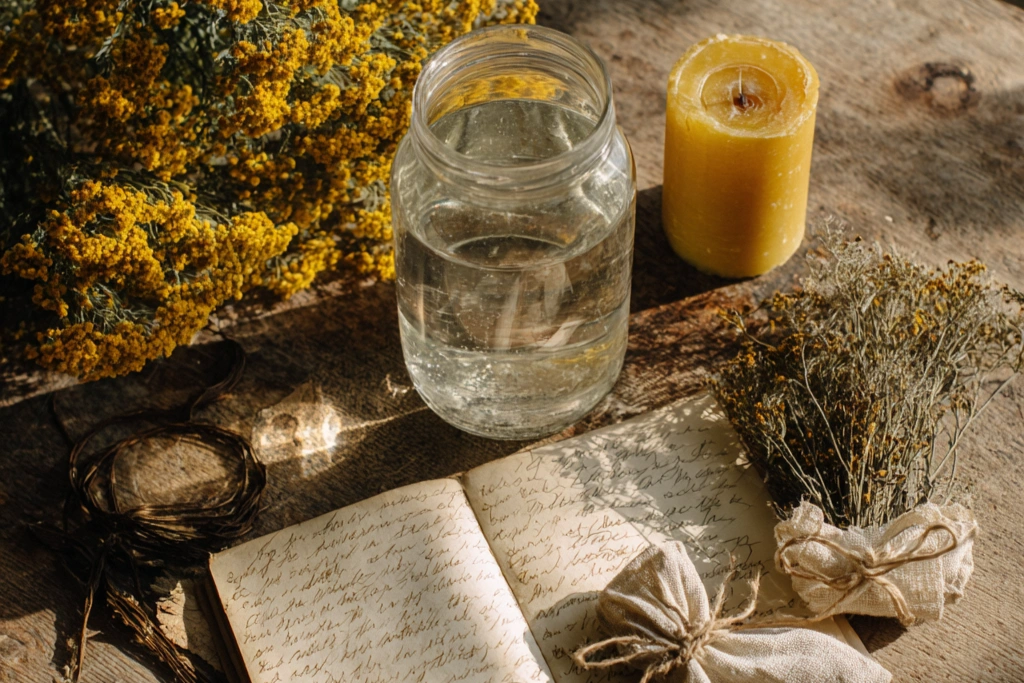
Litha is a sabbat for working magic. The peak of solar power, the longest day, the threshold moment when the year turns: these are conditions that traditional witchcraft recognises as exceptionally favourable for spell work, particularly any working concerned with growth, illumination, abundance, protection, or the release of what no longer serves.
This piece is a working guide to solstice sun magic. Five specific spells you can perform on or around the solstice: alone, with simple materials, in your own home or garden. The spells are drawn from folk-magic traditions and adapted for modern solitary practice. Each one is built around the same fundamental principle: using the concentrated energy of the longest day to give your intentions a particular kind of weight.
This is also the first piece in the Grimoire blog's Spells category, and it is worth saying directly what kind of spells these are.
What a spell actually is
A spell is a structured working that uses physical materials, intention, and timing to create change in the practitioner's life or environment. The materials matter. The timing matters. The intention has to be specific enough to track.
A spell is not a wish, and the difference is the specificity. I want abundance is a wish. I am growing the writing project I am starting on 1 July is a spell-grade intention. The materials of a spell are the physical anchors that hold that specificity in place: the jar, the herbs, the candle, the words written on paper. Without specificity the materials are just objects. Without materials the specificity has nothing to hold it.
The solstice does not make spells more powerful in any literal sense. What it does is give the practitioner a moment of natural alignment between the desired energy and the available conditions. Solar work at the solstice is easier because everything around you is already doing it. The ground is warm. The light is strong. The plants are at their fullest. You are working with the season, not against it.
Pick one or two of the spells below. You do not need to do all five.
1. Sun water for the year ahead
Sun water is the simplest and one of the most effective Litha workings. The practice is straightforward: you gather clean water in a glass vessel, place it in direct sunlight on the morning of the solstice, leave it for as much of the day as possible, and use it through the year that follows.
You will need: a clean glass jar or bottle, fresh water (filtered or spring water if you can; tap water if you cannot), and a window or outdoor space that gets direct sunlight.
The working. Fill the vessel with water on the eve of the solstice. Set it where sunlight will hit it from sunrise on the morning of the solstice itself. As you set it down, name aloud what you want this water to carry: clarity, warmth, courage, healing, energy for the work ahead. Leave it from sunrise to sundown if possible, or for as much of the day as you can. At sunset, retrieve the vessel, label it with the date, and store it somewhere cool.
Use this water through the year. A spoonful in your tea on dark mornings. A small amount in your bath when you need solar warmth. A few drops on the altar when you want to invoke the energy you sealed into it. Sun water is one of the longest-lasting Litha workings: what you make on the solstice will serve you until the next one.
2. A solar charging ritual
The solstice sun can charge anything you want associated with solar energy: tools, jewellery, written intentions, ritual objects. The working is simple but should be deliberate.
You will need: the object or written intention you want to charge, a clear space in direct sunlight, and a few minutes of focused attention.
The working. On the solstice day, set the object in direct sunlight at midday or close to it, when the sun is at its highest. Hold your hands above it for a moment. Speak aloud what you are charging it for: to carry warmth, to hold confidence, to amplify intuition. Whatever the intention is, name it specifically. Leave the object in the sun for one to several hours. Retrieve it as the light begins to shift.
A note on what not to leave in the sun for too long: amethyst, citrine, fluorite, and rose quartz can fade in prolonged direct sunlight. For these stones, brief exposure (twenty minutes) is sufficient. Selenite is also light-sensitive over time. For metal, wood, ceramic, and most other materials, longer exposure is fine. For paper and written intentions, watch the heat and protect from drying or curling.
3. A bonfire release working
The bonfire release is one of the oldest folk-magic practices of the solstice. Across northern and central European folk tradition, what you carried over the year was woven into a small bundle (a girdle, a wreath, a knot of herbs) and burned in the midsummer fire as the night peaked. The symbolic logic is straightforward. The burdens are transferred to the bundle. The bundle is given to the fire. The Golden Bough documents this custom across multiple European folk traditions, and a version of it survives in many modern witchcraft circles.¹
You will need: a small bundle of dried herbs (mugwort is traditional, see Herbs of Litha for the deeper folkloric context), a piece of natural twine, a cauldron or fire-safe vessel, and a candle or small fire.
The working. On the eve of the solstice, write on small strips of paper what you are ready to release. One thing per strip. Be specific: not anxiety but the specific worry I have been carrying about [thing]. Roll each strip and tie it into the herb bundle with the twine. As you do, speak each one aloud: I release this. It does not need to come with me into the second half of the year.
When the bundle is ready, take it to your fire. Burn it safely in a cauldron, fire pit, or ceramic dish (see the safety section below). Watch it burn completely. Bury or scatter the ashes outdoors when they have cooled.
This working is for things you have already done the work to release. It is not a substitute for that work. The fire confirms what you have already decided.
4. A solar abundance jar
Where the bonfire release is for letting go, the abundance jar is for seeding what you want to grow in the second half of the year. The two workings pair naturally on the solstice: release first, then plant.
You will need: a small glass jar with a lid, a bay leaf, a pinch of cinnamon, three small coins (any denomination, of any country), a small piece of citrine or pyrite if you have one, a small piece of paper, and a yellow or gold candle.
The working. On the morning of the solstice, write on the paper a single specific thing you are growing: the project I am starting in July, the practice I am committing to, the relationship I am tending. One thing only. Specificity is the whole working.
Fold the paper small. Place it in the jar. Add the bay leaf, cinnamon, coins, and stone if you have one. Seal the jar. Light the candle. Hold the jar in both hands and speak aloud what you are growing. Set the jar on the windowsill where it will catch the next several days of solstice sun. Let the candle burn down completely in a safe holder, or extinguish and re-light each day until the candle is gone.
Keep the jar somewhere visible until Lammas (1 August), when the early harvest sabbat traditionally invites you to check in on what is taking shape. At Lammas, open the jar, read what you wrote, and notice what has actually grown.
5. A protective Litha sachet
This is a small, portable working that carries solar protection through the rest of the year: one of the simplest Litha spells in folk tradition.
You will need: a small cloth bag or square of natural fabric, a piece of natural twine, and a small selection of solstice herbs: St John's Wort, vervain, and yarrow are the traditional combination (see Herbs of Litha for the folkloric context).
The working. Gather your herbs on the eve of the solstice or at solstice dawn (the traditional times). If gathering is impractical, dried herbs from a reputable source work too. Place a small quantity of each into the bag. Add a small piece of paper inscribed with a simple word for what the sachet is protecting: home, family, travel, the work. Tie the bag closed with the twine.
Carry the sachet on solstice day in a pocket or close to the body. After sunset, the sachet is consecrated. Keep it in your pocket through travel for the year, or hang it above a door, or place it on the altar. When the next Litha approaches, burn or bury the sachet and make a new one. The protection is for one year, not for ever.
Working safely with fire
Sun magic at the solstice is fire magic, even when the fire is just a candle. The witchcraft tradition has a poor track record on fire safety, and several of the workings above involve burning material in real flames. A few practical points:
- Never burn anything indoors without ventilation. Open a window. Use a fume-tolerant room. Smoke alarms, the people you live with, and your own lungs all matter.
- Use a proper container. A cauldron, a ceramic fire-safe dish, or an outdoor fire pit. Never burn directly on a wooden surface or anything not rated for heat.
- Keep water nearby. A small bowl of water, or a damp cloth. The point is to be able to extinguish quickly if needed.
- Watch what you are burning. Synthetic herbs, glossy or coloured paper, and treated wood release toxic smoke. Use only natural fibres, plain paper, and untreated dried herbs.
- Never leave a candle unattended. This is the most violated rule in modern witchcraft and the source of most house fires that started in an altar.
- If you are working outdoors, check the local conditions. A summer drought year is not the year to light a garden fire pit without supervision. Use a candle or a small contained fire instead.
The practical work of fire magic is fire stewardship. The aesthetic of magic should never override the safety practice that keeps the working from harming the witch.
Conclusion
These five workings (sun water, the solar charging ritual, the bonfire release, the abundance jar, and the protective sachet) are the most common Litha spells in modern solitary practice. They are not the only ones. The folk traditions of Europe contain hundreds of solstice variations adapted to local plants, customs, and beliefs. What unites them is the recognition that the longest day carries a particular kind of energy that supports particular kinds of work.
Pick one or two. You do not need to do all five in a single solstice. The deeper practice is to return to the same workings year after year, watching how they evolve, what changes, what stays the same. The witch's relationship to the solstice deepens with repetition more than with novelty.
For the wider Litha practice, see Litha for Solitary Witches. For the herbs used throughout these workings, see Herbs of Litha. For the deities of the season, see Litha Deities. For the energetic work that makes these spells more effective, see Litha Energy and Intentions.
This piece is part of A Witch's Working Library: The Spells Cluster: fourteen pieces on the practice, theory and seasonal application of spell craft.
Sources
- Sir James Frazer, The Golden Bough: A Study in Magic and Religion (1890–1915): the chapter on the fire-festivals of Europe documents the bonfire-release tradition (mugwort girdles, herbal bundles, written burdens) across multiple national folk-customs. Project Gutenberg
- Ronald Hutton, Stations of the Sun: A History of the Ritual Year in Britain, Oxford University Press (1996): covers midsummer customs in detail, including the full range of folk-magical workings recorded in British and Irish tradition.
- Wikipedia, Midsummer: overview of European midsummer traditions, including herb-gathering and bonfire customs that survive in modern witchcraft. en.wikipedia.org/wiki/Midsummer
- National Center for Complementary and Integrative Health (NCCIH), St. John's Wort: Usefulness and Safety: for the documented drug interactions relevant to the protective sachet (external use carries low risk; this source is included for readers who may consider internal use). nccih.nih.gov
More from the Blog
Hoodoo Spell Recipes: Floor Washes, Condition Oils, and Candle Workings
Hoodoo gives you specific plant materials, specific ratios, and specific methods. Six working recipes (floor washes, condition oils, and candle workings) with ingredients, method, and the magical logic behind each one.

Spell Crafting for Beginners: A Witch's Guide to How Spells Actually Work
How spells actually work: the materials, the intention, the timing, and the discipline of specificity. The foundational guide for new witches, and a reference for working ones.
Begin your practice
Grimoire is available now on Android and as a web app. Start today.