History
Witch Bottles: Archaeology and Practice
Rowenna
Solitary witch and the founder of Grimoire. Built the app she couldn't find anywhere else. Writes about the craft with primary sources, honest lineage notes, and a low tolerance for vague correspondences. Based in the UK with more herbs than shelf space.
· 10 min read
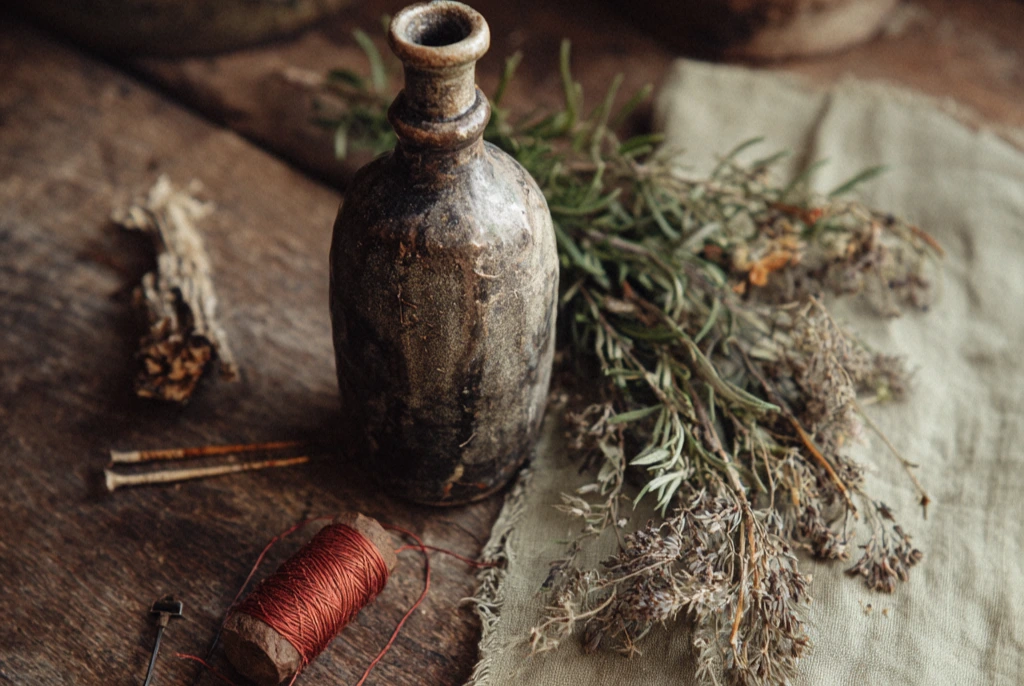
When builders and archaeologists excavate old English houses — lifting hearthstones, digging beneath doorsteps, opening cavities in chimney breasts — they sometimes find small bottles. They are sealed tightly, often with wax or cork, sometimes buried with deliberate care in a layer of sand or ash that suggests they were placed rather than discarded. When opened, they contain iron pins bent double, human hair, what analysis confirms is human urine, sometimes a small felt or cloth heart pierced with pins, sometimes salt and rosemary. They date from the late 16th century through to the early 20th. There are hundreds of them in the English archaeological record.
These are witch bottles — apotropaic counter-magical workings buried at the thresholds of houses to protect the household against witchcraft directed at it. They are the most archaeologically attested form of folk magic in the English record, they were made by professional cunning folk as a specialist service, and they remain a living practice in modern witchcraft. This piece covers all three: the archaeology, the historical practice, and the working.
What the archaeological record shows
Brian Hoggard's Magical House Protection: The Archaeology of Counter-Witchcraft (Berghahn Books, 2019) is the standard modern reference, the result of decades of systematic collection and analysis. His database runs to several hundred examples from across England, and the pattern is consistent enough across time and geography to constitute a tradition rather than a series of local accidents.
The finds span from approximately the 1560s through the early 20th century. The earliest examples use stoneware "Bartmann" jugs — also called Bellarmine bottles, after the Catholic cardinal Robert Bellarmine, whose bearded face was caricatured on the distinctive moulded face decorating the neck of the vessel. These were German imports widely used in 16th and 17th-century England for storing and transporting liquids. The bearded face is considered significant in the witch-bottle tradition: a face-vessel watching outward, the image-magic of surveillance applied to household protection. Later examples use glass bottles of various types, whatever was available.
Four named finds from the record are worth placing specifically. The Felmersham, Bedfordshire example — a Bartmann bottle found beneath the floor of a farmhouse, dated to the late 17th century — contained pins, hair, and cloth fragments, with clear evidence of deliberate burial rather than disposal. The Reigate find is one of the well-documented Surrey examples in Hoggard's survey. The Pevensey bottle, found in the East Sussex coastal area, and the Greenwich examples from the London area both demonstrate the practice's geographic spread across both rural and urban contexts. The Museum of Witchcraft and Magic in Boscastle, Cornwall, holds one of the most substantial physical collections.
What the bottles contained — and why each ingredient
The contents of witch bottles are not random. Each ingredient has a specific function within the working's logic, and the pattern holds with remarkable consistency across examples separated by a century and a hundred miles.
Human urine is the most consistently present ingredient, and it is the working's foundation. Urine provides a contagion connection — in the sympathetic-magic framework just covered in Sympathetic Magic: A Primer — between the bottle and the members of the household it is protecting. It comes from their bodies; it retains that connection. When a witch directs harmful magic at the household, the working is drawn toward the contagion connection in the bottle. The urine also "baits" the working: the hostile magic follows the sympathetic thread into the bottle and encounters what waits there.
Iron pins and nails, often bent, are what waits there. Iron has been a protective and harm-repelling material in European folk tradition since at least the early medieval period — the metal most widely associated with warding off malevolent spirits. The bent pins enact the counter-working by similarity: as the pins pierce and bend, so the hostile magical working is pierced and broken. Several examples show pins bent into loops or spiral forms, suggesting a specific bending gesture with magical significance.
Human hair and fingernail clippings reinforce the contagion connection, adding to the bodily material that links the bottle to its household. The more complete the connection, the more reliably the bottle draws the hostile working to itself.
A felt or cloth heart pierced with pins — present in several well-documented examples — introduces image magic alongside the contagion principle. The heart represents the household and its inhabitants; the pins in the heart enact the deflection of whatever was aimed at the living household's heart. Similarity and contagion operating simultaneously in one small object.
Salt, rosemary, and protective herbs appear in some examples, adding absorbing and protective qualities to the warding structure. Rosemary's threshold-protection function — documented in the folk-magic tradition and covered in The Witch's Guide to Rosemary — is precisely what the bottle requires at its buried threshold.
The threshold logic
Where the bottles were buried is as significant as what they contained. The consistent locations — beneath doorsteps, under hearthstones, inside chimney breasts, at window reveals — are all thresholds: the points where the boundary between inside and outside was considered permeable, and therefore the points where harm might enter.
The bottle creates a counter-force at the boundary. Buried at the threshold, it acts as a trap: the hostile working is drawn toward the contagion connection, crosses the threshold, and is caught and neutralised in the sealed vessel rather than reaching the living members of the household. The threshold is both the site of vulnerability and the site of the defence.
This is the sympathetic magic framework applied to protective architecture. The witch bottle is not a charm carried on the person; it is a fixed working embedded in the building itself, oriented outward at the points where harm arrives. It is, in this sense, the folk-magical equivalent of a structural intervention: not something you do during the crisis, but something you build into the house before the crisis arrives.
The cunning-folk context
The archaeological evidence and the documentary record are clear on this point: witch bottles were not typically made by ordinary householders working from folk knowledge. They were made by cunning folk: the professional folk-magicians whose trade is covered in detail in the History cluster's earlier piece. The witch bottle was a specialist service, prepared by the practitioner and provided to the client for burial.
The reason is structural: the bottle requires personal matter from the household, specifically urine, which established the contagion connection without which the working had no anchor. The cunning person would instruct the client to provide this material, would combine it with the professional's own prepared ingredients (the pins, the herbs, sometimes the felt heart) and would seal and deliver the completed bottle with instructions on where and how to bury it.
The bottle typically arrived in the context of a bewitchment complaint. A household experiencing unexpected sickness in its members, loss of livestock, or a persistent run of ill fortune would consult a cunning person, who would diagnose the cause (malevolent witchcraft), identify if possible the probable witch, and prescribe the remedy. The witch bottle was part of the remediation alongside other counter-magical measures. This context explains why the bottles were buried rather than kept visible (they were operational workings, not decorative objects) and why they were sealed so carefully: the sealing kept the working contained and prevented the hostile magic from escaping back into the household once trapped.
A genuinely continuous tradition
Every other honest-lineage move in the History cluster has gone in the same direction: the accused witch-trial victims were not practitioners; the cunning-folk tradition faded in the early 20th century; the modern pagan reception has placed stories over historical people who would not have recognised them. The witch bottle requires a different move.
The witch bottle is the exception. It is a genuinely continuous tradition in the English folk-magic record, without significant documented break. Cunning folk made witch bottles from the 16th century onward. The practice was documented by Victorian folklorists who observed it still being made and buried in rural communities. It entered the modern witchcraft revival through that folkloric documentation, not as a romantic reconstruction but as a living practice that was still being practised when the revival began. Contemporary witch-bottle practice descends from a practice that was never actually discontinued.
This matters because the standard honest-lineage move ("this is a modern adoption rather than an ancient survival") is not correct here. The bottle that a modern witch buries at her front doorstep in 2026 participates in a documented lineage of bottles buried at English thresholds stretching back to the 1560s. The ingredients have been adapted; the logic is unchanged. Where the Pendle victims and the Hopkins victims were not practitioners of anything, the makers and users of witch bottles were, and their successors are.
Making a witch bottle: a complete working
The Equinox Magic piece gave a simplified version in the context of seasonal protection. This is the fuller working, with its proper historical grounding now established.
You will need: a small bottle with a tight stopper or cork: stoneware if you can find it, glass otherwise; seven or nine iron pins or nails; personal matter from your household (urine is traditional and historically correct; a few strands of your own hair are the most common modern alternative); a pinch of dried rosemary; black peppercorns; sea salt; a length of red thread. Optional: a small felt or cloth heart to pierce with a pin before adding.
Before beginning: hold the empty bottle in both hands and state its purpose clearly and aloud. Not a spell formula, a plain statement: "This bottle protects this household from harm directed at it. What is sent against us is drawn here and held."
The assembly: add the personal matter first; this establishes the contagion connection the entire working depends on. Then add the iron pins or nails, bending each slightly before placing it if you choose to follow the historical practice. Add the rosemary, peppercorns, and salt. Tie the red thread around the bottle's neck seven or nine times. If you are using a felt heart, pierce it with one pin before placing it in the bottle.
The sealing: stop the bottle with cork or a tight lid, then drip wax over the seal: beeswax if you have it. As you seal it, speak the working once more. The sealing is the close of the active spell-work; what remains is placement.
The burial: bury the bottle at the threshold that concerns you most: beneath the front doorstep if you have access to the ground, in the soil of a pot immediately inside the front door if you do not, in the chimney breast or near the fireplace as an alternative threshold. The bottle should be placed rather than thrown; set it deliberately, with the same stated intention you used at the opening.
Afterwards: do not disturb the bottle. The traditional and consistent guidance across the historical record is that the bottle should remain sealed and undisturbed for as long as the protection is needed. If it is accidentally broken or uncovered, the working is considered disrupted and the bottle should be remade. If you choose to end the working formally, remove the bottle, thank it, and bury the contents in earth away from the house.
Common questions
Is the urine actually necessary? Historically, yes; it was the primary contagion ingredient and the one most consistently present across the archaeological record. Modern practice often substitutes hair, a drop of saliva, or in some traditions a drop of blood, all of which provide the same contagion connection. The substitution is practical rather than principled; the ingredient matters because of what it does (establish the bodily connection), not because of what it is specifically.
Can I make a witch bottle for protection without believing I'm being specifically targeted by witchcraft? Yes. The historical use was reactive: made in response to a diagnosed threat. The modern use is often proactive: the bottle as general household protection, made at a threshold moment such as moving into a new home or at the turn of the year. The working logic holds for proactive protection as well as reactive counter-magic.
Why iron specifically? Iron's protective function in European folk tradition is ancient and well-documented; it appears in Norse, Celtic, and Anglo-Saxon protective contexts, and the association between iron and the warding off of malevolent spirits runs through the record with unusual consistency. The practical explanation often offered is that iron tools represented human mastery over the natural world, making iron a threshold material between the human and the other-than-human. The pins in the bottle work because iron wards and because their shape pierces: both the material and the form contribute to the function.
Where can I see historical witch bottles? The Museum of Witchcraft and Magic in Boscastle, Cornwall, holds one of the most significant collections of apotropaic folk-magic objects in Britain, including witch bottles. The Pitt Rivers Museum in Oxford, the Museum of London, and various county museums with local archaeological collections hold examples. Some are also described in detail in Hoggard's Magical House Protection, which is the most comprehensive published survey available.
Sources
Brian Hoggard, Magical House Protection: The Archaeology of Counter-Witchcraft (Berghahn Books, 2019): the standard archaeological reference and the basis for the specific finds named in this piece. Owen Davies, Popular Magic: Cunning-Folk in English History (Hambledon Continuum, 2003): for the cunning-folk context of witch-bottle production. The Museum of Witchcraft and Magic, Boscastle, Cornwall: for the physical collection. For the sympathetic-magic framework applied here: Sympathetic Magic: A Primer.
Grimoire is a digital practice companion for the solitary witch: a private grimoire journal, sacred calendar, herbology compendium, daily tarot, spell builder, and deity work, all in one place. Now available on Android.
More from the Blog
Matthew Hopkins, the Witch-Finder General
Between 1644 and 1647, a self-styled 'Witch-Finder General' with no official authority moved through the eastern counties of England during the chaos of the Civil War, leaving behind approximately 100 executions — more than the entire previous century of English witch trials combined. A source-critical account of Hopkins, his methods, and his victims.

The Pendle Witches: A History of the Lancashire Witch Trials of 1612
The Pendle witch trials of 1612 are among the most documented witch trials in English history. Who the accused were, what actually happened, and how they are remembered by modern witches.
Begin your practice
Grimoire is available now on Android and as a web app. Start today.