History
The Salem Witch Trials
Rowenna
Solitary witch and the founder of Grimoire. Built the app she couldn't find anywhere else. Writes about the craft with primary sources, honest lineage notes, and a low tolerance for vague correspondences. Based in the UK with more herbs than shelf space.
· 10 min read
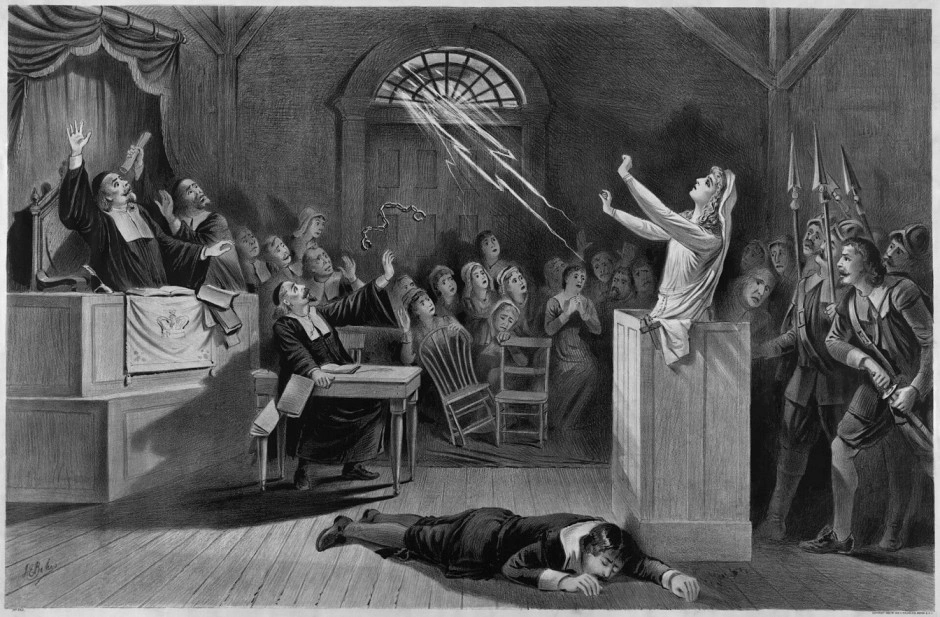
Salem is the most famous witch trial in history. It is also, in the form most people hold it, largely a fiction. The cultural image (devout witches persecuted for their pagan practice by theocratic hysteria) bears almost no relationship to the historical record, which documents the systematic destruction of ordinary Puritan church members by a court that ran for nine months on a legal methodology its own contemporaries questioned. The people who died at Salem were not witches. They were Puritan Christians. Understanding what actually happened, and why the mythology that replaced the history matters, is the work of this piece.
The same source-critical approach that shaped the Pendle and North Berwick pieces applies here. The record is the record. The story we have built around it is something we built.
What actually happened
In February 1692, Betty Parris (nine years old, daughter of the Reverend Samuel Parris of Salem Village) and her cousin Abigail Williams began having violent fits: convulsions, contortions, incoherent speech, complaints of being pinched and bitten by invisible forces. Other girls in the village soon displayed the same behaviour. The local physician, William Griggs, examined them and offered the only diagnosis his framework permitted: bewitchment.
The first three people accused were social outsiders: the category of person a frightened community reaches for first. Tituba was an enslaved woman from Barbados who worked in the Parris household. Sarah Good was a homeless woman with a difficult reputation. Sarah Osborne was an elderly woman who had stopped attending church. All three were brought before local magistrates in late February. Tituba confessed. Her confession was detailed, vivid, and exactly what the magistrates needed: she described a tall man from Boston who had made her sign his book, named her accomplices, confirmed the reality of the diabolical conspiracy. Confessors were not executed — they became witnesses. Every confession added credibility to the accusation process and expanded its scope.
By May 1692, the accusations had spread far beyond social outsiders. The Special Court of Oyer and Terminer (from the Anglo-French legal term meaning "to hear and determine") was established by Governor William Phips to process the volume of cases. The court accepted spectral evidence: testimony that the accused had appeared in a dream or vision to torment the witness. This was already controversial. If Satan could assume the form of an innocent person, spectral testimony proved nothing. Increase Mather, one of Boston's most prominent ministers and Cotton Mather's father, would publish Cases of Conscience arguing precisely this, but not until October, after the executions were complete.
Between June and September 1692, nineteen people were hanged on what is now called Proctor's Ledge in Salem, marked since 2017 with a permanent memorial. One man, Giles Corey, was pressed to death under heavy stones: the legal consequence of standing mute, refusing to enter a plea. More than two hundred people were accused in total. Several died in prison awaiting trial. The youngest accused was four years old.
In October 1692, Governor Phips dissolved the Court of Oyer and Terminer. His own wife had been named. The replacement Superior Court of Judicature refused to admit spectral evidence. Of the remaining cases, nearly all resulted in acquittal. In 1711, the Massachusetts legislature passed a bill restoring the legal rights and reputations of most of the condemned and providing limited financial restitution to survivors and families.
Who was accused and executed
This is the most important section of the piece, because the demographics of the accused are the single clearest refutation of the cultural mythology.
The Salem accused were overwhelmingly Puritan church members in good standing. They attended services, held community positions, paid their tithes. A few had minor social complications (a disputed inheritance, a history of conflict with neighbours) but the defining characteristic of most of the accused was not deviance from Puritan norms. It was membership of a community that had turned on itself.
Bridget Bishop, the first person executed, on 10 June 1692, had been accused of witchcraft once before and was known for wearing red clothing and operating a tavern: a figure of social nonconformity. But nonconformity is not witchcraft, and there is no evidence she practised any form of folk magic. Rebecca Nurse was seventy-one years old, a grandmother, a respected member of her church. The trial jury initially returned a not-guilty verdict; the presiding judge sent them back to deliberate further, and they reversed it. She was hanged in July. George Burroughs, a former minister, recited the Lord's Prayer perfectly from the scaffold: theoretically impossible for a witch, since the prayer was believed to be beyond the power of the diabolically corrupted. The execution proceeded anyway.
Tituba, the one person in the Salem record who described actual magical practice (she spoke of the devil's book, of familiars, of flying) was the one person who was not executed. She remained imprisoned until sold to cover her jail fees. Her confession, which saved her life, told the court what it wanted to hear. Its accuracy as a description of real practice is, at minimum, doubtful.
The Salem accused were not witches. Almost none of them practised any form of folk magic. The cultural mythology that Salem represents the historical persecution of pre-Christian goddess-worshippers is exactly that: mythology. It is a story modern paganism has placed over a different and more complicated event, and the people who died in 1692 deserve to have their actual identities returned to them.
Why it happened
The historian Mary Beth Norton, in In the Devil's Snare (2002), makes the most compelling argument for the crisis's deep cause: King William's War. The North American phase of the Nine Years' War, fought between English colonial forces and French-allied Native nations from 1689 to 1697, had produced repeated devastating raids on the frontier communities of Maine and New Hampshire. Families had been destroyed. Survivors had fled south. Many of the accusers, and key witnesses, were refugees from those frontier communities or were closely connected to people who were. The specific anxieties they carried (of unseen enemies, of attacks from the outside, of a world suddenly violent and unpredictable) gave the witchcraft panic its particular intensity.
Salem Village was also, independently, a community in chronic internal conflict. A long-running dispute with Salem Town over ecclesiastical autonomy had divided the village into factions. The appointment of Samuel Parris as minister had been contested. The accusation pattern that emerged in 1692 followed, broadly, the existing fault lines: accusers and accused clustered on recognisable sides of pre-existing community divisions. This does not explain the crisis, but it shaped its geography.
Cotton Mather's role is more complex than his reputation suggests. He attended the executions and wrote Wonders of the Invisible World (1693) defending the court's proceedings; this much is true, and he bears real responsibility for lending theological credibility to a flawed process. But he also privately expressed reservations about spectral evidence to the court before the executions began, in a letter that was ignored. He is not the simple villain the cultural narrative requires, though he is not innocent either.
The absence that mattered
There is a structural reason why the Salem panic went as far as it did, and it connects directly to what the Cunning Folk piece covered for England.
In English communities, when someone believed they were bewitched, they had somewhere practical to go: the cunning man or cunning woman of the parish could diagnose the curse, identify the witch, and provide counter-magic. The accused witch faced a community that already had a specialist's alternative account. The cunning folk were imperfect and their practice was legally marginal, but they absorbed a great deal of the social anxiety around witchcraft before it reached the courts.
Puritan New England had no cunning folk. The theology of the Massachusetts Bay Colony treated all magical practice (protective, healing, or harmful) as equally suspect diabolism. There was no licensed category of benevolent folk-magician to go to. When Betty Parris began having fits and the physician named bewitchment, the only recourse the community had was legal and theological. The panic had nowhere to go but the courts, and the courts, once engaged, had their own momentum. The structural absence of the cunning-folk tradition is part of why a local crisis became a capital catastrophe.
The cultural mythology and modern reception
The cultural mythology of Salem has two distinct modern lives. The first is the tourism industry: Salem, Massachusetts (now formally nicknamed Witch City) has built an identity around the trials that centres the witch aesthetic, the witch hat, the haunted and enchanted. The Peabody Essex Museum holds genuinely significant historical material; the tourist district around it sells a version of Salem that the historical condemned would not have recognised.
The second is the pagan reception. Some contemporary witches and pagans have consciously claimed the Salem condemned as ancestors of the tradition: as people persecuted for their spiritual practice, as proto-pagans crushed by theocratic power. The emotional pull of this identification is understandable; the historical claim it rests on is not sustainable. The Salem condemned were Puritan Christians. They were not Wiccans, not pagans, not goddess-worshippers, not practitioners of any form of nature spirituality. To claim them as pagan martyrs is to write a new identity over the actual people who suffered: a different kind of erasure from the one the trials themselves enacted, but an erasure nonetheless.
Arthur Miller's The Crucible (1953) sits behind much of this reception, having fixed the cultural image of Salem for several generations. The play was written as McCarthyism allegory and should be read as such; it is not history. John Proctor in the play is a romantic figure in his thirties; the historical John Proctor was sixty years old. Abigail Williams in the play is seventeen; the historical Abigail Williams was eleven or twelve. The distortions served the allegory and were never corrected in the popular imagination.
For the question of how modern paganism constructs its relationship to historical figures and traditions (where the line sits between legitimate inheritance and retrospective appropriation) the Aradia piece and the cunning-folk piece sit in the same conversation. The Salem mythology is the most dramatic example of a broader pattern: a living tradition reaching backward for ancestors it can claim, and sometimes reaching further than the evidence will hold.
Common questions
Were the Salem witches burned at the stake? No. This is the single most common factual error about Salem. Nineteen people were hanged; one was pressed to death. Burning was the execution method in Scotland and much of continental Europe. No one was burned in the Salem trials or anywhere else in the American colonial record.
Was Tituba a practising witch? The historical evidence does not support this. Tituba confessed to a detailed picture of diabolical practice, but the confession was almost certainly shaped by what her examiners led her toward; confessors were spared, and she survived while those who maintained their innocence were hanged. What she actually believed or practised is not recoverable from the record.
Why did the accusers behave as they did? This question has generated significant historical debate. The explanations range from deliberate fraud, through mass psychogenic illness, through the genuine trauma of refugee children from a frontier war, through the social dynamics of a factionalized community. Norton's frontier-war argument is currently the most persuasive to most scholars, but no single explanation fully accounts for all the evidence.
Have the condemned been officially exonerated? Largely yes, through a series of legislative and judicial actions between 1711 and 2001. The final formal exonerations (clearing the names of the last remaining condemned who had not been legally rehabilitated) came from the Massachusetts legislature in 2001.
Where this sits
The History cluster now covers three witch-trial cases across three distinct cultural and political contexts: the English north in Pendle, the Scottish court in North Berwick, and the Puritan colonial New England of Salem. In all three cases, the accused were not practitioners of any coherent surviving tradition. In all three cases, the trial record tells us far more about the prosecuting society than about the accused. And in all three cases, the modern pagan reception has placed stories over the actual historical people that those people would not have claimed.
Sources
Mary Beth Norton, In the Devil's Snare: The Salem Witchcraft Crisis of 1692 (Alfred A. Knopf, 2002): the standard modern scholarly history and the source for the frontier-war argument. Stacy Schiff, The Witches: Salem, 1692 (Little, Brown, 2015): rigorously sourced and highly readable; the individual narrative portraits of Bridget Bishop and Rebecca Nurse draw substantially on her account. For primary sources: the court records of the Salem trials are held at the Peabody Essex Museum and have been edited and published by Paul Boyer and Stephen Nissenbaum in The Salem Witchcraft Papers (1977).
Grimoire is a digital practice companion for the solitary witch: a private grimoire journal, sacred calendar, herbology compendium, deity work, and daily tarot, all in one place. Now available on Android.
More from the Blog
Cunning Folk: The Working Witches of English History
For five hundred years, when ordinary English people needed magical help, they went not to a witch but to a cunning man or cunning woman: paid professional folk-magicians present in nearly every parish. Who they were, what they did, and what modern witchcraft actually inherits from them.
Matthew Hopkins, the Witch-Finder General
Between 1644 and 1647, a self-styled 'Witch-Finder General' with no official authority moved through the eastern counties of England during the chaos of the Civil War, leaving behind approximately 100 executions — more than the entire previous century of English witch trials combined. A source-critical account of Hopkins, his methods, and his victims.
Begin your practice
Grimoire is available now on Android and as a web app. Start today.