History
Matthew Hopkins, the Witch-Finder General
Rowenna
Solitary witch and the founder of Grimoire. Built the app she couldn't find anywhere else. Writes about the craft with primary sources, honest lineage notes, and a low tolerance for vague correspondences. Based in the UK with more herbs than shelf space.
· 10 min read
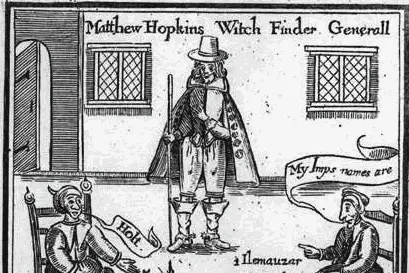
The English witch trials of the 16th and early 17th centuries were geographically scattered, legally variable, and relatively modest in scale when compared to the panics of Scotland or the Continent. In the entire century between 1542 and 1644, the best scholarly estimates suggest approximately 500 executions for witchcraft across England — an average of five per year. Between 1644 and 1647, a self-styled Witch-Finder General operating in the eastern counties produced roughly 100 executions in three years. One man, in one region, during one civil war, achieved in thirty-six months what the entire previous century of English witch-hunting had not. This is the story of Matthew Hopkins — and of the ordinary people he destroyed.
This is the fifth piece in the History cluster, continuing the source-critical approach of The Pendle Witches, The North Berwick Witch Trials, and The Salem Witch Trials. The pattern holds across all four: the accused were not practitioners of any surviving tradition, and the trials tell us far more about the prosecuting society than about the accused.
Who Hopkins was
Matthew Hopkins was born around 1620, the son of James Hopkins, a Puritan minister in Great Wenham, Suffolk. He died in 1647 — probably of tuberculosis, in Manningtree, Essex — at approximately twenty-seven years of age. His entire career as a witch-finder lasted three years. In that time he became the most prolific private witch-hunter in English history, responsible for more executions than any comparable figure in the record.
His background before 1644 is not well-documented. Malcolm Gaskill's authoritative research in Witchfinders: A Seventeenth-Century English Tragedy (2005) establishes that Hopkins was working as a minor legal professional in Manningtree — perhaps as a lawyer's clerk or a minor practitioner of some kind — when the investigations began. He had no formal appointment as a witch-finder. "Witch-Finder General" was a title he created for himself. Parliament issued him no commission. He had no royal warrant. He was a private individual who identified an opportunity and constructed an authority from nothing.
His collaborator John Stearne, who outlived him and published his own account (A Confirmation and Discovery of Witchcraft, 1648), came from a more explicitly Puritan activist background. Where Hopkins presented himself as a semi-official investigator, Stearne appears to have been genuinely theologically motivated — the extermination of witchcraft as a religious duty. Both men charged for their services. The exact financial arrangements varied by town, but fees were paid per investigation, per suspect, or per conviction, depending on the agreement. The financial incentive pointed consistently toward finding witches.
How it began — the Manningtree investigations of 1644
In March 1644, Hopkins reported that he had overheard a gathering of witches meeting near his lodgings in Manningtree on Friday nights. The first formal accusation focused on Elizabeth Clarke — an elderly, one-legged woman, a social isolate without community protection. She was subjected to "watching": kept awake, walked continuously, for three to four days on the theory that her familiar spirits would come to feed from her witch's mark during this period and could be observed. After days without sleep, Clarke confessed and named accomplices.
The first Essex trial was held in summer 1644 in Chelmsford. Thirty-six women had been accused by this point. Nineteen were hanged at the Chelmsford assize. Hopkins had established his model in a single season: sleep deprivation producing confession, confession producing names, names producing more accusations, the whole escalating cascade supervised by a self-appointed investigator being paid for each step of the process.
The methods
Hopkins's methods were not improvised. They drew on existing demonological theory, Puritan theology, and a practical understanding of how to break an accused person's resistance. The Discovery of Witches (1647), which he published in the form of a dialogue defending his methods against critics, shows how systematically he had thought about what he was doing.
Watching and sleep deprivation. The accused was kept awake, usually by being walked continuously by relays of watchers, for periods of several days. The stated purpose was to observe familiar spirits visiting to feed from the witch's mark. The actual effect was to produce a state of extreme exhaustion in which the accused would eventually confess to anything. Hopkins knew this was effective. He describes the watching method at some length in The Discovery, defending it against the accusation that it was itself a form of torture — his defence being that the watchers were observing rather than inflicting pain.
The swimming test. The accused was bound cross-body — right thumb to left toe, left thumb to right toe — and lowered into water. If they floated, they were guilty; the logic being that the water, as a baptismal element, rejected the diabolically corrupted. If they sank, they were innocent, though sinking meant drowning. Hopkins denied using this method in The Discovery of Witches, claiming it was something that happened spontaneously at the initiative of local communities. Contemporary evidence suggests he was not telling the truth on this point.
Searching for the witch's mark. The accused was stripped and examined by experienced female searchers for any abnormal bodily mark — a teat, a spot, a mole, a supernumerary nipple — from which the familiar was believed to feed. Natural skin variations were often identified as marks. The intimate violation of this process was a deliberate part of its function: it was humiliating, frightening, and positioned the accused as already partly convicted before any formal trial began.
The interrogation structure. Hopkins was a skilled questioner. His investigations followed patterns designed to lead the accused toward the expected answer — the named devil, the named familiar, the named accomplices. Each confession became the foundation for the next accusation. The dialogue structure of The Discovery of Witches reveals how carefully he had mapped the anticipated objections to his methods and prepared his responses.
The scale and the spread
From Essex in 1644, Hopkins and Stearne moved through Suffolk (1645), including the large Bury St Edmunds trials; into Norfolk, where the investigations reached their greatest scale; and westward into Cambridgeshire, Huntingdonshire, and Northamptonshire. The total across these counties runs to approximately 100 executions by Gaskill's careful accounting — some estimates go as high as 300 if you include deaths in prison and executions attributed to Hopkins's network rather than directly to his investigations. The lower figure of approximately 100 is the most defensible from the documentary record.
The accused followed the same demographic pattern as the Pendle and Salem victims: overwhelmingly women, disproportionately old, disproportionately poor, disproportionately widowed or isolated. Not eccentric figures on the margins of their communities alone — some were well-regarded locally, their accusations generating genuine community distress — but consistently people without the social and economic resources to mount an effective legal defence.
The cunning folk dimension is worth noting. Hopkins's investigations were not entirely random in their targets. Some of the accused had minor reputations for folk-magical practice — small-scale charm work, herbal remedies, finding lost property. These practices made them somewhat more plausible as witchcraft suspects in the demonological framework Hopkins was applying. But the majority had no such reputation, and no accusation involving actual magical practice survived rigorous legal scrutiny in this period. The cunning folk were a target in part because their existing reputation made them easier to convict — not because they were practitioners of any coherent tradition that Hopkins was suppressing.
Why 1644 to 1647 specifically
Hopkins could not have done what he did in ordinary times. The English Civil War is the essential context.
The war between King Charles I and Parliament had begun in 1642. By 1644 the eastern counties — Essex, Suffolk, Norfolk, Cambridge — were firmly Parliamentarian territory, controlled by the Eastern Association, the coalition of counties that provided Oliver Cromwell's cavalry and the core of the Parliamentary army. This region was strongly Puritan in its religious culture: intense, disciplined, theologically serious, and convinced that England was engaged in a spiritual as well as a political war.
The machinery of central justice was disrupted. County justices operated with reduced oversight from London. The normal legal constraints on witch-hunting — the scepticism of professional judges, the requirement for credible evidence, the central court review of capital cases — were weakened. Local authorities had both the ideological motivation to believe in witchcraft as a serious threat and the practical freedom to act on that belief without the usual checks.
Hopkins arrived at the precise intersection of legal disruption, Puritan theological intensity, and community anxiety about the war. Without any one of those conditions, his campaign would not have been possible. With all three, it was almost inevitable that someone would do what he did — he happened to be that someone.
The end
By 1646, significant opposition was developing. John Gaule, a minister in Huntingdonshire, preached and published against Hopkins — his Select Cases of Conscience Touching Witches and Witchcrafts (1646) challenged the theological and legal validity of Hopkins's methods. Judges in some counties began refusing cases built on sleep-deprivation confessions. The swimming test was increasingly identified as illegal under English common law, which did not recognise trial by ordeal.
Hopkins's last substantial campaign appears to have been in Norfolk in 1646. His activities diminished sharply thereafter, and he died in Manningtree in 1647, probably of tuberculosis. He was buried in the churchyard of St Mary's, Mistley, though the exact grave is not marked.
The folk legend that Hopkins was himself subjected to the swimming test and drowned — a tidily satisfying end — is not supported by any contemporary evidence. It is almost certainly false. He died of illness, in his lodgings, at twenty-seven, having never been called to account for what he had done.
The legacy and the honest reckoning
Hopkins's methods entered the broader record of witch-hunting methodology. His Discovery of Witches was read, discussed, and referenced in subsequent decades. The specific framework he articulated — the familiar spirit, the witch's mark, the sleep-deprivation watching method — was part of the transatlantic Puritan intellectual culture that shaped colonial New England. Whether the Salem crisis of 1692 drew directly on Hopkins is debated by historians; the direct documentary evidence for Salem judges having read Hopkins is thin. What is clear is that the same theological and methodological assumptions operated in both contexts, and that Hopkins had given those assumptions their most systematic English articulation in 1647, forty-five years before Salem.
The victims. This is where the piece must arrive. The approximately 100 people executed as a result of Hopkins's investigations were predominantly old, poor, female, and isolated. They were Puritan church members, farm labourers, widows, women who had outlived their social support networks. Almost none of them had any meaningful connection to magical practice. They were caught in the specific intersection of civil war chaos, Puritan zeal, and one private individual's self-serving enterprise, and they died for it.
They were not witches. They were not pagan survivors. They were not practitioners of any craft. The same conclusion that the Pendle, North Berwick, and Salem pieces reached applies here, with specific force: the Hopkins victims were ordinary people destroyed by extraordinary circumstances, and naming what they actually were — ordinary, innocent, destroyed — is the only honest response to their history. The modern pagan community's periodic impulse to claim the victims of witch trials as ancestral practitioners is, in every case the History cluster has examined, a form of appropriation that does violence to the actual people who died.
For the broader question of what modern witchcraft actually inherits, and from whom, the Cunning Folk piece and the Aradia piece sit in that conversation.
Common questions
Did Hopkins have any legal authority? None. "Witch-Finder General" was a title he invented. He had no commission from Parliament, no royal warrant, no formal judicial role. He was a private individual who persuaded local authorities to hire him as an investigator and pay him for his results.
How many people did Hopkins actually kill? Approximately 100 executions are directly attributable to his investigations by the most careful modern accounting (Malcolm Gaskill's Witchfinders). Some estimates reach higher if prison deaths and executions linked to his network are included. 100 is the most defensible figure from the surviving records.
Was Hopkins himself accused and drowned? No. This is a satisfying folk legend with no contemporary documentary support. Hopkins died of tuberculosis in Manningtree in 1647. He was never subjected to any formal accusation or legal proceedings.
Is there a connection between Hopkins and the Salem trials? The direct documentary connection is debated — evidence that Salem judges read Hopkins specifically is thin. What connects them is the shared framework of Puritan demonological theory and the specific methodological assumptions (familiar spirits, the witch's mark, confession-as-evidence) that Hopkins had systematised in The Discovery of Witches. The influence is plausible even if direct citation cannot be demonstrated.
Sources
Malcolm Gaskill, Witchfinders: A Seventeenth-Century English Tragedy (John Murray, 2005) — the standard modern scholarly history and the source for the most reliable execution figures. Matthew Hopkins, The Discovery of Witches (1647) — primary source, freely available in digital archives and modern reprints. John Stearne, A Confirmation and Discovery of Witchcraft (1648) — Hopkins's collaborator's account. John Gaule, Select Cases of Conscience Touching Witches and Witchcrafts (1646) — the principal contemporary opponent's published objection.
Grimoire is a digital practice companion for the solitary witch — a private grimoire journal, sacred calendar, herbology compendium, daily tarot, and deity work, all in one place. Now available on Android.
More from the Blog
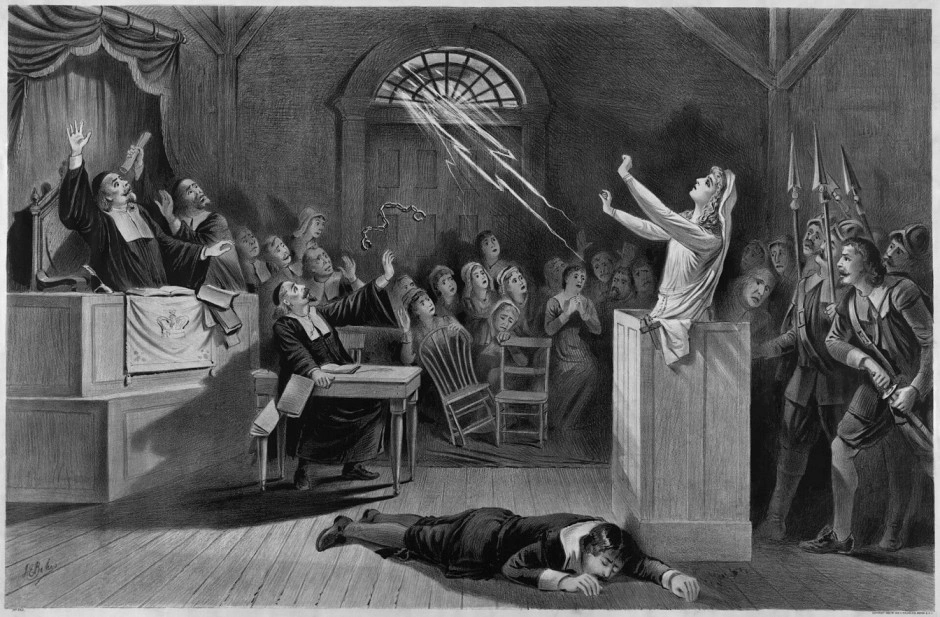
The Salem Witch Trials
The Salem witch trials of 1692 are the most mythologised in history, and the most misunderstood. A source-critical account of what actually happened, who the accused really were, why it happened when and where it did, and what the modern pagan reception gets wrong.

Witch Bottles: Archaeology and Practice
Beneath the floors of old English houses, archaeologists have been finding sealed bottles of iron pins, urine, hair, and protective herbs for two centuries. These are witch bottles — the most archaeologically attested form of folk magic in English history. A source-critical account of the evidence, the cunning-folk tradition behind it, and how to make one.
Begin your practice
Grimoire is available now on Android and as a web app. Start today.