Crystals
How to Cleanse and Charge Your Crystals
Rowenna
Solitary witch and the founder of Grimoire. Built the app she couldn't find anywhere else. Writes about the craft with primary sources, honest lineage notes, and a low tolerance for vague correspondences. Based in the UK with more herbs than shelf space.
· 7 min read
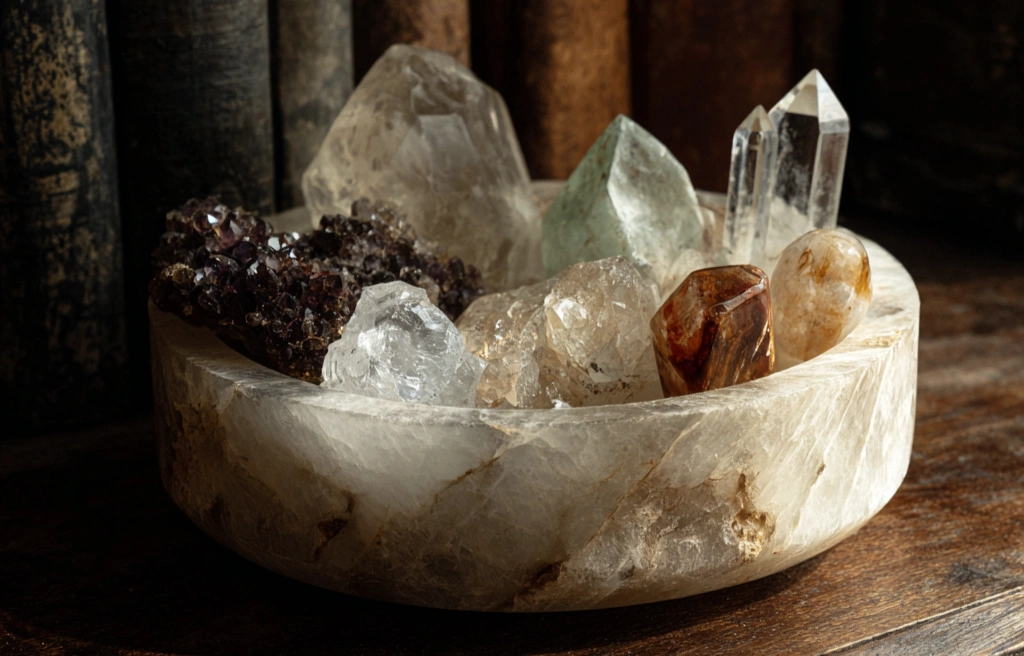
Cleansing and charging are two different things, often treated as one.
Cleansing is what you do to clear a stone of energy it has picked up. Charging is what you do to set a stone toward a particular purpose. You can cleanse without charging. You cannot meaningfully charge a stone that has not been cleansed first.
This piece covers both (what to actually do, and what to avoid) including the well-known cleansing methods that quietly damage some of the most popular stones a witch owns.
Cleansing and charging are not the same thing
The confusion is common, and it matters in practice.
Cleansing removes accumulated energy. A stone in regular use takes on residue from the workings and spaces it has been in. Protective stones in particular fill up over time. Cleansing empties them.
Charging is the opposite move. Once a stone is cleansed, it can be set toward a purpose: protection, abundance, a specific spell, the energy of a particular moon phase. Charging is sometimes called programming or dedicating, and the language varies between traditions. The action is the same.
Some witches charge every stone they own. Some only charge stones being used for specific workings. Both approaches are valid. What is not valid is skipping the cleansing.
How to tell a stone needs cleansing
A stone that needs cleansing tends to feel different. Heavier and duller. Less responsive than it was. As if something has settled into it.
The rose quartz in your pocket on a hard week. The black tourmaline by the front door after months of foot traffic. These are the stones that need cleansing most often, because they are doing the most work.
I can tell by weight more than anything else. A clear quartz point in heavy use for a week feels different in the hand from a freshly cleansed one: denser, less responsive, as though the signal has become static. The feeling is hard to describe to someone who has not yet learned to read it, but it becomes reliable quickly.
Some witches cleanse on a fixed schedule, often the full moon. Others cleanse only when a stone tells them it needs it. Either is workable. The important thing is that protective and absorptive stones get cleansed regularly.
New stones should always be cleansed before first use. They have passed through many hands.
Methods of cleansing
Several work. Some are gentler than others. Some are inappropriate for particular stones. Here is the working witch's standard set.
Selenite (the default)
A tumbled selenite or a flat selenite plate, kept on a tray with your working crystals, will clear them passively. No timing needed, no ritual required. This is the simplest method, and the one most witches default to once they have figured out what works.
The only stone selenite cannot cleanse is itself. Selenite needs sunlight or moonlight occasionally to reset.
Smoke
Passing a stone through the smoke of burning herbs or incense is a traditional method, used widely across cultures. Rosemary, frankincense, mugwort, cedar, and lavender all work. Avoid white sage from non-Indigenous sources, which has been over-harvested and is part of a wider conversation about cultural appropriation.¹
Incense magic covers the wider tradition if you want to go deeper.
Sound
A singing bowl, a bell, or a tuning fork held near the stone breaks up stagnant energy through vibration. This is a good method for stones that cannot get wet and that you do not want to leave out overnight.
Moonlight
Leaving a stone where moonlight reaches it overnight is gentle, universal, and works for almost every stone. Full moons charge as well as cleanse. New moons are quieter and good for stones being reset for new intentions.
If working with the moon is already part of your practice, this method integrates without effort.
Running water
Cold running water from a tap or a stream clears most quartz-family stones quickly. Hold the stone in the water for thirty seconds, dry it, and that is the cleansing.
This method is not safe for water-soluble stones (see below) or for stones with metallic content like hematite, which can rust.
Earth
Burying a stone in the ground for a day or longer is the deepest cleansing method, used most often for stones that have absorbed something heavy and need a full reset. Wrap the stone in a cloth or place it in a small dish so you can find it again.
Cleansing is part of the relationship, not an extra task on top of it.
Methods of charging
Once a stone is clean, charging is a quieter act.
Full moon
Place the stone where the moonlight will reach it from sunset to sunrise. A windowsill is fine, outdoors is better. The full moon is the standard charging window for most witches, and works for nearly every stone. It is also the ritual most worth keeping monthly, because it builds a rhythm rather than a one-off habit.
Sunlight
For solar stones (sunstone, citrine, golden topaz, carnelian) a few hours of morning sun charge them particularly well. Keep the session short. These stones, along with amethyst, rose quartz, smoky quartz, and fluorite, fade in prolonged or midday sun.²
Crystal clusters and geodes
A clear quartz cluster or an amethyst geode acts as a small, persistent charging station. Place smaller stones on or beside it, and they take on energy passively. This is one of the few legitimate uses for the very large geodes that sit in many witches' rooms. They are working pieces, not just decorative.
Intention setting (programming)
Hold the stone, picture clearly the purpose you want it set toward, and speak the intention aloud or in your head. This stone is for calm during difficult conversations. This stone is for protection at the threshold of the home. The clarity of the intention matters more than the words.
This is the method to use when a stone is being prepared for a specific spell or working.
Dedicating to a deity
Some stones are better kept in service to a specific relationship than held as general-purpose tools. A moonstone dedicated to Hecate work. Rose quartz on the Brigid altar at Imbolc, left there for the season and returned to general use when the feast day passes. The dedication makes the stone more specific, which makes it more useful in the context it has been set toward.
To dedicate: cleanse the stone first. Hold it during a devotional moment: a candle lit for that deity, an invocation spoken or held in mind. State what the stone is for, specifically. The stone is then set for that purpose; treat it accordingly. If the dedication ends (the working is complete, the season closes) cleanse it again before assigning a new purpose.
What not to do
A short list of mistakes that quietly damage stones, made repeatedly because they appear in too many crystal guides without warning.
- Do not put selenite, halite, kyanite, or calcite in water. They dissolve. Selenite especially, which is a soft form of gypsum.³
- Do not leave amethyst, rose quartz, smoky quartz, citrine, or fluorite in direct sunlight for hours. The colour fades, sometimes permanently.
- Do not bury or soak stones with metallic content. Hematite, pyrite, and lodestone can rust or oxidise.
- Salt water is best avoided. Many guides recommend it, but salt is abrasive and damages porous stones (lapis, malachite, calcite, turquoise) and softer ones (selenite). The risk outweighs the convenience.
When in doubt: selenite tray, smoke, or moonlight. These three between them safely cleanse almost any stone.
Quick reference: which methods are safe for which stones
| Stone | Water | Prolonged sunlight | Selenite tray | Smoke | Moonlight |
|---|---|---|---|---|---|
| Clear quartz | ✓ | ✓ | ✓ | ✓ | ✓ |
| Rose quartz | ✓ | Fades | ✓ | ✓ | ✓ |
| Amethyst | ✓ | Fades | ✓ | ✓ | ✓ |
| Black tourmaline | ✓ | ✓ | ✓ | ✓ | ✓ |
| Citrine | ✓ | ✓ | ✓ | ✓ | ✓ |
| Smoky quartz | ✓ | Fades | ✓ | ✓ | ✓ |
| Moonstone | ✓ | ✓ | ✓ | ✓ | ✓ |
| Selenite | Dissolves | Brief only | N/A | ✓ | ✓ |
| Malachite | Toxic when wet | ✓ | ✓ | ✓ | ✓ |
| Pyrite | Rusts | ✓ | ✓ | ✓ | ✓ |
| Lapis lazuli | Porous, avoid | ✓ | ✓ | ✓ | ✓ |
| Calcite | Dissolves | ✓ | ✓ | ✓ | ✓ |
| Halite | Dissolves | ✓ | ✓ | ✓ | ✓ |
When in doubt: selenite tray, smoke, or moonlight. These three safely cleanse almost every stone in common use.
A simple monthly rhythm
A practice that lasts is a practice that fits. The same is true of crystal care.
The simplest workable rhythm is this:
- A selenite tray on the altar, holding the stones currently in use. They cleanse passively between full moons.
- A full moon session once a month, where every stone in active use is cleansed and charged. Half an hour. The selenite goes too.
- Spot cleanses as needed, when a stone has done heavy work. After a difficult conversation. After a spell. After a hard week.
My own version runs like this. I keep a selenite slab on the altar shelf where the working stones live. The full moon session is the one I most reliably keep: partly because it is already in the practice calendar and partly because it builds a monthly rhythm rather than a reactive cleanse whenever something feels wrong. On that night I put everything on the windowsill, the selenite included, and leave it until morning. The stones doing heavy work (the black tourmaline at the door, the obsidian on the altar) get a separate smoke cleanse when they feel heavy, usually every three or four weeks. The stones kept in a drawer and worn occasionally need almost nothing.
This is enough. More elaborate routines are available, but they tend to be where practice becomes performance.
Cleansing and charging are two practices, not one. Cleansing empties the stone. Charging sets it toward something. The methods differ, and so does the care each stone requires. The witch who knows which stones can take water and which dissolve in it is the witch whose crystals last.
A small, well-maintained kit, cleansed regularly and charged with intention when needed, will serve a practice longer than any new acquisition. The five-stone starter kit covered elsewhere on this blog is a good place to begin, and a good place to stay if expanding feels unnecessary.
Questions
Do all stones need cleansing?
Most do, particularly any stone in regular use, any stone used for protection, and any stone newly acquired. Selenite cleanses other stones and rarely needs cleansing itself.
Can I use salt water to cleanse my crystals?
It is best avoided. Salt damages porous and softer stones, and the convenience does not outweigh the risk to your collection. Selenite, smoke, and moonlight cover almost every situation salt water is recommended for.
How long should I charge a crystal on the full moon?
Sunset to sunrise is the standard window. The full moon's energy is strong for the night before, the night of, and the night after, so a single overnight session in any of those three windows is enough.
Do I need to cleanse a brand-new crystal?
Yes. New stones have passed through miners, traders, polishers, and shop staff before reaching you. A first cleansing clears the residue of that journey and marks the stone as yours.
What if I forget for a few months?
The stone is not damaged. Cleanse it when you remember. Crystals are patient. The practice of cleansing is more for the practitioner than for the stone. It is a way of paying attention to what is being worked with.
Sources
- The Atlantic: The Sage Smudge Stick That Could Save Your Life, on the over-harvesting of California white sage and the conversation around its use outside Indigenous traditions.
- International Gem Society: Care Guide for Coloured Gemstones, covering photosensitive minerals including amethyst, rose quartz, smoky quartz, citrine, and fluorite.
- Wikipedia: Selenite (mineral), on the geology and water-solubility of selenite as a hydrous calcium sulfate (gypsum).
- Scott Cunningham: Cunningham's Encyclopedia of Crystal, Gem & Metal Magic (Llewellyn Publications, 1988). The standard modern reference for crystal correspondences in Western witchcraft, including foundational instructions on cleansing and charging.
Further reading: the previous pieces in this series cover the five-stone starter kit and working crystals astrologically. For the specific case of stones from sacred landscapes, see the fairy stones of Fontainebleau.
More from the Blog

Five Crystals Every Witch Should Own
A working witch's starter kit. Five versatile crystals that earn their place on the altar: what each one does, how to use it, and how to source it ethically.
The Witch's Guide to Hag Stones
A working guide to the oldest piece of magical equipment a witch can own. The folklore, the names, the uses, and how to find one.
Begin your practice
Grimoire is available now on Android and as a web app. Start today.