Sabbats
Mabon Deities
Rowenna
Solitary witch and the founder of Grimoire. Built the app she couldn't find anywhere else. Writes about the craft with primary sources, honest lineage notes, and a low tolerance for vague correspondences. Based in the UK with more herbs than shelf space.
· 7 min read
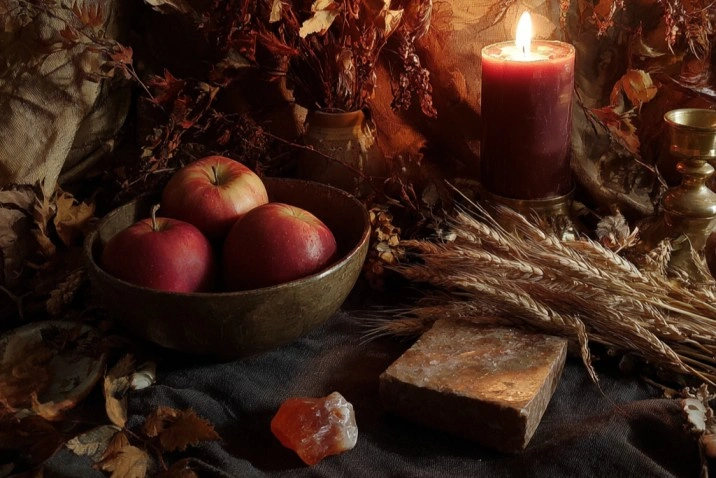
The Mabon cluster opens here. This piece covers the deities of the autumn equinox: who they are, the traditions they come from, and how a solitary practitioner might work with each of them. For the full solitary practice guide, including rituals and altar work, see Mabon for Solitary Witches.
This piece sits alongside Beltane Deities, Litha Deities, and Lughnasadh Deities in the cumulative wheel-of-year pattern. The warm half of the year now has its deities named and profiled from Beltane to Mabon.
The name, and where it came from
Most of what needs to be said about the name "Mabon" can be said plainly: it was coined for the autumn equinox sabbat by an American Wiccan named Aidan Kelly, sometime around 1970 to 1974. Kelly was constructing a complete eight-sabbat wheel with names for all eight festivals, and chose the name "Mabon" — drawn from the Welsh divine youth Mabon ap Modron, for the autumn equinox because he felt it needed a Celtic-sounding name to sit beside the others. Before Kelly, the autumn equinox had no consistent pagan or Wiccan name. Kelly has written about this himself. Ronald Hutton documents it in The Triumph of the Moon. It is not a hidden history.
What this means is that the Welsh god Mabon ap Modron is genuinely ancient: his mythology appears in the Mabinogion, he is a real figure of Welsh tradition, and he is worth working with. The festival named after him is not ancient. The equinox association is Kelly's invention, not a Celtic harvest practice. Both things are true simultaneously, and modern paganism is richer for being able to hold them that way. The deity cluster that follows draws on several traditions across time and geography, and all of them are named honestly for what they are.
Mabon ap Modron
In the Welsh tradition, Mabon ap Modron is the Divine Youth: the Great Son of the Great Mother, whose name means simply that: mabon, son or youth; modron, mother. He appears most fully in the tale of Culhwch and Olwen in the Mabinogion, where he is described as having been taken from between his mother and the wall when he was three nights old and imprisoned since before memory. No one knows where he is held or how long he has been there. Arthur's company must seek him out, guided by a succession of the oldest animals in the world, and when they find him he is in Caer Loyw (the fortress of light) crying out from captivity. He is released, and it is only then that certain tasks become possible.
This mythology carries its own autumnal weight without any need to force an equinox reading onto it. Mabon is the divine potential held through the dark: the light imprisoned, the youth who cannot grow older until he is freed. At the turning point when the year tips toward winter, invoking the figure who waits in the fortress of light is a way of acknowledging what is held in trust through the dark months and what must be sought again come spring. He is not a harvest deity. He is a deity of preserved potential, and that is a different and equally true autumnal theme.
Modron
Modron is the Mother: Mabon's counterpart and the older of the two in the mythological logic. Her name is the Brythonic form of *Matrona*, the Divine Mother, the same root that gives the Gaulish Matres and Matronae, the triple mother figures whose inscriptions appear across Roman Britain and the Continent. In the Welsh tradition she is present primarily as Mabon's mother, the one from whose side he was stolen and to whom, implicitly, the journey of rescue returns him.
At the autumn equinox, Modron is the earth herself in the act of withdrawal: the mother into whose keeping the world passes as the light diminishes. She is not absent in winter; she is holding. Working with Modron at Mabon is working with the principle of safe containment through difficulty, the trust that what has been taken into the dark will be returned. Her altar correspondences are earthy and warm: chestnuts, root vegetables, apples, deep reds and browns, anything that holds the warmth of a finished summer.
Persephone and Demeter
The Persephone and Demeter narrative is the single most influential mythic frame for the autumn equinox in modern Western paganism, and with good reason; it is genuinely an ancient story about the onset of winter, grounded in the Homeric Hymn to Demeter and the Eleusinian Mysteries, among the most significant religious rites of the ancient Mediterranean world.
Persephone, daughter of Demeter the grain goddess, is taken to the underworld by Hades. Demeter, in her grief, withdraws her gift from the earth; nothing grows, the world grows cold. An agreement is eventually struck: Persephone will spend part of each year in the underworld and part above, and the seasons follow her movement. The autumn equinox is her threshold: the moment when she turns toward the descent and Demeter begins to grieve.
The honest note is that the Eleusinian Mysteries were secret, and we do not know their exact form or timing. The equinox association is an approximation rather than a historically fixed date. But the mythic logic is sound: the goddess of spring's return begins her descent in autumn, and the earth's response is winter. For a practitioner working the Mabon season, Persephone is the figure of the willing or necessary descent (the one who goes down knowing she will return) and Demeter is the grief of the world at her going, and also the fierce maternal love that negotiates her return. Both aspects are present at the equinox, and both are worth holding.
John Barleycorn at the second harvest
John Barleycorn was introduced in Bread and Grain Magic as the grain personified: the figure cut down at Lughnasadh's first harvest. At Mabon he appears in a different aspect: the transformed one. The grain cut at Lughnasadh is now stored. The ale is brewed. The bread is in the larder. What was raw at the first harvest has become, through fermentation and fire, something that will sustain a household through months of darkness.
John Barleycorn at Mabon is not a god of cutting but a god of completion: the raw made refined, the ending that was necessary become the substance that carries life forward. He is the embodied answer to the question Lughnasadh asked: what does the harvest actually become? The ale is his blood and he is glad of it, as the folk-song insists. At the autumn equinox, raising a glass (of ale, of apple juice, of whatever the season has made available) is one of the oldest and most straightforward devotional acts in the calendar.
The Cailleach
The Cailleach (the Old Woman, the divine hag of Scottish and Irish tradition) is the personification of winter itself. She is ancient, large, and unsentimental. She strikes the earth with her staff and the ground freezes. She wades through lochs and her breath is the storm coming off the mountains. She is not cruel; she is the season, and the season does not apologise.
Her traditional awakening is associated with Samhain in many tellings, but her shadow falls earlier: the first quality-of-light shift in late August, the first morning cold enough to see your breath, is already hers. At Mabon, the Cailleach is not yet fully present; she is approaching. Working with her at the equinox is working with that approach — acknowledging the season that is coming without pretending it is not, making your peace with the dark half of the year before it arrives in full.
She is not a deity for softness. She is a deity for honesty about difficulty and endurance through it. An offering to the Cailleach at Mabon might be as simple as going outside in the morning cold without complaining about it, or sitting with what in your life will require endurance in the months ahead — looking at it plainly, without flinching, as she would.
Working with these deities at Mabon
The five figures above offer five different angles on the same season. Mabon ap Modron and Modron together hold the theme of preserved potential and safe keeping through the dark. Persephone and Demeter hold the theme of necessary descent and the grief and love it calls from those left at the surface. John Barleycorn holds the theme of transformation: the raw made into what sustains. The Cailleach holds the theme of honest endurance, the season met without flinching.
A practitioner does not need to work with all five. Choose the one whose theme sits closest to what this particular turning of the year means for you. A year that has involved real loss might call for Demeter. A year that has required endurance might call for the Cailleach. A year whose harvest has been quiet but real might call for Modron or John Barleycorn. The deities of a sabbat are not a checklist. They are a vocabulary; use the word that fits.
For the construction question (how much of what we associate with these figures at Mabon is ancient and how much is modern) the same answer applies here that applies throughout this blog's approach to sabbat practice: the modern construction is real practice, and naming it as modern does not diminish it. The Aradia piece covers this question at length in a different context.
Common questions
Is Mabon a real Celtic deity? Yes. Mabon ap Modron is a genuine figure of Welsh mythology, appearing in the Mabinogion. The use of his name for the autumn equinox sabbat is a 1970s American Wiccan invention, but the deity himself predates that association by centuries.
Is the Persephone myth really about the autumn equinox? The myth is genuinely about the onset of winter, grounded in the Homeric Hymn to Demeter. The precise equinox dating is a modern approximation; the seasonal association with autumn's beginning is authentic.
Do I need to choose one deity or can I work with several? Either is fine. Some practitioners keep a single sustained devotional relationship and bring that deity to each sabbat. Others work with the deity whose mythology fits the specific season. Mabon's cluster offers enough range that one of these figures will suit almost any practitioner's current year.
Sources
For Mabon ap Modron and Modron: Sioned Davies, trans., The Mabinogion (Oxford World's Classics, 2007): the standard modern scholarly translation; the tale of Culhwch and Olwen is the primary source for Mabon. For the naming history: Ronald Hutton, The Triumph of the Moon (Oxford University Press, 1999). For the Eleusinian Mysteries: the Homeric Hymn to Demeter is the primary literary source; Walter Burkert, Ancient Greek Religion (Blackwell, 1985) provides scholarly context. For the Cailleach: Donald Mackenzie, Scottish Folk Lore and Folk Life (Blackie, 1935) and the wider corpus of Scottish and Irish seasonal folklore.
Grimoire is a digital practice companion for the solitary witch: a sacred calendar, deity journal, daily tarot, private grimoire, herbology compendium, and spell builder, all in one place. Now available on Android.
More from the Blog
Lughnasadh Energy and Intentions: The Harvest Accounting
The third spoke of the wheel-of-year intention arc. Lughnasadh's mode is accounting: not gratitude, not celebration, but the honest ledger of what was planted, what has returned, and what it cost.
Mabon for Solitary Witches
Mabon falls on the autumn equinox: the moment of perfect balance before the year tips into the dark half. A complete practical guide for the solitary practitioner: rituals, altar, journal prompts, and how to work with the season's central theme of equilibrium and release.
Begin your practice
Grimoire is available now on Android and as a web app. Start today.