Sabbats
Mabon for Solitary Witches
Rowenna
Solitary witch and the founder of Grimoire. Built the app she couldn't find anywhere else. Writes about the craft with primary sources, honest lineage notes, and a low tolerance for vague correspondences. Based in the UK with more herbs than shelf space.
· 8 min read
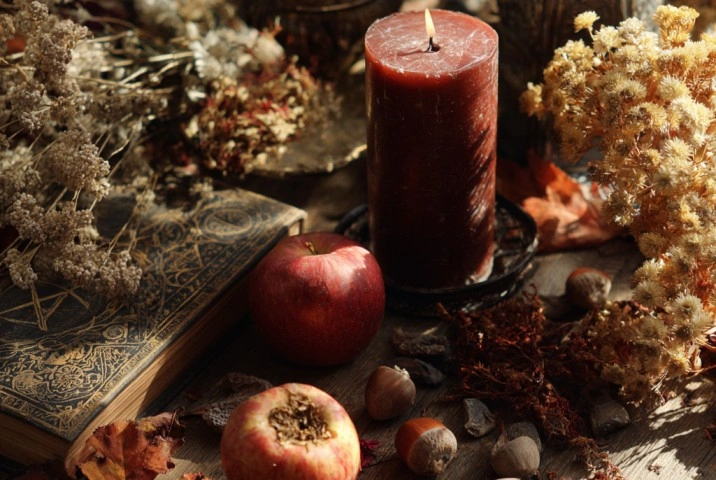
The autumn equinox arrives around 22 September each year, and for a single day (or close enough to a single day) the light and the dark are equal. Then the balance tips. From the equinox onward, the nights lengthen and the year turns inward. Mabon is the sabbat that marks this threshold: the second harvest, the moment of perfect equilibrium held briefly before it shifts, the last breath of warmth before the cold half of the year begins its approach.
For a solitary witch, Mabon is one of the most naturally suited sabbats in the calendar. Its central character (stillness, accounting, the inward turn) asks for exactly the kind of quiet, personal work that solitary practice does best. You are not missing something by celebrating it alone. You are working with what the season actually is.
What Mabon is
Mabon is the modern Wiccan name for the autumn equinox sabbat, adopted from the Welsh divine youth Mabon ap Modron by the American Wiccan poet Aidan Kelly around 1970–74. The naming is modern; the equinox is ancient. Humanity has tracked this threshold (the day when day and night are equal) since before writing, and autumn harvest customs are documented across every agricultural culture in the northern hemisphere. The Mabon Deities piece covers the naming history and the deities of the season in full. This piece is about the practice.
Mabon sits in the second harvest position in the wheel of the year: after Lughnasadh's first cutting and before Samhain's final close. Where Lughnasadh is the grain harvest, Mabon is the fruit harvest: apples, nuts, late berries, the last of the vine. The altar reflects this shift from gold to copper, from bread to fruit, from the open summer to the darkening approach of winter.
What makes Mabon well suited to solitary practice
The sabbats that work most naturally in community tend to be the ones built around fire, movement, and shared energy: Beltane's Maypole, Lughnasadh's games, Samhain's collective reckoning with the dead. Mabon asks for something different. Its central image is the scale in perfect balance: not the celebration of what is building, but the quiet acknowledgement of what is complete. That is reflective, inward work. It does not require a coven. In some ways it benefits from solitude.
The practices below are built for one person, working alone, on or around the equinox. The equinox window runs from roughly 20 September through 25 September; the exact date shifts slightly year to year, but the energy holds across the week. You do not have to work on the equinox moment itself, though if you can, there is something specific and grounding about marking the day as it actually falls.
Rituals and practices
The threshold practice. This is the simplest and oldest Mabon working, and it requires nothing but your own presence outside at the right time. Go outside at dusk on or near the equinox: the moment when the light is exactly tipping toward the dark. Stand still. Notice the quality of the air, the angle of the light, the particular way this specific evening feels different from a summer one. Then, aloud or in your mind, name one thing you are carrying into the dark half of the year and one thing you are leaving here at the threshold. Not a grand ritual gesture: just a naming. The equinox asks to be witnessed more than it asks to be worked, and witnessing is itself the practice.
The apple working. The apple is Mabon's most central correspondence; it is the fruit of the season, and it carries the Avalon association that runs through the Glastonbury Tor tradition. Cut an apple horizontally across the middle and hold what you find: the five-pointed star of seeds, the pentagram inside the fruit. This is the moment the working turns on. Set the apple on your altar as the centrepiece. Eat part of it: the harvest taken in, the nourishment of the year claimed. Leave part outside as an offering: the giving back, the acknowledgement that the harvest was never entirely yours. Speak, simply, what you are grateful for this year. The working does not need to be longer than that.
The balance ritual. Take two equal-sized pieces of paper and something to write with. On one, write what you are carrying forward into the dark half of the year: the practices that held, the relationships that grew, the work that is continuing. On the other, write what you are releasing: what is complete, what has served its purpose, what belongs to the year that is closing rather than the one that is coming. Fold both toward you. Set them on opposite sides of your altar, balanced. Light a candle between them. Then burn the release paper in the candle flame (watched rather than rushed, let it go fully) and keep the carry-forward paper somewhere meaningful until Imbolc. This is the structural equivalent of the harvest accounting working from Bread and Grain Magic, applied to the whole year rather than just the growing season.
The descent meditation. If you work with Persephone (or if you want to approach Mabon through the mythic frame of the descent) this is the working for the equinox evening. Sit comfortably with a lit candle. Close your eyes. In your mind, stand at the threshold of the underworld: not its depths, just its entrance. The threshold is a doorway in the earth, and beyond it is the dark half of the year. You are not being pulled through against your will. You are choosing to step across, because the dark half holds things the light half cannot: rest, depth, the slow work of root and seed, the dreams that only come in winter. Step through. Notice what it feels like to choose the descent rather than resist it. Sit with that for as long as is useful. Come back. Blow out the candle. The equinox has been marked.
A lunar Mabon pull. If the equinox falls near a full or new moon, you have a natural anchor for a Tarot or oracle pull. A single card drawn at the equinox moment (not as prediction but as a frame for the season you are entering) can carry extraordinary specificity. For lunar practice in the context of seasonal work, see Working with the Moon.
The Mabon altar
The Mabon altar is the autumn altar: the colours and textures of the turn. Build it in layers over the week leading up to the equinox, letting it accumulate rather than assembling it all at once.
Colour palette: copper, bronze, deep gold, burgundy, rust, forest green, rich brown. The palette of leaves at their moment of turning. Deep red is Mabon's primary candle colour; orange and gold work equally well.
Items to include: Apples, ideally at least one cut horizontally to show the seed-star. Autumn nuts (acorns, hazelnuts, chestnuts) gathered outside if you can, bought if not. Dried or fresh autumn leaves. Wheat or corn in its stored form. A pomegranate, Persephone's fruit, if available. Late summer flowers: chrysanthemum, marigold, aster, dried sunflower heads. A representation of balance: two objects of equal weight set facing each other, a small set of scales, two identical candles.
Crystals: Carnelian for the harvest season's warmth; citrine for abundance made manifest; golden tiger's eye for the threshold between day and night; obsidian for the dark half's approach; amber for the warmth of the year preserved in resin.
Deities: Mabon ap Modron, Modron, Persephone and Demeter, John Barleycorn, the Cailleach: profiled in full in Mabon Deities. Invite the presence that fits your year. The altar does not need to hold all five.
Journal prompts for the season
Mabon's reflective character makes it one of the best sabbats in the year for journalling. These prompts are designed to be worked slowly: one per day across the equinox week, rather than all at once.
What is at its fullest right now: in my practice, in my life, in myself?
What am I ready to release before the dark half begins?
What did I plant at the beginning of this year (in intention, in action, in relationship) that has come to fruit?
Where has balance been difficult this year, and where has it been restored?
What do I want to carry into winter?
What does the descent ask of me this year; what is the inward work of the dark half?
Mabon in the wider sabbat pattern
Mabon is the third harvest sabbat and the second equinox of the year. Together with Litha, it marks the two great axes of the solar year: the longest day and the last balanced day. Together with Lughnasadh, it closes the harvest arc that opened at the first cutting. And together with Beltane, it brackets the warm half of the year: the long arc from May's opening to September's close.
The Mabon cluster continues into September, with the herbs of the season, the energy and intentions piece, and the full astrological context of Libra Season. For now, the equinox is here. The apple is cut. The balance tips.
Common questions
When exactly is Mabon? The autumn equinox falls between 21 and 24 September each year in the northern hemisphere; the precise date shifts slightly with the solar calendar. In 2026 it falls on approximately 22 September. Most practitioners observe it across the surrounding week rather than on a single fixed date.
Do I need a coven or group to celebrate Mabon? No, and as noted above, Mabon's reflective, balancing character is particularly well suited to solitary practice. The most meaningful Mabon workings tend to be quiet and personal rather than communal.
What if I cannot go outside for the threshold practice? Open a window at dusk and stand at it. The threshold of the window is a genuine threshold, and the evening air coming through it is the same evening air. The practice works at any boundary between inside and outside.
Is Mabon the same as the autumn equinox? Mabon is the modern Wiccan name for the autumn equinox sabbat. The equinox itself is an astronomical event that long predates the name. Both are real; the name is recent and the event is ancient. The Mabon Deities piece covers the naming history in full.
Sources
Ronald Hutton, The Stations of the Sun: A History of the Ritual Year in Britain (Oxford University Press, 1996): the standard scholarly account of the British autumn harvest traditions the modern sabbat draws on. For the naming history and modern pagan reception: Ronald Hutton, The Triumph of the Moon (Oxford University Press, 1999). The Persephone and Demeter mythological frame draws on the Homeric Hymn to Demeter; the apple-Avalon correspondence on the traditions covered in Glastonbury Tor.
Grimoire is a digital practice companion for the solitary witch: a sacred calendar, private grimoire journal, daily tarot, herbology compendium, deity work, and spell builder, all in one place. Now available on Android.
More from the Blog
Mabon Deities
The deities of the autumn equinox: Mabon ap Modron, Modron, Persephone and Demeter, John Barleycorn, and the Cailleach. Who they are, where they come from, and how to work with them at the turn of the year.
Herbs of Mabon
Five herbs for the autumn equinox: apple, hawthorn berries, sage, yarrow, and mugwort in its autumn aspect. Botany, folklore, magical correspondences, and how to work with each at the turning of the year.
Begin your practice
Grimoire is available now on Android and as a web app. Start today.