Sabbats
Herbs of Mabon
Rowenna
Solitary witch and the founder of Grimoire. Built the app she couldn't find anywhere else. Writes about the craft with primary sources, honest lineage notes, and a low tolerance for vague correspondences. Based in the UK with more herbs than shelf space.
· 9 min read
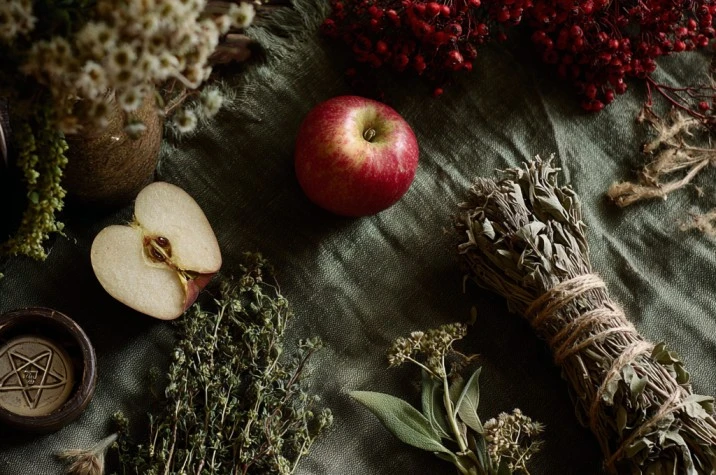
Mabon's herbs are the herbs of the pivot. The summer's abundance is either already stored or tipping into decay; the nights have begun to win. The five plants below are the botanicals most tightly associated with the autumn equinox in the Western witchcraft tradition: some for their harvest timing, some for their folklore, and one for the hidden geometry a knife reveals in its centre. This piece sits alongside Mabon Deities and Mabon for Solitary Witches as part of the autumn equinox saturation cluster, and continues the pattern established by Herbs of Litha and Herbs of Lughnasadh.
Apple, Malus domestica
Botany. The cultivated apple belongs to the Rosaceae family: the same family as hawthorn, rowan, and rose. A deciduous tree of temperate zones, it has been in cultivation for thousands of years from its probable wild ancestor Malus sieversii in the Tian Shan mountains of Central Asia. By September the fruit is setting fully on early varieties; October brings the main harvest. The apple is one of the most culturally saturated fruits in the northern hemisphere; it has been grown, eaten, fermented, and worked with symbolically longer than almost any other temperate crop.
Folklore. The apple's magical significance in the British and Celtic traditions is inseparable from the word itself: aval or abal, the Old Welsh and Breton word for apple, is the probable root of Avalon: the otherworldly isle to which Arthur is carried after his final battle, whose name carries the fruit at its heart. Whether or not the etymology is strictly proven, the association is ancient enough to be real practice material. Norse mythology gives apples to Idun, the keeper of the golden apples that preserve the gods' immortality. In European folk tradition, apple orchards carried protective powers and were wassailed in midwinter to ensure the following harvest. The apple appears in Samhain divination practices (bobbing for apples is a survival of harvest-festival fortune-telling) which sits precisely at the far end of the arc that Mabon begins.
The most striking piece of apple symbolism for Mabon practice is what a horizontal cut reveals: the five seeds arranged in a perfect pentagram at the fruit's core. Every apple carries this geometry. Cutting one open at the equinox and holding the five-pointed star in your hands is not a constructed ritual; it is an observation. For the apple's Avalon association in its sacred-landscape context, see Glastonbury Tor.
Correspondences. Venus; water; love, wisdom, the otherworld, the harvest completed, immortality. The apple is a fruit of completion; it arrives at the end of the growing season, sweet and finished, carrying the seeds of the next year inside.
Practical use. The cut apple as the central altar object; dried apple slices strung as garland; apple cider as offering and as feast drink; apple wood as incense or as a writing surface for intentions. The working is the cutting: slow, deliberate, with the intention spoken as the pentagram is revealed.
Hawthorn berries, Crataegus monogyna
Botany. The common hawthorn is one of the most familiar hedgerow trees in Britain: a dense, thorned shrub or small tree of woodland edges, old field boundaries, and ancient trackways. At Beltane it flowers white and intoxicatingly sweet; by Mabon those same flowers have become haws: small, deep-red berries that ripen through September and October and persist on bare winter branches long after the leaves have gone. The haw is a drupe (a small fleshy fruit around a hard seed) and it has been eaten, with care, by humans across the northern hemisphere since before cultivation.
A safety note. Hawthorn berries in normal quantities as food or decoration are safe for most people. However, hawthorn contains flavonoids with mild cardiovascular activity and is used medicinally in standardised preparations for heart conditions; those on heart medication should avoid medicinal quantities of hawthorn. The seeds contain small amounts of cyanogenic compounds; haws eaten as a food in normal quantities are fine, but do not consume concentrated seed preparations.
Folklore. The hawthorn's double life (flowering at Beltane, fruiting at the harvest) makes it one of the year's most symbolically loaded trees. In Irish tradition it is the fairy thorn, a tree so deeply associated with the otherworld that old hawthorns standing alone in fields were not cut even when it was agriculturally inconvenient to leave them. The haw is the threshold berry: protective, boundary-marking, associated with the liminal places between the human world and whatever lies beyond. At Mabon, the hawthorn berries mark the same threshold the season does: the tipping point between the warm half and the dark.
Correspondences. Mars and Venus together; protection, threshold-guarding, the fairy world, the boundary between seasons. A Mabon herb above all for its timing: the same tree that opened Beltane now closes the summer with its blood-red fruit.
Practical use. Haws as altar decoration: a small bowl of berries beside the autumn candle. A simple hedgerow protection charm: three haws gathered from one branch, wrapped with red thread, placed at a threshold with the intention spoken. Haw vinegar made from the berries for kitchen magic. The berries can also be dried and kept through winter.
Sage — Salvia officinalis
Botany. Garden sage is a perennial sub-shrub of the Lamiaceae (mint) family, native to the Mediterranean basin. Its grey-green, softly textured leaves are among the most immediately recognisable of culinary herbs; the plant is hardy in British gardens and can be harvested year-round in mild conditions, with its primary growth flush in summer and a secondary autumn harvest as the plant settles into its woodier winter form. The name comes from the Latin salvia, from salvere — to be saved, to be well. The Romans called it salvia salvatrix, sage the saviour.
A note on attribution. Garden sage (Salvia officinalis) and white sage (Salvia apiana) are different plants from different traditions. White sage is sacred to specific Indigenous American cultures and should not be casually burned as a generic "cleansing" practice by people outside those traditions. Garden sage has its own substantial and separate European folk-magic tradition — one that neither borrows from nor requires the Indigenous American one. The smoke-cleansing guidance below refers to garden sage only.
Folklore. The English proverbial tradition asked: "Why should a man die whilst sage grows in his garden?" The herb was the cornerstone of the medieval garden of simples — the physic garden of useful plants — and its associations with wisdom, longevity, and protection against death made it an autumnal plant in temperament before any calendar confirmed it. "Sage" and "sagacious" share the same Latin root: sapere, to know, to taste, to be wise. The herb's name carries the correspondence in itself.
Correspondences. Jupiter; wisdom, longevity, purification, clarity of mind, the crossing to what comes next. The autumn association is earned — this is the herb of harvest wisdom, of experience distilled, of the elder's counsel rather than the maiden's enthusiasm.
Practical use. Culinary magic at its most direct: cook with garden sage in autumn dishes with intention. Dried sage bundle for smoke-cleansing a space before ancestor work (the approaching Samhain season makes this particularly apt). A sage leaf with a word written on it burned in a candle flame as a simple wish-sending. Garden sage dried and kept in a jar for use through the winter months ahead.
Yarrow — Achillea millefolium
Botany. Yarrow is one of Britain's most common wildflowers — a perennial of meadows, roadside verges, and waste ground with feathery, finely divided leaves and flat-topped clusters of small white or pale pink flowers that bloom from June through October. The species name millefolium means "thousand-leaf," for the characteristic leaf texture. It is a member of the Asteraceae (daisy) family, and it remains in flower as late as October in sheltered spots, making Mabon a natural harvest point.
A safety note. Yarrow is a mild emmenagogue and should be avoided in pregnancy. Some people with Asteraceae sensitivity react to it; if ragweed or chrysanthemums cause problems, treat yarrow cautiously. These cautions apply primarily to internal use — yarrow as altar decoration or smoke is generally safe.
Folklore. The genus name Achillea honours Achilles, who is said in myth to have used yarrow to stanch the wounds of his soldiers at Troy. The wound-herb association runs consistently through its folk history: yarrow was one of the most important battlefield and domestic wound-dressings in European folk medicine, its styptic properties genuine and well-documented. In British folk tradition it appeared in love divination ("if yarrow shows me blood I shall see my love soon") and in the broader repertoire of the cunning woman's herb basket. In China, yarrow stalks were the original I Ching oracle instrument — the tradition of using the plant for divination runs independently through multiple cultures without any connection between them, which is worth noting.
Correspondences. Venus; healing, courage, protection in battle (in the old sense — the courage to withstand what is hard), divination, love. The autumn harvest of yarrow concentrates its healing and protective powers; the dried herb keeps well through winter.
Practical use. Dried yarrow in protective sachets and pouches. A divination tea, weak and taken before a tarot or scrying session. Yarrow in a healing charm for someone in difficulty — the wound-herb logic applied to non-physical injury. Gathered in early autumn and hung in small bundles to dry, it keeps its properties and its beauty through the winter months.
Mugwort in its autumn aspect — Artemisia vulgaris
The full profile — botany, folklore, safety note, correspondences, and sourcing — is in The Witch's Guide to Mugwort. This section focuses on the herb's specific character at Mabon and into the dark half of the year. The pregnancy contraindication is restated there; it stands here too.
The autumn turn. Mugwort's harvest window is mid-to-late summer, which means that by Mabon it should already be dried and stored. The Mabon use is not the fresh plant but the kept one — the dried bundle, the smoke, the dream pillow already sewn and placed. In this sense mugwort at Mabon is mugwort-as-preparation: the protective and divinatory herb laid in for the long months of dreaming and inward work ahead.
The nights that follow the autumn equinox are the nights mugwort was made for. As the dark half of the year lengthens, the dreaming time lengthens with it. Mugwort smoke before sleep, or a dream pillow beside the bed, is the Mabon working most likely to deepen across the whole winter rather than being a single-day practice. Begin it at the equinox and let it run through to Imbolc.
In its aspect as Una — the eldest of herbs, the first named in the Nine Herbs Charm — mugwort stands as guardian at exactly the kind of threshold that Mabon represents. The year is tipping. The herbs that guard the crossing are the appropriate herbs for the day.
Working with Mabon herbs
An autumn altar arrangement. Set a cut apple horizontally at the centre of the altar so the seed pentagram faces upward. Arrange a small bowl of hawthorn berries to one side and dried yarrow flowers to the other. Lay a dried mugwort bundle and a few sage leaves at the back. Light a deep red or amber beeswax candle. The five herbs present five aspects of the season: the apple as completion and otherworldly threshold, the hawthorn as protection at the turning, the sage as wisdom laid in for winter, the yarrow as courage for what the dark half asks, and the mugwort as guardian of the dreaming months ahead.
An apple working for the equinox week. Take one apple and a small knife. Speak aloud one thing you have harvested from the year — one thing that has genuinely grown, arrived, or been earned. Then cut the apple horizontally across its equator. Hold the two halves and look at the pentagram of seeds in the exposed core. Eat one half slowly and in silence, taking the harvest inward. Take the other half outside and leave it as an offering — to the land, to a deity, to the year that has grown it. Walk back inside without looking back. The working is complete.
Common questions
Can I use white sage instead of garden sage at Mabon? The short answer is that garden sage is the more appropriate herb for Mabon in European and modern Wiccan practice, and has its own history entirely independent of white sage. The cultural-attribution question around white sage is addressed in detail in the Jar Spells piece's sourcing section. Rosemary is also an excellent alternative for smoke-cleansing with a strong European folk-magic lineage.
Are hawthorn berries safe to eat? Yes, in normal quantities as food. The seeds contain trace cyanogenic compounds and should not be consumed in concentrated form. Those on heart medication should consult a doctor before taking hawthorn in any medicinal quantity, as it has genuine cardiovascular activity. For decoration and altar use, these cautions do not apply.
When is the best time to harvest these herbs? Apple and hawthorn berries are at their peak through September and October — harvest after the first frosts have softened the haws slightly, or gather before they soften if you want them for decoration. Yarrow should be harvested before the final October flowers fade. Mugwort was harvested in July and August and should already be drying; use the stored harvest for Mabon work. Sage can be harvested year-round in mild climates.
Sources
Ronald Hutton, The Stations of the Sun (Oxford University Press, 1996) for the British autumn harvest context. Apple folklore and the Avalon etymology from the broader Celtic and Welsh mythological record; the hawthorn's fairy tradition from Dáithí Ó hÓgáin, The Sacred Isle: Belief and Religion in Pre-Christian Ireland (Collins Press, 1999) and comparable Irish folklore scholarship. Yarrow's wound-herb history and the Achillea naming are standard botanical and ethnobotanical record. For mugwort in full: The Witch's Guide to Mugwort.
Grimoire is a digital practice companion for the solitary witch — a herbology compendium, sacred calendar, daily tarot, private grimoire journal, and spell builder, all in one place. Now available on Android.
More from the Blog
Mabon for Solitary Witches
Mabon falls on the autumn equinox: the moment of perfect balance before the year tips into the dark half. A complete practical guide for the solitary practitioner: rituals, altar, journal prompts, and how to work with the season's central theme of equilibrium and release.
Mabon Energy and Intentions
The autumn-equinox piece in the wheel-of-year intention arc: Beltane was commit, Litha was recognise, Lughnasadh was account, Mabon is integrate. What Mabon energy supports, how to set an intention at the autumn equinox, and the particular relief that comes from folding the year's work into who you are rather than continuing to work on it.
Begin your practice
Grimoire is available now on Android and as a web app. Start today.