Sabbats
Mabon Energy and Intentions
Rowenna
Solitary witch and the founder of Grimoire. Built the app she couldn't find anywhere else. Writes about the craft with primary sources, honest lineage notes, and a low tolerance for vague correspondences. Based in the UK with more herbs than shelf space.
· 8 min read
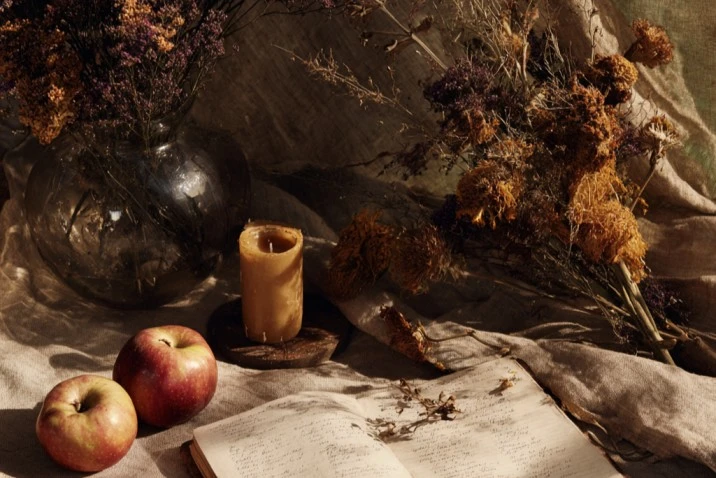
This piece lands on Mabon (the autumn equinox, 22 September) and it closes something. At Beltane, the wheel-of-year intention arc asked you to commit: to name the thing you were planting and to mean it. At Litha, it asked you to recognise: to see what was growing and to hold it with attention at the year's peak. At Lughnasadh, it asked you to account: to cut what had grown, weigh it honestly, and name what the harvest actually was. Mabon asks the final thing, and it is perhaps the most difficult: to integrate. To fold what has happened into who you are, so that the work can stop.
Integration is not the same as completion. It does not require that everything went well, that every intention bore fruit, that the year was a success by any external measure. It requires only that you receive what happened (including what didn't) as material that is now part of your working self rather than as an ongoing project that still needs attention. The relief of integration is real, and Mabon's specific gift is permission to stop working on it. The intention planted in May, grown through June, accounted for in August, is now you. You can put it down.
The name and the history
"Mabon" as the name for the autumn equinox sabbat is a 1970s coinage by the American Wiccan Aidan Kelly, who took it from the Welsh divine youth Mabon ap Modron, a real and ancient figure of Welsh mythology, appearing in the Mabinogion as the divine prisoner released by Arthur's companions. The god is genuinely ancient; the festival name is modern. The Mabon Deities piece covers this in full, as does the earlier Mabon Deities profile.
It is worth noting what the autumn equinox was called before Kelly named it. Bede's De temporum ratione (725 CE), the primary source for Anglo-Saxon month names, records September as Hāligmōnaþ ("holy month") without naming a specific equinox festival. October is Winterfylleð (the winter full moon) and November is Blōtmōnaþ (blood month, for the autumn slaughter). The autumn equinox does not carry a well-documented pre-modern Germanic festival in the way that Beltane and Samhain carry Irish documentation. What we call Mabon is a modern naming of an ancient astronomical event. Both the naming and the event are real; keeping them distinct is part of the brand voice that has run through this blog since the beginning.
What Mabon energy supports
Integration. The central theme. Mabon energy does not support beginning; it supports receiving. What has been built, grown, and accounted for during the warm half of the year is now available to be absorbed into the self rather than managed as an ongoing project. Integration is the alchemical step that turns experience into identity, and the equinox is where the year makes it available.
Balance. The equinox is the one day when day and night are literally equal, held in perfect equilibrium for a threshold moment before the balance tips. The energy of true balance (not compromise between two things but the genuine meeting point where both are fully present simultaneously) is most available here. Any working that requires holding two things in tension without resolving them is well-timed at Mabon. So is honest acknowledgement of where the year was in balance and where it was not.
Gratitude. Not the vague or aspirational gratitude of asking for things while feeling grateful, but specific, grounded acknowledgement of what the year actually produced. Harvest gratitude requires honesty: you are grateful for what grew, which means you have looked squarely at what grew and named it as real. Gratitude that has not looked at the actual harvest is not harvest gratitude; it is optimism dressed in autumn colours. Mabon energy supports the specific version.
Descent. As the equinox tips the year toward the dark half, the energy supports the willing, deliberate choice to enter the inward season rather than resist it. The descent working in Equinox Magic is the practical expression of this theme. The ancestor work begun this week is part of the same inward movement. Mabon does not ask you to be happy about the darkening; it asks you to choose it consciously rather than experience it as something that simply happens to you.
Working with Mabon energy
The technique most suited to Mabon's integrative energy is the retrospective. Not the prospective intention (not "I will" or "I want to") but the honest present-tense accounting: what is actually true now, as a result of the year that has happened.
A Mabon working session: sit with your journal at dusk on or near the equinox. Go back (to your Beltane journal entries if you kept them, or to your best memory of what you committed to in May) and read through the arc. What did you commit to at Beltane? What did you recognise at Litha? What did you account for at Lughnasadh? And now, at Mabon: what has become part of you?
The working is not evaluation; it is reception. You are not asking whether the year met a standard. You are asking what the year made you. The practice that held through four sabbats and seven months has changed the person who held it, whether the external results were impressive or not. Name that change. That is the integration.
The equinox is also a threshold for releasing the working pressure of the warm season. If you have been tracking intentions across the wheel of the year, this is the formal close of that tracking. The intention does not need to be managed further. It has become material. Set down the work of watching it.
The Mabon intention: integration as form
A Mabon intention looks different from a Beltane or Litha intention. Where the earlier intentions in the arc are directional (pointing toward something developing, recognising something growing) the Mabon intention is constitutive. It names what you already are, not what you are working toward.
The form: not "I will" or "I am building" but simply "I am." Not future-directed but present-receiving.
Some examples of the register:
"I am the practice I have built this year."
"The work of this year is now part of who I am."
"I have earned what I am carrying into winter."
"What I planted in May has grown into me."
Write your own in this register: in the present tense, specific to what the year actually produced in you. One sentence is enough. It does not need to be grand. The year made something; name what it made.
This is also the moment to name what you are releasing as complete. The intention that didn't bear fruit, the project that stalled, the relationship that didn't develop as hoped: at Mabon, these are released not as failures but as complete. They happened. They are part of the year. You are not carrying them forward into winter as ongoing work; you are setting them down as material that ran its course. The release is as important as the integration.
Recording the Mabon intention
Write both parts (what you are integrating and what you are releasing) in your journal on the equinox. Date the entry. Read it aloud once.
Then fold the paper and keep it until Imbolc (1 February), when the next intention arc begins. At Imbolc, read it back. The integration statement may have deepened into something more established; the release may have continued to soften; the year's material will look different from the other end of winter than it did at the equinox. Reading it back at Imbolc is the first act of the next arc: seeing what you are now, before you name what you are committing to next.
For the recording method that has worked well across the arc: brief, specific, dated, kept. The journal entry does not need to be long. The Mabon for Solitary Witches journal prompts offer additional questions if you want to work more extensively.
The arc as a body of work
The wheel-of-year intention arc (four coordinated pieces across the warm half of the year, each asking a different question of the same intention) is now complete. Beltane was commit. Litha was recognise. Lughnasadh was account. Mabon is integrate.
These four pieces describe a single year-long working: a way of holding an intention through the wheel of the year that is more structured than a vision board and more honest than a manifestation practice. The arc does not promise that intentions become reality. It promises that you will know, by Mabon, what you actually planted, what actually grew, and what the year has made of you. That is enough. It is, in fact, more than most practices offer.
The four pieces are designed to be worked in sequence. If you are arriving at Mabon without having worked the earlier pieces, the integration intention still holds; you can work with whatever the year has produced, with or without the formal tracking. And if you want to begin the arc from the beginning, Beltane Energy and Intentions is where it opens, followed by Litha Energy and Intentions and Lughnasadh Energy and Intentions. The next arc begins at Imbolc.
For the astrological context of the equinox season and the weeks ahead, Libra Season 2026 publishes 24 September: the seasonal piece that carries the equinox's energy into the relational work of early autumn.
Sources
Bede, De temporum ratione (725 CE): for the Anglo-Saxon month names including Hāligmōnaþ (September). Ronald Hutton, The Triumph of the Moon (Oxford University Press, 1999): for Aidan Kelly's 1970s naming of the sabbat and the modern Wiccan reception. The Welsh Mabon ap Modron mythology draws on Sioned Davies, trans., The Mabinogion (Oxford World's Classics, 2007). The intention-arc structure across the four sabbats is a body of practice developed across this blog's sabbat cluster from Beltane through Mabon 2026.
Grimoire is a digital practice companion for the solitary witch: a sacred calendar, private grimoire journal, daily tarot, herbology compendium, and deity work, all in one place. Now available on Android.
More from the Blog
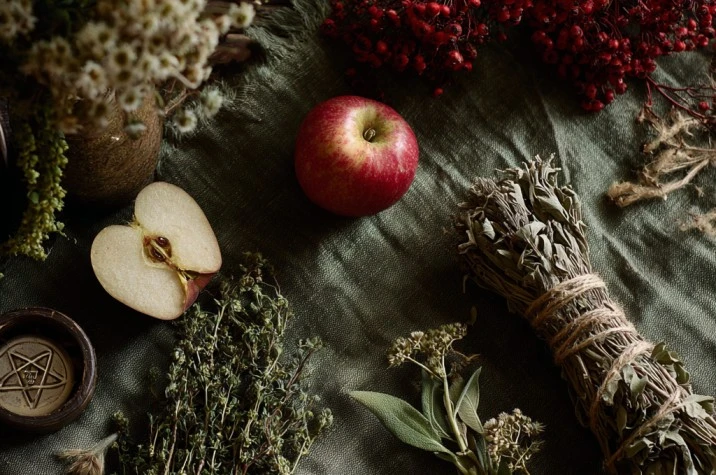
Herbs of Mabon
Five herbs for the autumn equinox: apple, hawthorn berries, sage, yarrow, and mugwort in its autumn aspect. Botany, folklore, magical correspondences, and how to work with each at the turning of the year.
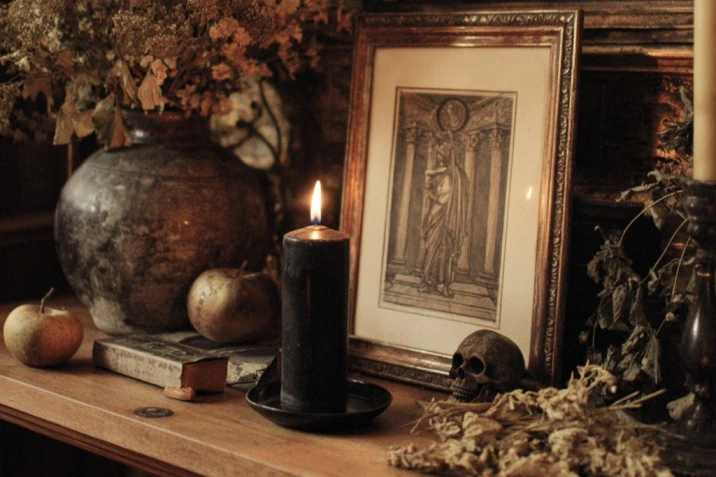
Samhain Deities
Samhain has the richest deity associations of any sabbat: Hekate, the Morrigan, the Cailleach, Cerridwen, Hel, and the leaders of the Wild Hunt. Six deity profiles with mythology, honest historical context, and how to work with each at the crossing of the year.
Begin your practice
Grimoire is available now on Android and as a web app. Start today.